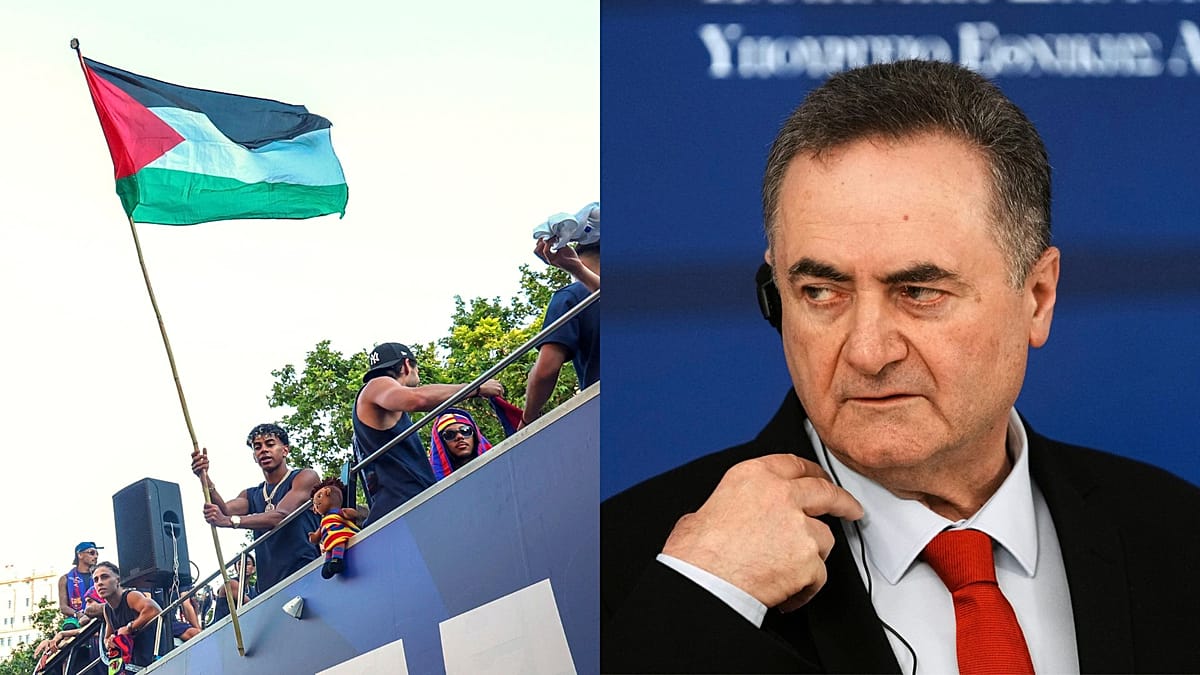
FC Barcelona has declined to comment on accusations from Israeli Defence Minister Israel Katz that star forward Lamine Yamal “incited hatred towards Israel and the Jewish people” by waving a Palestinian flag during the club’s La Liga title celebrations. The club told Euronews it had “no comment” on the matter, leaving the 18-year-old player without public backing from his employers.
Katz posted on social media that Yamal’s gesture, made as Barcelona paraded through the city, was an act of incitement “while Israeli soldiers were fighting the terrorist organisation Hamas, which massacred, raped, burned and murdered children, women and Jewish elders on 7 October.” He called on the Catalan club to “make it clear that there is no place for incitement or support for terrorism.”
The row has drawn in figures across Spanish politics and football. Prime Minister Pedro Sánchez publicly defended Yamal, a move that former Barcelona president Joan Gaspart dismissed, telling Euronews: “He is not a Barcelona supporter, so I am not going to assess what he said.” Gaspart, who led the club from 2000 to 2003, added that the Israeli minister can say “whatever he wants” and that he “respects his opinion.” On the club’s silence, he said: “If the club has said that, there’s nothing else for me to add.”
The Royal Spanish Football Federation also declined to comment, arguing that Yamal is only considered a national team player while in its camp, not during club activities. Yamal, who has Moroccan and Guinean-Ecuadorian heritage and is Muslim, has previously condemned racist chants against Muslims during a friendly match with Egypt. He has not publicly supported Hamas or the 7 October attacks.
Political and public reactions
Catalan nationalist politician Gabriel Rufián voiced support, suggesting that “maybe some people have moved from indifference to condemning the genocide in Gaza simply because he waved that flag.” In contrast, Elías Bendodo of the opposition Partido Popular argued that “sport must not be mixed with other issues.”
Barcelona coach Hansi Flick took a cautious stance, saying: “I usually don’t like these things. But he’s old enough, so he should make his own decisions.” Gaspart praised Flick’s approach, saying: “I fully agree with him. Lamine is young and a great player and should listen to him.” However, some Catalan media criticised Flick, with commentators on Catalunya Radio arguing that the German coach should not make Yamal’s freedom of expression conditional. Online, some fans speculated that Flick’s views are influenced by his agent, Pini Zahavi, an Israeli citizen — a claim for which no evidence has emerged.
The incident has revived debate over political expression in sport, especially with the 2026 World Cup — jointly hosted by the United States, Canada and Mexico — less than a month away. For Barcelona, this is not the first intersection of football and politics: in 2017, the club issued a statement defending Catalonia’s right to self-determination ahead of the independence referendum.
In Gaza, a mural depicting Yamal waving the Palestinian flag has been painted on the rubble of a destroyed building. The player, considered one of Spain’s best talents, was named this week in the preliminary squad for the World Cup despite an injury that has kept him out of recent matches.
For more on the broader context, see our coverage of Sánchez Defends Yamal's Palestinian Flag Gesture Amid Israeli Criticism and Lamine Yamal's Palestine Flag Gesture Reignites Football-Politics Debate.