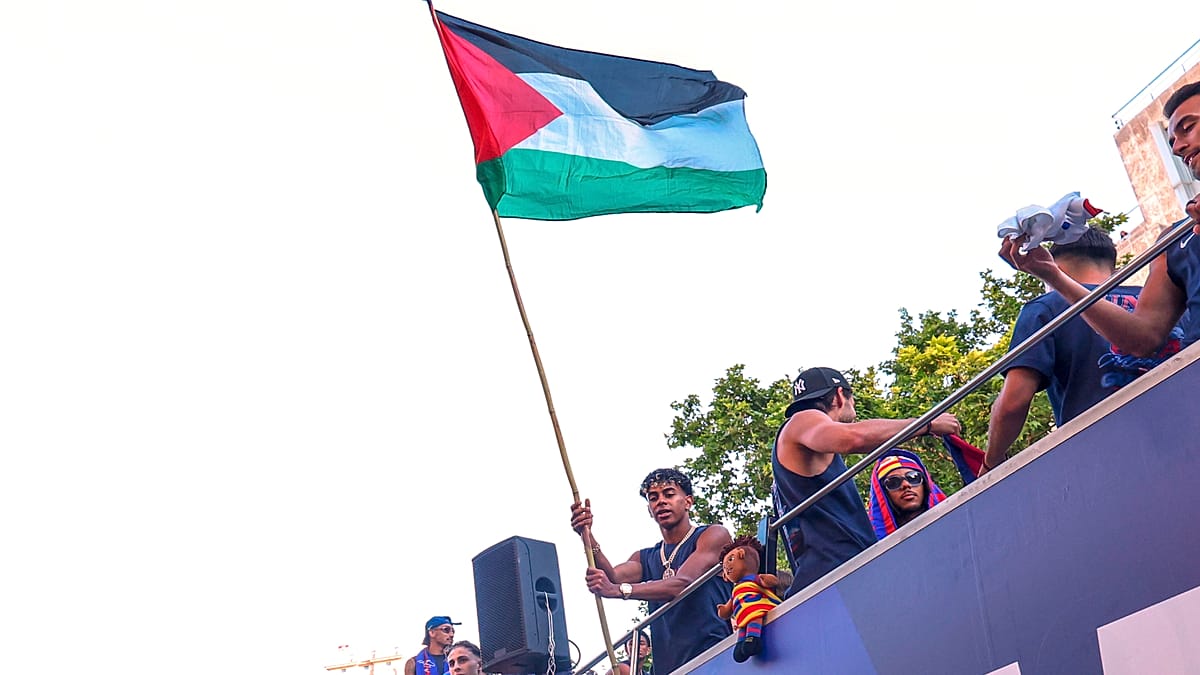
On Monday, Barcelona forward Lamine Yamal, recently named the world's best young footballer, waved a Palestinian flag during the club's open-top bus parade through Barcelona celebrating their La Liga title. The image, captured as the bus passed through the city's streets, quickly spread across social media. A subsequent Instagram post from Yamal featuring the flag garnered over six million likes.
The gesture has reignited a long-running debate about whether politics and sport should mix, especially with the 2026 World Cup—jointly hosted by the United States, Canada, and Mexico—less than a month away. Yamal's action comes amid heightened geopolitical tensions in the Middle East and follows similar controversies at previous tournaments.
Mixed Reactions from Football Figures
Rima Hassan, a far-left French Member of the European Parliament who was recently arrested and held in custody by French authorities over a social media post deemed antisemitic, responded positively with a Palestinian flag emoji. Pep Guardiola, the Manchester City manager and former Barcelona player and coach, offered a more measured endorsement: “A football player is a role model followed by millions, and his opinion is influential, so he should express it when necessary.”
However, Barcelona's German coach Hansi Flick struck a different tone. Speaking to reporters on Tuesday, Flick said: “I don’t like these things and I spoke with him. If he wants to do it, it’s his decision. He’s old enough, he’s 18 years old.” He added that what Barcelona fans expect is for football “to make them happy, and that is the first thing we have to do.”
Media reactions were split. Some commentators argued that Yamal was injecting a highly sensitive political issue into a celebratory context without sufficient nuance, while others praised the teenager for using his platform to take a stand.
FIFA's Stance and Inconsistency Concerns
The debate echoes the controversy at the 2022 Qatar World Cup, where FIFA prohibited several team captains from wearing armbands supporting LGBTQ+ inclusion as part of the 'OneLove' campaign, initiated by the Royal Dutch Football Association. FIFA warned that players wearing the armband risked a yellow card, leading to the campaign's abandonment during the tournament.
FIFA regulations state that team equipment must not contain “political, religious, or personal slogans,” and the tournament stadium code bans banners, flags, or flyers of a “political, offensive and/or discriminatory nature.” The enforcement of these rules in Qatar prompted accusations of inconsistency, with critics arguing that different forms of political expression were treated unevenly.
Yamal, who is endorsed by Adidas, Powerade, and Beats by Dr Dre, has been outspoken against racism and supportive of social causes throughout his short but highly lucrative career. His mother, Sheila Ebana, was born in Equatorial Guinea and moved to Spain seeking opportunities, where she met Yamal's father, Mounir Nasraoui, of Moroccan origin. Yamal has spoken openly about his early struggles before reaching the top levels of international football.
He was approached by Morocco's national team but said his “heart” was with Spain and that he never doubted his decision to represent the Spanish side. He has also criticised those who have attacked his Muslim faith during matches, describing them as “ignorant” and “racist.”
As the World Cup approaches, the incident raises questions about how FIFA and host nations will handle political expression. The debate is not limited to football; it touches on broader European discussions about free speech, identity, and the role of public figures in political discourse. For more on related debates, see Lamine Yamal Waves Palestinian Flag at Barcelona's La Liga Title Parade and Meloni Deepfake Sparks Italian Debate on AI Regulation and Online Safety.