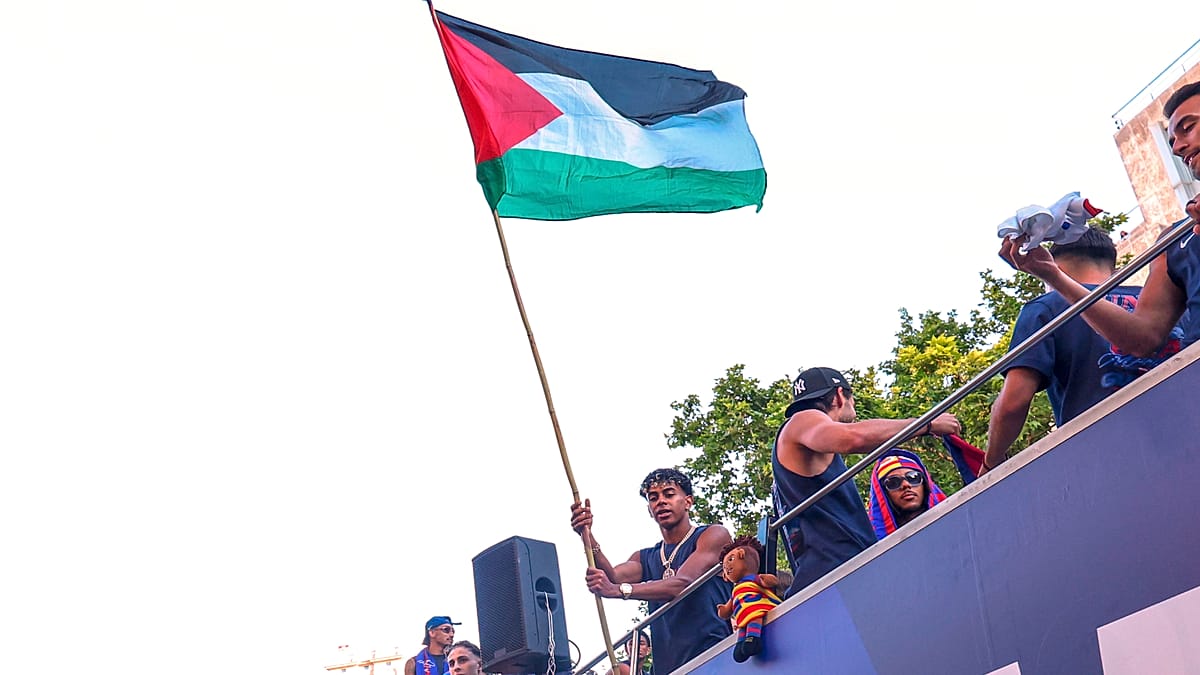
Barcelona winger Lamine Yamal sparked debate after footage emerged of him waving a Palestinian flag during the club's La Liga title parade on May 12. The 17-year-old, a breakout star this season, was celebrating Barcelona's 29th league title when he displayed the flag, a move that quickly circulated on social media and drew comment from his coach.
Flick's Response
In a press conference following the parade, Barcelona head coach Hansi Flick addressed the incident. "I don't like such gestures," Flick said, according to reports. "But Lamine is old enough to make his own decisions." The German coach's remarks reflect a careful balance between personal disapproval and respect for player autonomy, a stance that has become common in European football when athletes engage in political expression.
Yamal's gesture comes amid heightened attention to the Israeli-Palestinian conflict, particularly as Palestinians mark the 78th anniversary of the Nakba, renewing calls for the right of return. The timing of the parade, which celebrated Barcelona's domestic success, intersected with a moment of political significance for many in the region and beyond.
European football has seen a growing number of players use their platform to express solidarity with Palestinians. In recent years, players from clubs across the continent—including in Germany, France, and England—have displayed Palestinian flags or made gestures during matches, often drawing fines or warnings from league authorities. The practice has sparked broader debates about the role of politics in sport, with some arguing that athletes should remain neutral, while others defend their right to free expression.
Barcelona, a club with a strong Catalan identity and a history of political activism, has not officially commented on Yamal's action. The club's foundation has previously supported humanitarian causes, but it typically avoids taking sides in international conflicts. The incident also comes as Slovenia joined a boycott of Eurovision over Israel's participation, highlighting the broader European cultural and political landscape where the conflict resonates.
Yamal, who made his first-team debut for Barcelona at age 15, has become one of the most promising talents in European football. His performances this season helped secure the La Liga title, and his visibility as a young star of North African descent—his father is Moroccan—adds another layer to the symbolism of his gesture. For many fans, the flag display was a personal statement of identity and solidarity, while for others it was an unwelcome intrusion of politics into sport.
The incident also underscores the challenges faced by young athletes navigating public life. At 17, Yamal is still a minor under Spanish law, though he is considered an adult in football terms. Flick's comment that Yamal is "old enough to make his own decisions" acknowledges this tension, while leaving the door open for potential disciplinary action by the club or league.
La Liga, Spain's top football division, has rules prohibiting political messages during matches and official events, but the parade was a club-organized celebration, not a league-sanctioned match. This legal gray area may protect Yamal from formal sanctions, though the club could still impose internal measures. Barcelona has a history of supporting players' personal causes, but it also values its brand and relationships with sponsors, which could be affected by controversial political statements.
As the debate continues, Yamal's gesture has become a talking point across European media, reflecting the continent's diverse perspectives on the Israeli-Palestinian conflict. In Spain, where public opinion is often divided, the incident has sparked conversations about the limits of free expression in sport and the responsibilities of young role models. For now, Yamal remains focused on his football career, with Barcelona preparing for the upcoming season and the Champions League, where they will face stiff competition from clubs like Bayern Munich and PSG.