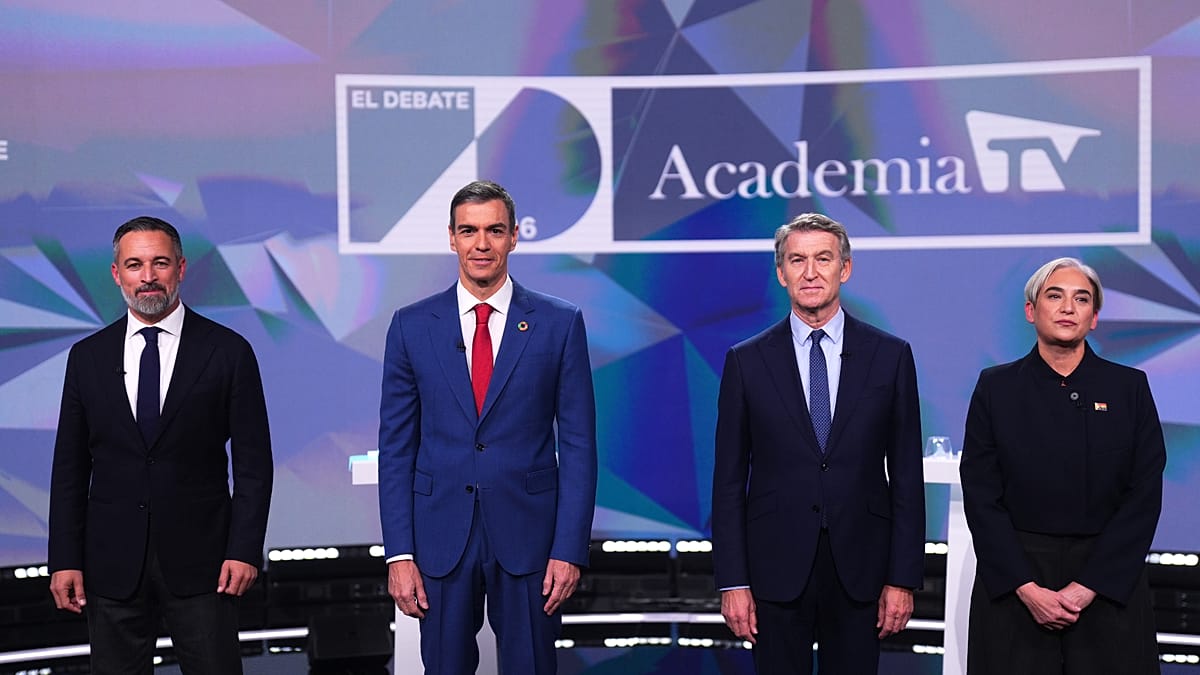
In a final televised showdown ahead of Spain's 29 November general election, the leaders of the two main right-wing parties pointedly ignored each other, while the left-wing candidates appeared almost perfectly in sync. The debate laid bare a campaign in which voters are being offered two starkly different visions for the country.
The four-way encounter opened with Ada Colau, leader of the left-wing Frente Amplio and former mayor of Barcelona, wearing an LGBT pin and urging her rivals to condemn gender-based violence, marking the International Day for the Elimination of Violence against Women. Only Santiago Abascal, head of the far-right Vox party, declined to do so.
Alberto Núñez Feijóo, the conservative People's Party (PP) candidate, entered the debate with visible confidence after being widely judged the winner of his previous head-to-head with Prime Minister Pedro Sánchez. He even tried to appeal to younger voters with a nod to meme culture, referencing the Luna Rossa pizzeria and using the phrase “Amiga, date cuenta” (roughly, “Girl, wake up”).
Feijóo's main task was to avoid mistakes after his earlier success, especially with polls showing him as the favourite, as in 2023. But an exchange on public services proved awkward. Colau accused him of hypocrisy for not demanding the resignation of Carlos Mazón, the former head of the Valencia regional government, who faced heavy criticism over his handling of the deadly floods of October 2024. She also criticised Feijóo for not asking Mazón to give up his status as an aforado—an office-holder who can only be tried by a higher court.
“Good management is taking charge in a national emergency, not running away from Paiporta while you stay quiet,” Feijóo retorted, referring to the town near Valencia worst hit by the floods. The exchange quickly became another viral clip in a campaign that seems to be followed more on live streams than on traditional broadcasts. Feijóo, who did not respond immediately, returned to the remark in the final segment of the night.
Left-wing synergy, right-wing silence
The rapport between Sánchez and Colau was almost complete throughout the programme, recalling the July 2023 campaign when Yolanda Díaz of Sumar was in the spotlight. Only in the closing moments of each segment—covering housing, the economy, public services, corruption, foreign policy and immigration—did Colau gently criticise certain policies of the Spanish Socialist Workers' Party (PSOE).
Abascal, who used the loaded term Reconquista in his closing statement, focused his attacks on three perceived enemies: immigration, environmental policies and corruption. He never directly addressed his hypothetical coalition partner, whether inside or outside government, and directed most of his fire at Sánchez.
The Vox leader also sought to appeal to working-class voters by attacking the profits of IBEX 35 companies, Spain's benchmark stock index, and contrasting them with the economic conditions he claimed ordinary people endure.
Sánchez had a better night than in his previous debate with Feijóo, but he was slow to go on the offensive, leaving several awkward silences after attacks from his two right-wing rivals. He began with a conciliatory tone, a strategy that had already failed him earlier, and only adjusted as the debate progressed. He appeared far more comfortable taking on the far-right leader than the conservative one.
In the final segment, Feijóo laid down a direct challenge to the prime minister. He vowed to resign from his post, give up his seat in parliament and renounce his legal protection if he did not become prime minister, and demanded that Sánchez commit to doing the same. Sánchez did not accept the challenge.
The debate underscored the deep polarisation of Spanish politics, with the two blocs offering contrasting models for the country's future. As voters prepare to go to the polls, the question of who will govern—and under what conditions—remains wide open. Related coverage: housing, immigration and polarization dominate the campaign, and the PP's lead in the polls.



