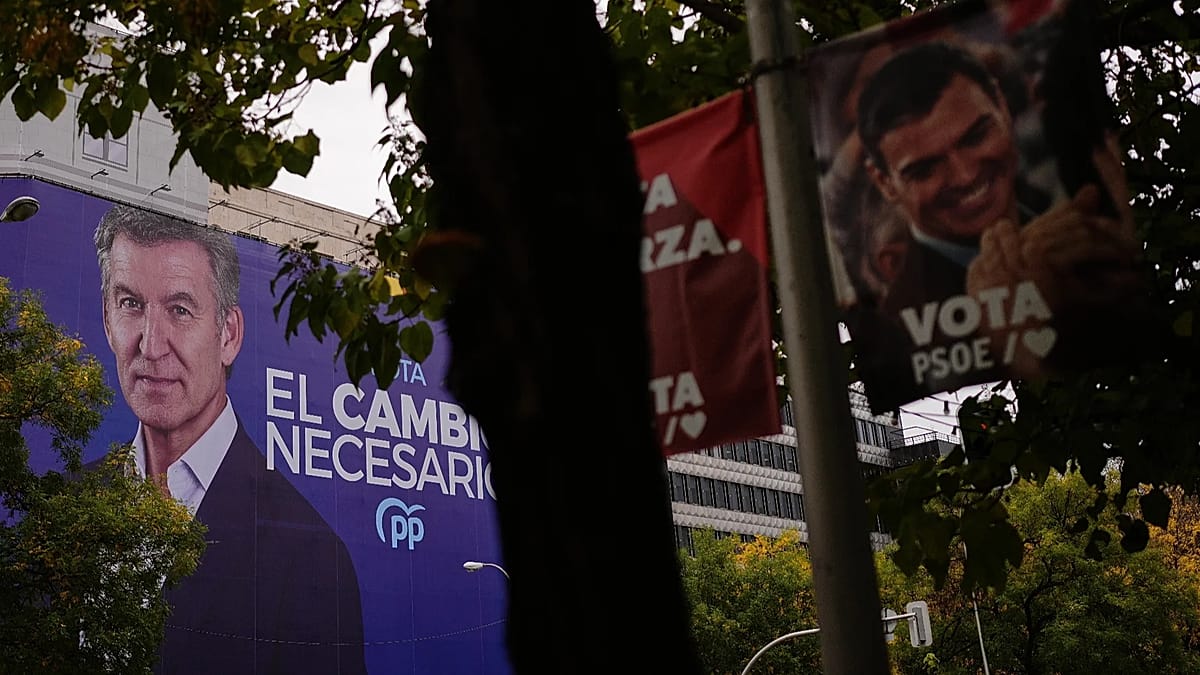
With one week to go before Spain's snap general election on 29 November, the four most recent opinion polls all place the conservative Popular Party (PP) of Alberto Núñez Feijóo ahead of the ruling Socialist Party (PSOE) of Pedro Sánchez. The surveys, published on Sunday by Ipsos, Data10, GAD3 and Hamalgama Métrica, differ on the size of the gap and on the projected strength of the far-right Vox party, but they converge on one key point: a right-wing coalition would likely command a working majority in the Congress of Deputies.
The combined PP-Vox seat projections range from 190 to 210, comfortably above the 176 seats needed for an absolute majority in the 350-seat lower house. The PSOE would secure between 98 and 119 seats, while the left-wing alliance Frente Amplio would become the fourth-largest force in those polls that provide a specific figure for its representation.
Poll-by-poll breakdown
Ipsos, published by La Vanguardia, gives the PP 30.3% of the vote and 127 seats, against 29.8% and 119 seats for the PSOE. Vox would win 17.9% and 63 deputies, bringing the right-wing total to 190. The same survey assigns 11 seats to ERC, seven to EH Bildu, six to Frente Amplio, five to Junts and four to Adelante Andalucía.
Data10's tracking poll, published by Okdiario, puts the PP at 32.1% and 133 seats, with the PSOE at 27% and 111 seats. Vox would reach 19% and 63 seats, for a combined right-wing total of 196. Frente Amplio, together with its territorial allies, would win 6.6% of the vote and ten seats.
GAD3, in its survey for ABC, estimates the PP at 31.1% and 131 seats, the PSOE at 28.4% and 110 seats, and Vox at 18.1% and 63 seats, yielding a PP-Vox majority of 194. Frente Amplio would win seven seats on 5.8% of the vote.
Hamalgama Métrica, published by Vozpópuli, is the most favourable to the right: the PP would take 31.8% and 130 seats, the PSOE would fall to 25.4% and 98 seats, and Vox would surge to 20.6% and 80 seats, giving the two parties a combined 210 seats. ERC and Frente Amplio would each win nine seats.
The spread between the polls is significant. The PP-PSOE gap ranges from just 0.5 points in the Ipsos survey to 6.4 points in Hamalgama Métrica's. Vox's projected seat count varies between 63 and 80, reflecting uncertainty about how the far-right party will perform in the final stretch of the campaign.
The election comes at a turbulent time for Spanish politics. Sánchez called the snap vote after his minority government struggled to pass legislation and faced mounting pressure from regional parties. The left's hopes now rest on Frente Amplio, a broad coalition that includes Podemos and other progressive forces, but the polls suggest that unity may not be enough to close the gap with the right.
If the PP and Vox do secure a majority, it would mark a significant shift in Spain's political landscape, ending nearly seven years of Socialist-led governments. Feijóo, who has campaigned on economic stability and a tougher line on regional nationalism, would likely become prime minister with the support of Vox's Santiago Abascal. That scenario has raised concerns in Brussels, where a PP-Vox government could align more closely with the conservative bloc in the European Parliament and adopt a more confrontational stance on issues like migration and EU fiscal rules.
The campaign has also been shaped by broader European trends, including cost-of-living protests that have hit several countries, and by Spain's recent push to mandate 80% renewable power for data centres, a policy that could become a point of contention if the government changes hands.
With just days left, the polls suggest that the right is within reach of power, but the margins are tight enough that a late swing could still alter the outcome. Voter turnout, particularly among younger and urban voters, will be crucial. The Socialists are hoping that a last-minute mobilisation of the left, similar to what happened in previous elections, could narrow the gap. But the arithmetic from all four surveys points in one direction: a PP-Vox majority is the most likely result.
As Spain prepares to vote, the rest of Europe will be watching closely. A shift to the right in Madrid would not only change the balance of power in the EU's fourth-largest economy but also signal a broader realignment in southern Europe, where left-wing governments have been under pressure from inflation and housing crises. The outcome on 29 November will be a defining moment for both Spanish politics and the European centre-right.