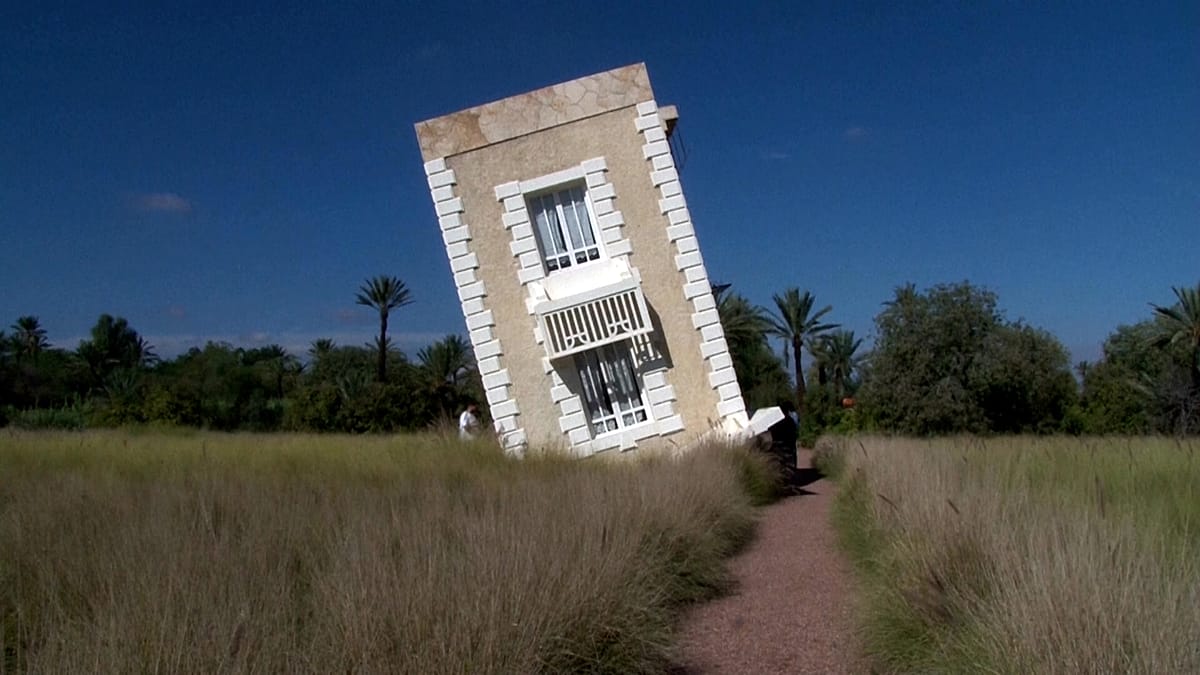
Just outside Marrakech, an 11-hectare field has become a playground for the absurd. At Ramakech, visitors wander among upside-down houses, oversized chairs, and figures with heads made of vegetables. The park is the work of French artist Jean-François Fourtou, who has spent years turning his childhood recollections into monumental, disorienting sculptures.
Fourtou, who divides his time between France and Morocco, conceived Ramakech as an open-air museum where the ordinary rules of scale and gravity no longer apply. A traditional Moroccan home appears to have been flipped on its roof, its door and windows pointing skyward. Nearby, a giant teapot and cups suggest a tea ceremony for a race of titans. The effect is both playful and unsettling, inviting visitors to question what they see.
From childhood memories to monumental art
The artist has said that many of the installations draw on dreams and memories from his youth. The vegetable-headed figures, for instance, echo the characters he imagined as a child, while the oversized furniture recreates the feeling of being small in an adult world. By placing these works in the Moroccan landscape, Fourtou also nods to the region's craft traditions, using local materials and artisans in the construction.
Ramakech is not a conventional gallery. There are no walls, no labels, and no prescribed route. Visitors are encouraged to wander, touch, and even climb some of the pieces. The park has quickly become a destination for art lovers and tourists alike, offering a surreal counterpoint to the bustling souks and historic sites of Marrakech.
The project also reflects a broader cultural exchange between Europe and North Africa. Fourtou, who has exhibited across France and beyond, brings a distinctly European surrealist sensibility to a Moroccan setting. The result is a dialogue between cultures, one that resonates with the continent's interconnected history. For those interested in how such cross-border creativity flourishes, the park is a vivid example.
While Morocco is often in the news for its defence industry ambitions or its role in renewable energy deals, Ramakech offers a quieter kind of innovation. It is a reminder that the country is also a hub for artistic experimentation, drawing on European influences while remaining firmly rooted in its own landscape.
The park's name, a play on Marrakech and the artist's own, hints at its personal nature. Fourtou has described the site as a "living work" that evolves with each new installation. He plans to keep adding pieces, ensuring that no two visits are ever quite the same.
For now, Ramakech stands as a testament to the power of imagination. It turns the world upside down, literally, and invites everyone who enters to see it from a new angle. Whether you are a seasoned art enthusiast or simply curious, the park promises an experience that is as thought-provoking as it is entertaining.
As the sun sets over the Atlas Mountains, the silhouettes of upside-down houses and giant vegetables cast long shadows across the dusty ground. It is a scene that could only exist in the mind of an artist who refuses to accept the world as it is. And for those who visit, it is a chance to step into that world, if only for an afternoon.