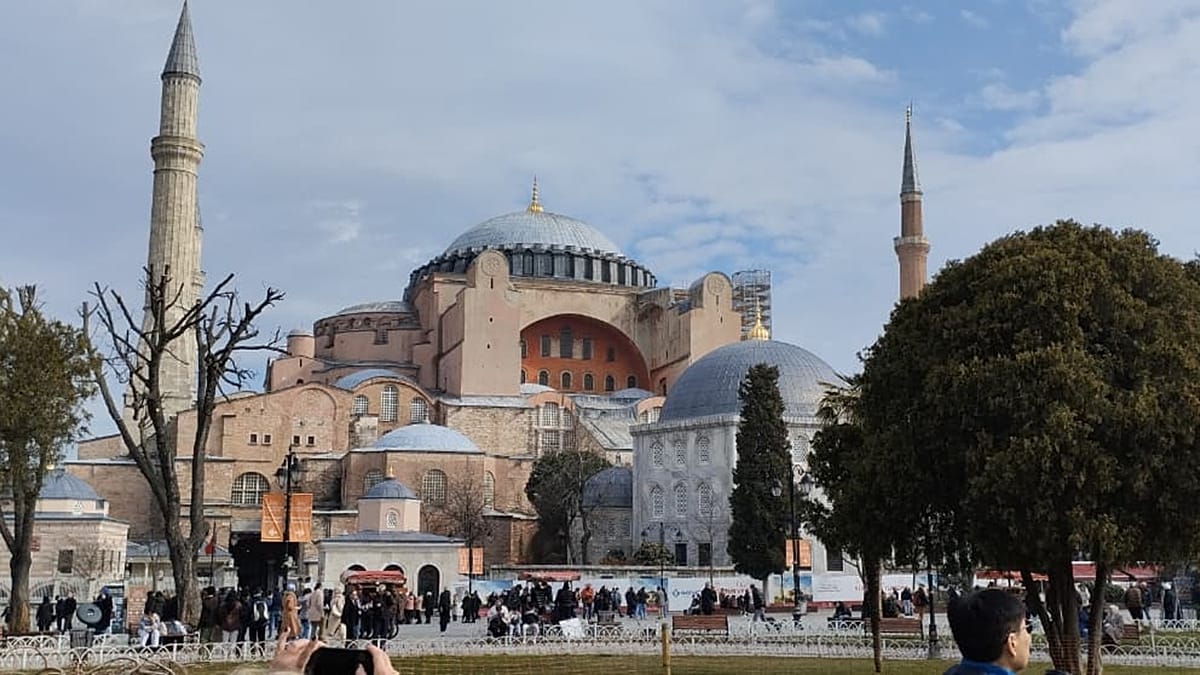
Beneath the venerable dome of Hagia Sophia, a labyrinth of forgotten passages is slowly emerging from centuries of silence. During ongoing restoration, archaeologists have uncovered six underground spaces, nine tunnels, and nearly 3,000 tonnes of soil removed, revealing new chapters in the monument's layered history.
The discoveries were presented by Turkey's Minister of Culture and Tourism, Mehmet Nuri Ersoy, who descended into the subterranean network alongside scientists. CNN Türk broadcast the first images of galleries that had remained sealed for centuries, offering a rare glimpse into the infrastructure of Byzantine Constantinople.
Traces of an earlier era
One of the most significant finds lies in the Vizier's Garden, where a rock-cut burial chamber, or hypogeum, has yielded architectural layers at depths greater than the known floor level. Excavations went 1.5 metres below the mud-covered surface, exposing remnants that may belong to a structure predating the current basilica, built under Emperor Justinian between 532 and 537 on the site of older churches.
While the dating remains unconfirmed, the possibility of pre-Justinian remains has sparked intense interest. As Ersoy explained, the team encountered traces of an earlier building phase, but scientific analysis will determine their exact age.
An underground network with nine tunnels
In the western garden, six underground spaces connected by nine tunnels have been identified. Three are believed to be remnants of the old atrium, the courtyard linked to the church complex. Seven of the tunnels have been cleared of backfill, while two await documentation. The cleaned sections total 420 metres, with the longest tunnel stretching 180 metres.
This long gallery runs parallel to Hagia Sophia's facade, from the Fatih Madrasa area toward the visitors' entrance, with a gradient of about 3%. Researchers are investigating whether it connected to the famed Roman Road of Constantinople, though its original function remains unconfirmed.
The hidden water network of Constantinople
The tunnels likely formed part of a broader water management system for the Byzantine capital, handling distribution and rainwater drainage essential for such a vast complex. Their study offers a window into the technical ingenuity of the era.
Restoration efforts extend beyond cleaning. Vaults are being repaired, masonry stabilised, and damaged sections reinforced. In one 56-metre underground space, an 18-metre section has already been restored, while other tunnels are being strengthened with stainless steel elements to ensure structural integrity.
Underground galleries open to visitors?
The Turkish government is exploring ways to make some of these spaces accessible to the public. Ersoy announced a plan for presenting the underground structures, with monument protection and visitor safety as priorities. No timeline or specific sections have been confirmed.
Specialists are also considering whether the tunnels could improve ventilation. Currently, the existing underground opening covers only 3.6% of Hagia Sophia's needs. Future studies will assess whether historic galleries could contribute to a modern air supply without compromising their character.
The discoveries add a new dimension to Hagia Sophia, a monument that has already yielded so much. As restoration continues, the underground world promises to deepen our understanding of Constantinople's urban fabric and the lives of those who built and maintained this architectural marvel.