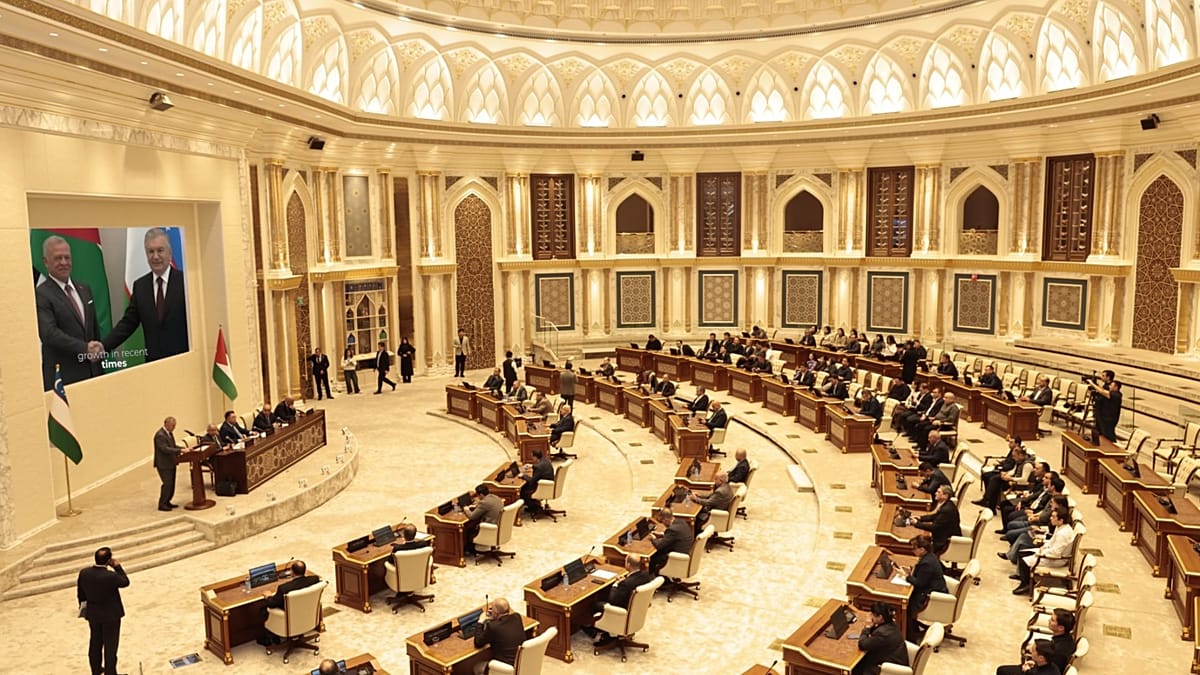
In a series of events spanning Amman and Tashkent, Uzbekistan and Jordan have moved to deepen their cultural, humanitarian, and academic ties. The initiative, which included book presentations, academic conferences, and a university rectors' forum, reflects a broader effort by both countries to build a partnership that goes beyond traditional diplomacy.
The programme in Amman introduced Jordanian audiences to works by Uzbek President Shavkat Mirziyoyev, as well as studies on contemporary Uzbekistan and illustrated volumes on the country's historical and cultural heritage. The events also featured international conferences and meetings with members of Jordan's academic community, drawing more than 1,500 participants from government, parliament, religious institutions, and the media.
Books as a bridge
Central to the cultural exchange was the launch of the Arabic edition of President Mirziyoyev's book The Contemporary World and New Uzbekistan. The volume outlines the country's reform agenda, strategic development goals, and its approach to global challenges, with a focus on protecting citizens' rights and improving well-being. Alongside the president's book, nine other Arabic-language publications and photo albums were presented, covering topics from Uzbekistan's Silk Road legacy to its modern transformation.
The book exhibition Uzbekistan: Civilisations, Personalities, Discoveries was also held, and the publications were donated to Jordanian libraries. Plans are underway to establish dedicated "New Uzbekistan" book sections in libraries and educational institutions across Jordan, with support from local research centres and universities.
In Tashkent, the exchange became reciprocal when King Abdullah II of Jordan's memoir, Our Last Best Chance: The Pursuit of Peace in a Time of Peril, was presented at the University of World Economy and Diplomacy on 13 November 2026. The book offers insights into the monarch's views on international relations, regional security, and diplomacy, giving Uzbek readers a window into Jordan's foreign policy perspective.
Universities as a platform
The academic dimension of the partnership was underscored by the first Forum of Rectors of Higher Education Institutions of Uzbekistan and Jordan, held in Tashkent on 17–18 November. The Jordanian delegation was led by Education Minister Azmi Mahafza, and the forum brought together rectors from 16 Jordanian universities and representatives from 19 Uzbek institutions. Discussions focused on joint educational programmes, research collaboration, and academic exchanges, with priority areas including artificial intelligence, engineering, renewable energy, water management, and medical education.
At Al al-Bayt University in Jordan, an academic symposium on President Mirziyoyev's book was held on 18 November, further cementing the scholarly link between the two countries. The events build on momentum from meetings between the two leaders, including King Abdullah II's state visit to Uzbekistan in August 2025 and a subsequent meeting on the sidelines of the Aqaba Process in Astana in November 2026.
The cultural and academic exchanges come at a time when Europe and Jordan are exploring deeper strategic partnerships, and Uzbekistan is increasingly positioning itself as a hub for regional cooperation. The country's efforts to modernise its economy and education system have drawn attention from international partners, and its agricultural reforms and renewable energy projects are part of a broader transformation.
For Jordan, the partnership offers access to Central Asian markets and academic collaboration, while Uzbekistan gains a foothold in the Middle East. The exchange of books and university initiatives is laying the groundwork for a relationship that could extend into trade, technology, and cultural diplomacy.
As both countries look to the future, the emphasis on education and knowledge sharing may prove as significant as any political agreement. The events in Amman and Tashkent have created a foundation for deeper cooperation, one that could resonate well beyond the lecture halls and libraries where they began.