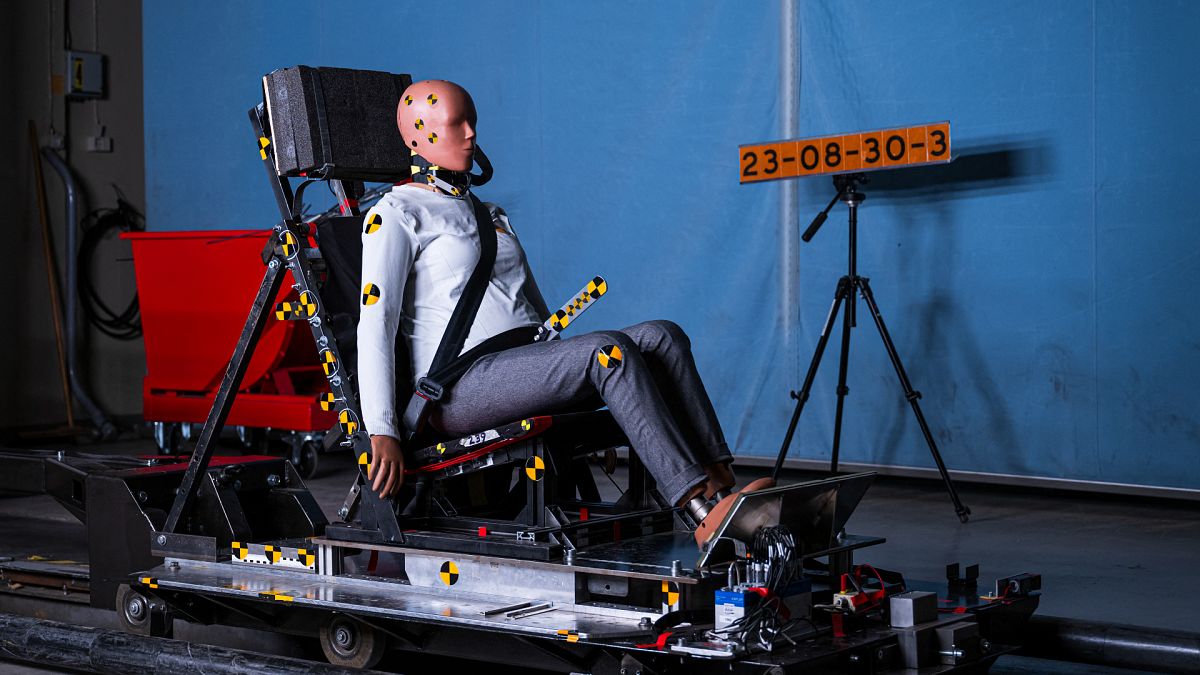
For decades, the standard crash test dummy has been modelled on an average male body — a design choice that may help explain why women are 73 percent more likely to be injured in frontal car collisions. Now, a team of Swedish researchers has unveiled a prototype that could begin to close that gap.
The SET 50F, developed by the Swedish National Road and Transport Research Institute (VTI), is the first crash test dummy designed entirely from female anatomical data. Unlike existing models that are essentially smaller versions of male dummies, the SET 50F accounts for differences in body shape, weight distribution, and muscle strength.
“In the minimum standard that is required for a car to be sold in the regulation, it says you have to use the model of an average male for all the testing full-stop,” said Astrid Linder, director of traffic safety at VTI. “Both males and females should be equally represented when we assess the protection of the occupants or the users in the crash. By that, we will have an inclusive assessment, whereas today, it’s exclusive.”
How Europe Tests Car Safety
In Europe, new vehicles are evaluated by the European New Car Assessment Programme (Euro NCAP), a voluntary safety rating system backed by motoring organisations in several EU member states and the European Commission. Euro NCAP runs a battery of tests — frontal impacts, side collisions, pole crashes, and pedestrian safety — using five adult dummy models. Only one of those, the Hybrid III, is intended to represent a small female occupant. But the Hybrid III is largely a scaled-down version of the male dummy that has been in use since the 1970s, not a true female surrogate.
The SET 50F, by contrast, was built from the ground up using data on female anthropometry. Its neck, for instance, is more flexible and allows greater movement during a crash, reflecting the generally weaker neck muscles of women. “The muscles in the neck are weaker normally in a woman, so if you compare it with a male dummy, this neck is more flexible and has more movements if you perform exactly the same crash test at the same speed and acceleration,” explained Tommy Pettersson, a research engineer on the project.
Studies from the United States have highlighted the disparity. A 2019 University of Virginia analysis found that women are 73 percent more likely than men to be injured in car accidents. A 2021 report by the Insurance Institute for Highway Safety suggested that factors such as women driving smaller, lighter cars and being more often in the struck vehicle during side-impact and front-into-rear crashes contribute to the statistic. But Linder and her team believe the dummy itself is a critical missing piece.
“The aim, hopefully, is to make it possible to make better seats both for women and men. That’s the reason why we have created one man and one woman,” Pettersson added.
The SET 50F is still a prototype, but its developers hope it will eventually be adopted by Euro NCAP and other testing bodies, leading to vehicles that protect all occupants equally. The work comes amid broader European efforts to improve road safety, including EU rules on vehicle safety systems and ongoing investigations into crash causes, such as the Belgian carnival crash that killed seven.
For now, the prototype represents a step toward a more inclusive standard — one that recognises that safety should not depend on gender.