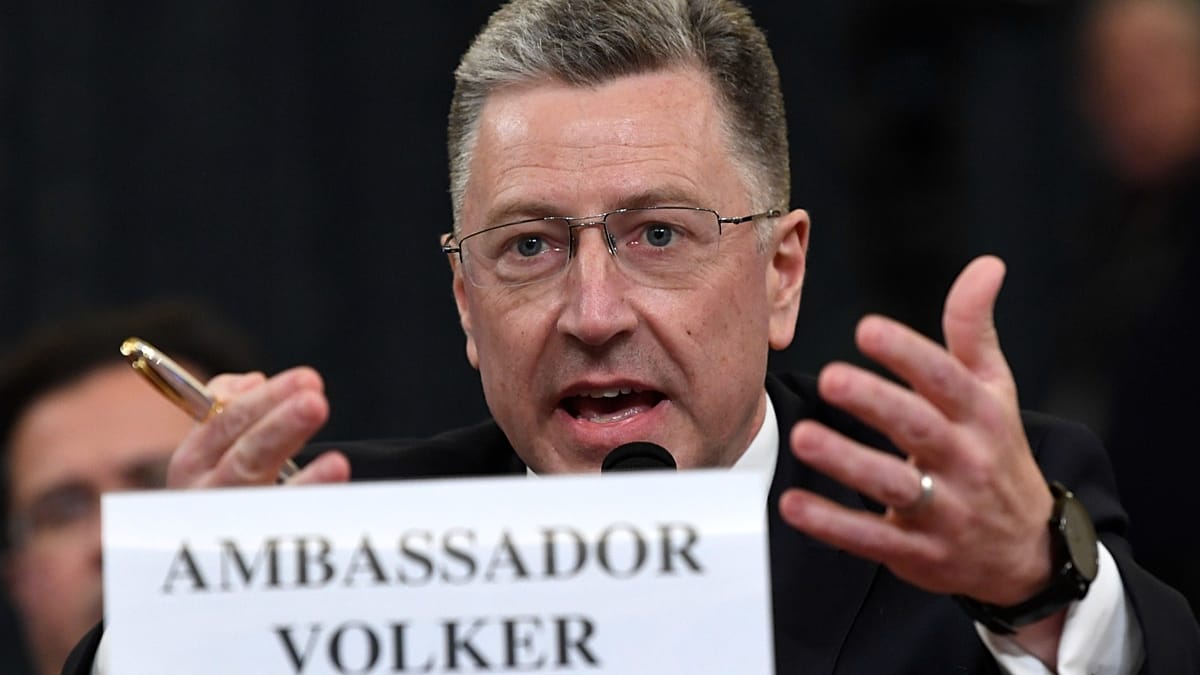
As US President Donald Trump prepares to attend next week's NATO summit in Ankara, a former senior American diplomat has offered a blunt assessment of his temperament. Kurt Volker, who served as US ambassador to NATO and later as the first Trump administration's special representative to Ukraine, told Euronews' Europe Today programme that Trump's frequent outbursts against European allies are often disproportionate.
“Donald Trump is always raging about something: he's unhappy about European contributions, European defence spending, Iran, whatever it might be,” Volker said. However, he predicted that Trump would temper his criticism out of respect for the summit's host, Turkish President Recep Tayyip Erdoğan. “He has a good relationship with Erdoğan, and he doesn't want to rain on Erdoğan's parade.”
Trump has repeatedly lambasted NATO allies in recent months over their refusal to support the US and Israel in the joint war with Iran. Spain and Italy denied access to their bases, while France refused Israel permission to use its airspace for flights carrying weapons destined for Iran. In May, Trump engaged in a bitter public feud with German Chancellor Friedrich Merz after Merz criticised the “ill-conceived” strategy behind the conflict. Trump responded by hastily announcing the withdrawal of 5,000 US troops from Germany and denouncing European partners as “cowards”, calling NATO a “paper tiger”.
Allies Push Back on US Narrative
European governments have consistently argued that they were not consulted in the planning of the war in Iran and that the conflict falls outside NATO's core defensive mandate. Despite a preliminary peace agreement being signed to end hostilities, Trump remains aggrieved. On Thursday night, just days before the summit, he posted on his Truth Social platform that it was “ridiculous” for the US to maintain its “one-sided” relationship with NATO. “They were not there for us!!!”, he wrote, describing the alliance as “not reciprocal”.
Yet Trump has confirmed to reporters that he will attend the Ankara summit out of deference to Erdoğan. “If the summit was not taking place in Turkey, I don't think I would have gone to it,” Trump said on the margins of a meeting with NATO Secretary General Mark Rutte at the White House. “I'm going out of respect to President Erdoğan.”
Volker, who has decades of experience in transatlantic diplomacy, dismissed Trump's characterisation of allies as abandoning the US as an “exaggeration”. He noted that European nations were not involved in the decision to go to war. “The administration right now likes to say that Europe wasn't there for us,” Volker said. “They didn't let us use bases and airspace and things like that.”
Since returning to the White House for a second term, Trump has been particularly scathing about European defence spending, frequently describing the continent's nations as “free riders” on US military investment. His rhetoric has contributed to a broader decline in European confidence in the United States, which has fallen sharply ahead of the July 4th anniversary.
The Ankara summit comes at a delicate moment for NATO, with member states still grappling with the fallout from the Iran war and the broader implications of Trump's transactional approach to alliances. While Trump's attendance is seen as a gesture of personal respect for Erdoğan, his public dismissal of US support for NATO has raised questions about the alliance's future cohesion.
Volker's assessment suggests that while Trump's anger may be a constant feature of his presidency, it does not always translate into concrete action. The question for European leaders is whether they can manage the volatility of a US president who views alliances through a lens of personal loyalty and perceived slights, rather than shared strategic interests.