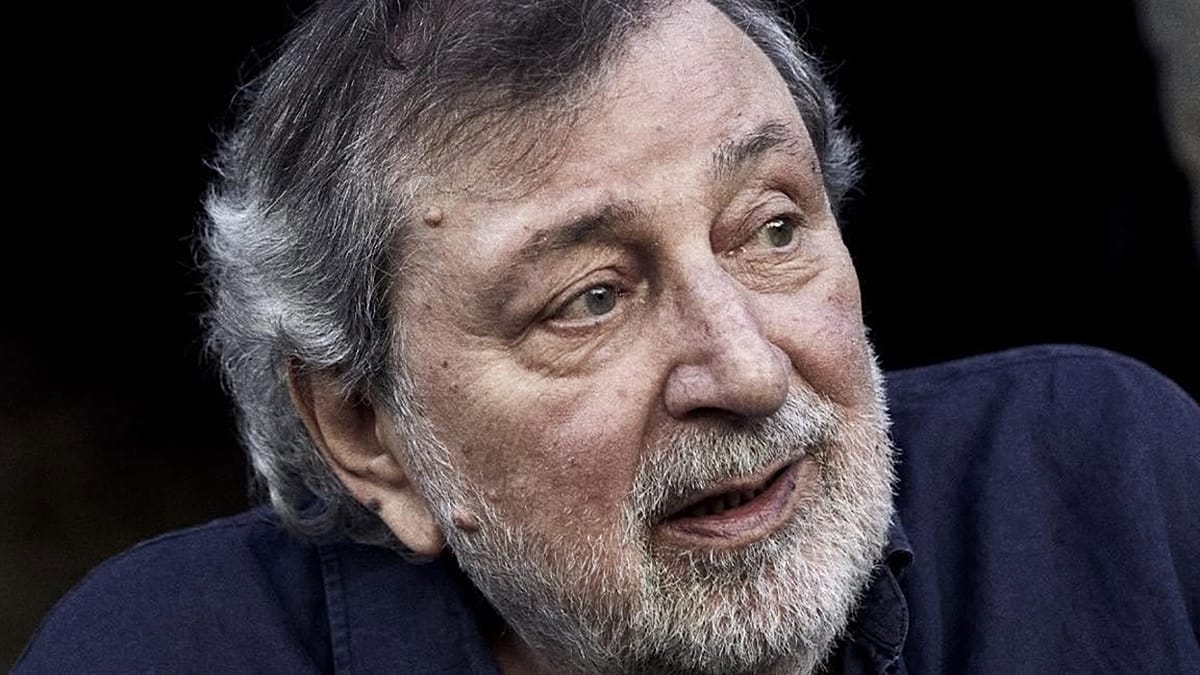
Francesco Guccini, one of the most revered figures in Italian music and culture, died on Thursday morning in the small hamlet of Pavana, in the municipality of Sambuca Pistoiese, in the Tuscan-Emilian Apennines. He was 86.
His family announced the death in an official statement, saying he passed away surrounded by the love of his wife Raffaella, his daughter Teresa, and other relatives. In line with his wishes, the funeral will be held privately in the coming days.
“In asking that this moment of grief may be lived in the utmost intimacy, we would like to thank in advance all those who will share in their mourning with affection, discretion and respect,” the family said.
A public commemoration is planned for September, a fitting tribute to a man whose work spanned more than five decades and left an indelible mark on Italian songwriting.
A life rooted in the Apennines
Born in Modena on 14 June 1940, Guccini spent much of his childhood in Pavana, his paternal grandparents’ village, after being evacuated during the Second World War. That deep connection to the Tuscan-Emilian Apennines would become a recurring theme in his poetry and prose, shaping his identity as an artist.
After early musical experiments in the 1950s and a brief stint as a reporter for the Gazzetta di Modena, he moved to Bologna in 1961. The city, with its vibrant intellectual and musical scene, became his creative home.
Guccini’s career took off in the 1960s, initially as a songwriter for other performers, including Caterina Caselli, Equipe 84, and I Nomadi. For them, he wrote some of the era’s most iconic tracks, such as “Auschwitz,” “Dio è morto,” “Per fare un uomo,” and “Noi ci saremo.”
His own recording debut came in 1967 with Folk beat n. 1. In 1972, he released Radici, an album that included landmark songs like “La locomotiva,” “Incontro,” “Il vecchio e il bambino,” and “Piccola città.”
Commercial success arrived in 1976 with Via Paolo Fabbri 43, a blues-infused record that captured the nocturnal atmosphere of Bologna. The track “L’avvelenata” on the same album was a defiant response to critics, mixing anger and pride.
In 1978, Amerigo featured the celebrated song “Eskimo,” which earned him the nickname “the singer-songwriter with the eskimo.” His live performances, such as Opera buffa and Fra la via Emilia e il West, blended music with monologues and cabaret-style storytelling.
Guccini’s work was rich with cultural references, drawing on Italian poetry, international literature, and even the Bible. After releasing L’ultima Thule in 2012, he announced his retirement from active music-making to focus on writing. He later returned with Canzoni da intorto (2022) and Canzoni da osteria (2023).
Beyond music, Guccini was a prolific author. His narrative debut came in 1989 with Cròniche epafàniche, followed by numerous books, including Vacca d’un cane and a series of novels co-written with Loriano Macchiavelli. He also taught Italian at Dickinson College in Bologna from 1965 to 1985, and worked as a screenwriter, comic-book writer, actor, and dialectologist.
In 2002, the University of Bologna awarded him an honorary degree in Education Sciences. Over his career, he received multiple Targa Tenco and Premio Tenco awards, cementing his status as a master of Italian songwriting.
Guccini’s death marks the end of an era for Italian music, but his legacy lives on in the songs and stories that continue to resonate across Europe.