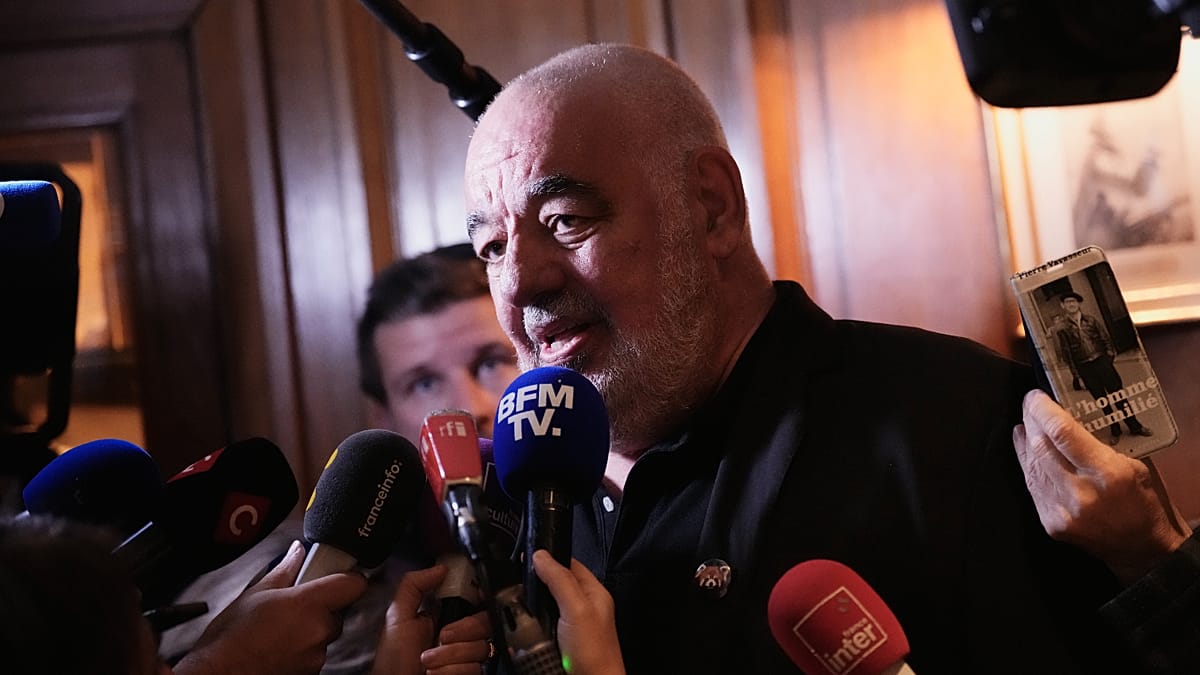
Philippe Jaenada, the newly crowned winner of the 2026 Prix Goncourt, has acknowledged using artificial intelligence while writing his award-winning novel, L'Inconnue du quai de Javel. The admission, made during an interview on France Inter, has reignited a heated debate across the European literary world about the role of AI in creative writing.
Jaenada, a 62-year-old novelist known for his deep dives into unsolved criminal cases, said he turned to AI on three separate occasions. The first use was a playful insertion: he included a sentence generated by ChatGPT to "play with the reader." He revealed that sentence to the Goncourt jury only on Tuesday, joking, "If it comes out, I know who it will come from."
He also used the technology to mock its limitations. "To make fun a bit of ChatGPT, which gives completely absurd answers about a technical piece of data," he explained, without offering further specifics. The third use was more practical: he employed AI for technical research.
"I think we cannot push AI away, we cannot act as if it did not exist," Jaenada said. "We have to use it, we have to acknowledge it, we have to tame it and not let ourselves be replaced. It has to be useful."
A literary season under scrutiny
Jaenada's remarks come at a sensitive moment for French letters. The literary world is still reeling from the case of Thélyson Orélien, whose novel C'était ça ou mourir was removed from the second Goncourt shortlist and excluded from other prizes amid suspicions of AI use and plagiarism. His publisher, Éditions du Boréal in Montreal, has severed ties and halted reprints.
Social media reacted swiftly to Jaenada's confession. Some users defended the use of AI, arguing it will become as commonplace as spellcheckers. Others expressed disappointment. "I want to read authors who make the effort and take the time to create by themselves, with the strength of their heart, their guts and their brain," one fan lamented on X. Another asked, "Does no one know how to write alone in this 2026 literary season or what, and OK, for 'playing with the readers', but what does that have to do with the novel?"
Jaenada succeeds Laurent Mauvignier, the 2025 laureate. His winning novel investigates the unsolved murder of a young woman in Paris in the late 1940s, continuing the intimate crime vein that earned him a loyal readership with earlier works such as Sulak (2013), La Petite Femelle (2015), and La Serpe (2017).
The debate over AI in literature is not confined to France. Across Europe, publishers and authors are grappling with how to integrate or resist generative tools. Some see AI as a research aid, others as a threat to originality. Jaenada's stance—embrace and tame the technology—reflects a pragmatic current, but his playful use of a ChatGPT sentence has left many wondering where the line between human and machine creativity should be drawn.
As the 2026 literary season unfolds, Jaenada's admission may prompt other authors to come forward about their own use of AI. For now, the Goncourt winner seems unapologetic, insisting that AI is a tool to be mastered, not feared. Whether the literary establishment agrees remains an open question.