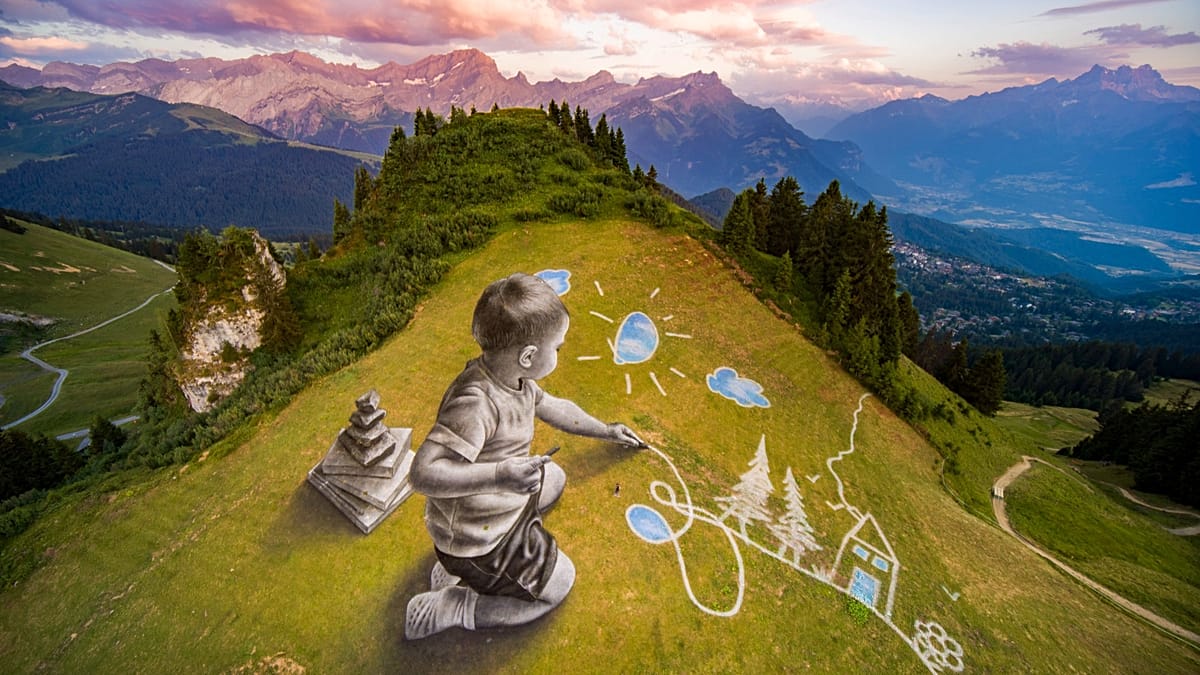
High above the Swiss resort of Villars-sur-Ollon, French land artist Saype has installed his latest works: two monumental frescoes painted directly onto alpine grass. The pieces, part of a series he has been developing in the region for four years, are deliberately temporary. They are already beginning to fade, and by the end of August they will likely be gone.
Saype, whose real name is Guillaume Legros, is known for large-scale, environmentally friendly paintings on grass, earth, sand, and snow. His new diptych, titled À portée de ciel (Within Reach of the Sky), is the first time he has introduced colour into his alpine works. One fresco, located at the Bretaye pass, shows a child drawing the sun and clouds; the other sits lower down the resort. Together they form a single narrative about childhood imagination and the cosmos.
Art as a child's adventure
Saype's art often revolves around childhood, but he insists it is not simple. “Childhood observations lie at the heart of what I describe as a child's ongoing adventure to become the author of his own destiny,” he said. “They remind us that possibilities are endless.” The choice of a ski resort as a canvas is no accident. The artist has been building a story here over several years, and it is usually the children who develop it. “Year after year, they create the story themselves,” he explained.
The execution is physically demanding. Saype works on steep slopes, often battling the elements. “The challenge is twofold. It's physical because there's a bit of a slope... and there's the weather. I had to deal with thunderstorms, wind, rain, so that's always what makes it complicated for me,” he said. The materials are eco-responsible, using chalk and charcoal, which means the art leaves no lasting trace on the environment.
This is not Saype's first foray into the Swiss Alps. He has painted in Villars since 2022, and his works have been exhibited globally, from New York to Nairobi. Each piece is designed to disappear slowly, a deliberate metaphor for the fragility of both nature and human societies. “I love that moment because, ultimately, it's when nature reclaims what I've created,” Saype said.
The current dry spell in Switzerland has kept the grass short, but forecast rain and storms will accelerate the fading. Saype estimates the frescoes will remain visible until the end of August. For those who cannot make the trip, the artist's website offers a glimpse of the works in progress.
Saype's approach resonates beyond the art world. His use of natural materials and his focus on impermanence echo broader conversations about sustainability and our relationship with the environment. As Europe grapples with climate change, his art serves as a reminder of what we stand to lose. Heatwaves are already reshaping how Europeans live, and Saype's work is a visual meditation on that reality.
The project also highlights the role of children in shaping narratives. Saype's collaboration with local kids is not just a gimmick; it is central to his creative process. “Kids have been inspired by the cosmos, by adventures, and by their observations—and for the first time, they're putting that into drawings, and the drawings come to life,” he said. “That's why I added colour—it feels as though the sky is reflected in the drawings, and my idea is to convey that the cosmos acts as a kind of window onto the world.”
For those interested in the intersection of art and environment, Saype's work is a must-see. But time is short. The frescoes are ephemeral by design, and nature is already reclaiming them. As Saype puts it, the end is bittersweet but worth celebrating. “It's when nature reclaims what I've created,” he said. “But basically, I think it'll be visible until the end of August without too many problems.”
Saype's project is part of a broader trend of land art that emphasizes process over permanence. His works have been featured in discussions about childhood and play, and his latest pieces are no exception. They invite viewers to reflect on the fleeting nature of beauty and the importance of imagination.
As the summer progresses, the frescoes will continue to fade, but their impact will linger. Saype has already begun planning his next project, though he remains tight-lipped about the details. For now, the mountains of Villars-sur-Ollon offer a unique glimpse into an artist's vision—one that is as fragile as it is grand.