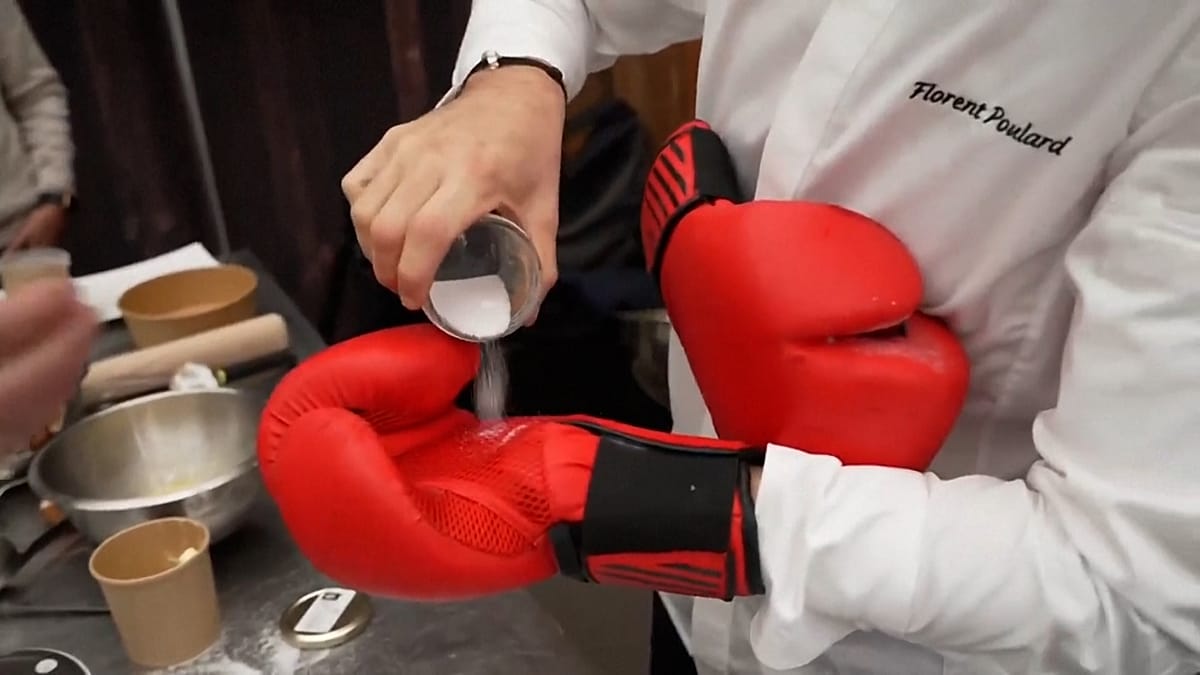
At a food festival in the French Alps, the usual clatter of knives and pans gave way to the thud of boxing gloves as professional chefs took on an unusual challenge: coaching amateur cooks through a delicate soufflé omelette while their own hands were bound in padded gloves.
The event, held in the mountain town of Megève, turned the traditional masterclass on its head. With their fingers useless inside the gloves, the chefs could only shout instructions, encouragement, and the occasional warning as their teammates wrestled with eggs, butter, and a hot pan. The amateurs, many of whom admitted to limited kitchen experience, had just 20 minutes to produce a dish that would impress a panel of top culinary names.
Judging with a pinch of salt
The jury was led by Éric Frechon, the three-Michelin-starred chef known for his work at the Bristol in Paris. Frechon, a native of the nearby Picardy region, was generous in his assessment, noting that despite a few scorched pans and some creative interpretations of the recipe, the results were surprisingly edible. “The spirit of the competition is what matters,” he said after tasting the entries. “It shows that cooking is about guidance, trust, and a little bit of chaos.”
The winning team was led by Patricia Mathon, who confessed she rarely cooks at home. Under the gloved guidance of her coach, she managed to produce an omelette that the judges deemed the best of the day. Her victory was met with applause from the crowd, many of whom had gathered to watch the spectacle unfold between the snowy peaks.
The competition is part of a broader trend in European food festivals to make haute cuisine more accessible and playful. Similar events have popped up in Lyon, Turin, and Barcelona, where chefs trade their whites for aprons and their precision for improvisation. But the boxing glove twist, organisers said, was a first.
“We wanted to break down the barrier between the chef and the home cook,” said one of the event’s organisers. “When the chef can’t use their hands, they have to communicate differently. It’s a lesson in pedagogy as much as gastronomy.”
The festival also served as a reminder of the region’s culinary heritage, with local producers showcasing cheeses, charcuterie, and wines from the Savoie and Haute-Savoie. For many attendees, the competition was a light-hearted interlude in a weekend dedicated to the Alps’ rich food culture.
Frechon, who has been a vocal advocate for French culinary education, used the occasion to stress the importance of passing on skills to the next generation. “We are seeing a revival of interest in home cooking across Europe,” he said. “Events like this, even if they are fun, help people realise that cooking is not intimidating.”
The event comes at a time when France’s restaurant scene is navigating post-pandemic challenges, from staff shortages to rising ingredient costs. But for one afternoon in Megève, the focus was purely on the joy of cooking—and the comedy of watching a professional chef try to whisk eggs with a boxing glove.