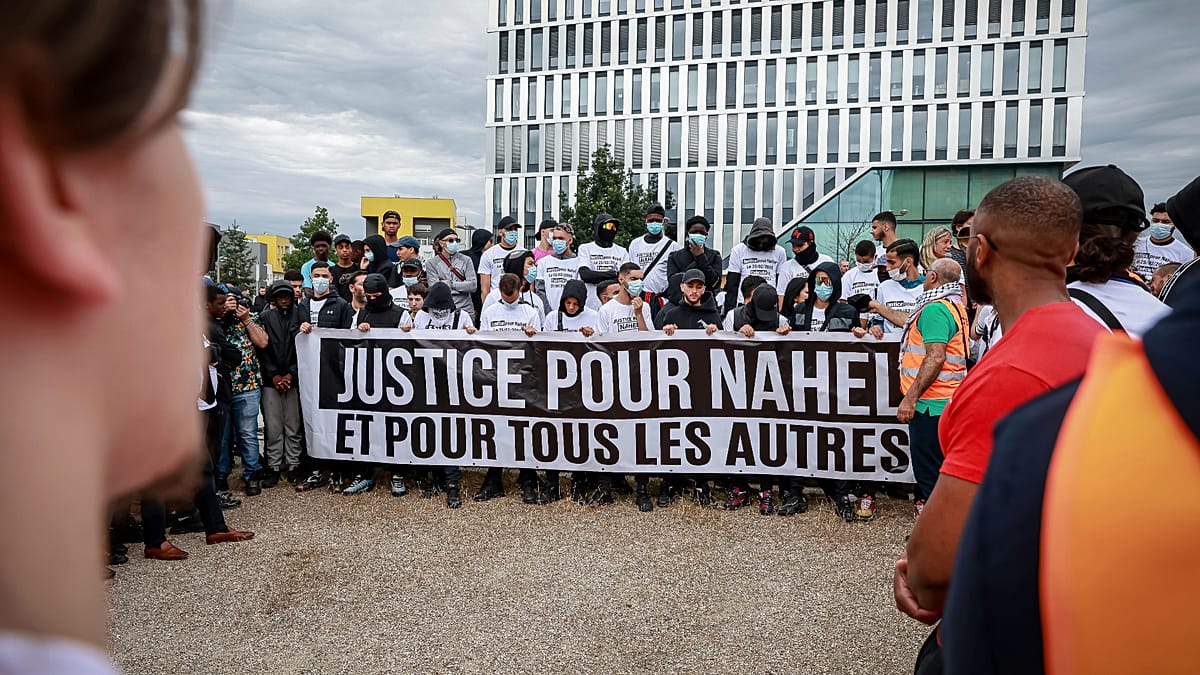
The Versailles Court of Appeal ruled on Tuesday that Florian M., the police officer who fatally shot 17-year-old Nahel Merzouk in Nanterre in June 2023, must stand trial for murder before an assize court. The decision overturns a previous ruling that had downgraded the charge to violence resulting in death without intent to kill.
The court found that the circumstances of the shooting—a single shot fired from just 16 centimetres away, striking the teenager in the chest—pointed to an intention to kill. As a result, Florian M. now faces up to 30 years in prison, compared with a maximum of 15 years under the lesser charge.
The case will now be heard by an assize court, which includes a lay jury, rather than a criminal court composed solely of professional judges. The ruling marks the latest twist in a legal saga that has become a symbol of police violence in France and sparked nationwide unrest.
A shooting that shook France
On 27 June 2023, Nahel Merzouk was pulled over for a traffic violation in Nanterre, a suburb west of Paris. During the stop, Florian M. fired a single shot through the windscreen of the car, killing the teenager. The incident was captured on video and spread rapidly across social media, triggering several nights of rioting in cities across France and reigniting debates about policing and racial profiling.
After a two-year investigation, two investigating judges initially ordered Florian M. to stand trial for murder, aligning with the recommendation of the Nanterre public prosecutor's office. The officer, who spent five months in pre-trial detention before being released, appealed that decision.
In March, the investigating chamber of the Versailles Court of Appeal reclassified the case, ordering a trial on the lesser charge of violence resulting in death without intent to kill. The judges argued that the evidence was insufficient to prove intent, a decision that dismayed Nahel's family, who are civil parties in the case. The same ruling also dismissed charges against a second officer present during the traffic stop.
The reclassification satisfied no one. The prosecutor general's office, the civil parties, and even the defence—which had hoped for the case to be dropped—all appealed to the Court of Cassation, France's highest court.
Legal twists and the question of intent
In June, the Court of Cassation overturned the reclassification, ruling that the appeal court had not adequately justified its decision to downgrade the charge. The case was sent back to the Versailles Court of Appeal, where a different panel of judges re-examined the evidence in September.
On Tuesday, that panel concluded that the use of a firearm, the extremely short distance of the shot, and the fact that the bullet struck a vital area of the body all indicated an intent to kill. The ruling, delivered behind closed doors, can still be appealed.
Franck Berton, the lawyer for Nahel's mother, Mounia Merzouk, had argued that the officer should face murder charges. Laurent-Franck Liénard, representing Florian M., declined to comment before the ruling. The Justice for Nahel committee, of which Mounia Merzouk is a member, had called for a “firm decision” upholding the murder charge. Louise Tort, who represents several family members, said they had been waiting “impatiently” for the ruling.
The decision comes amid broader debates in France about police accountability and the use of lethal force. It also follows other controversies, such as the French publisher under fire for sending sensitive images to journalists, and the investigation into a French prefect over alleged leaks to the National Rally. The case has also drawn attention to the wider European context of policing and civil unrest, as seen in the insurance costs from earlier protests.
For now, the legal process moves forward. The assize court will determine whether Florian M. is guilty of murder, a verdict that will be closely watched across France and beyond.