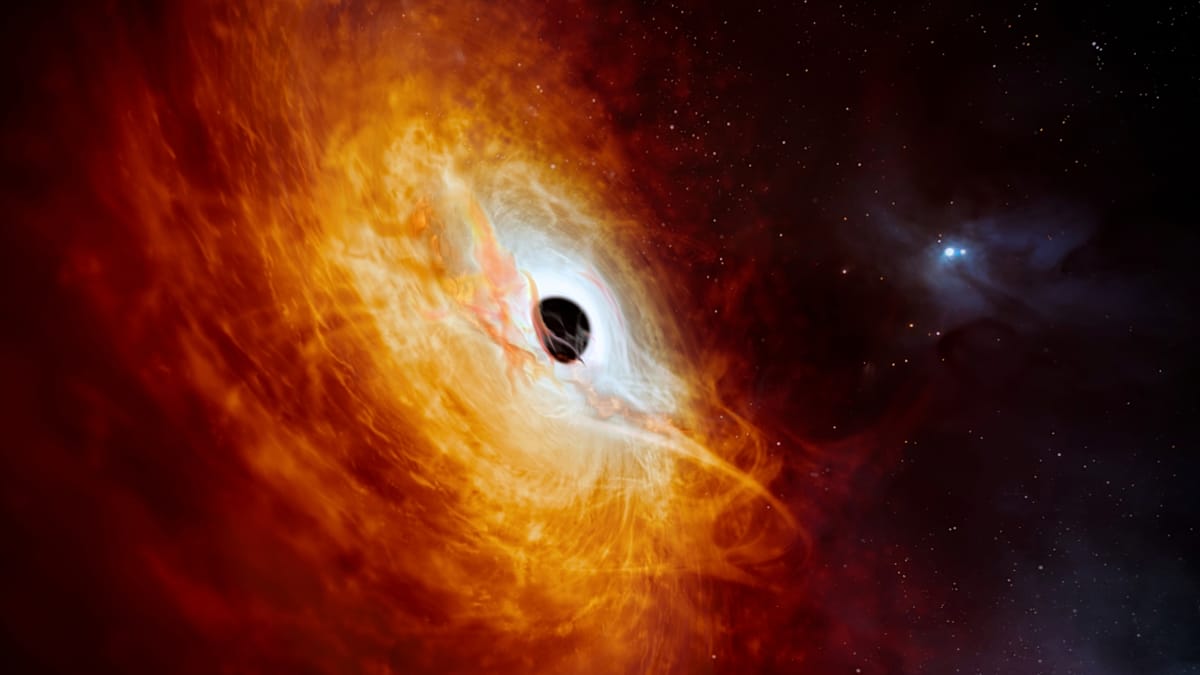
Astronomers have identified the most distant quasar ever observed, a brilliant galactic core powered by a supermassive black hole that existed just 630 million years after the Big Bang. The find, reported by a German-led team, pushes the cosmic frontier back by nearly 40 million years — the largest single leap in such records in almost a decade.
Quasars are among the most luminous objects in the universe, outshining entire galaxies. This one, nicknamed Dun Aonghasa after a prehistoric stone fort on Ireland's Aran Islands, is seen as it was 13.1 billion years ago, when the cosmos was less than 5% of its current age.
“This time the leap in cosmic time is huge!” said Julien Wolf, an astronomer at the European Southern Observatory (ESO) who led the study. “The previous two records each took us back by about 15 million years or less. This one takes us back by nearly 40 million years, the biggest advance in nearly a decade!”
Wolf and his colleagues sifted through millions of observations from the European Space Agency's Euclid telescope, launched in 2023 to map galaxies and probe the dark matter and dark energy that dominate the universe. The quasar's extreme distance and brightness made it stand out in the survey data.
A slow-eating giant
What makes Dun Aonghasa particularly puzzling is the size of its central black hole. Follow-up observations with the Hubble and James Webb space telescopes, as well as ground-based observatories, revealed that the black hole has a mass equivalent to 360 million suns — an astonishing figure for such an early epoch.
“Finding a quasar so early in the universe is rare,” Wolf said. “But this one is even rarer because of its massive black hole, despite being a relatively slow eater of everything around it.”
The black hole's growth rate appears to be modest, yet it still reached a colossal size within a few hundred million years of the universe's birth. This challenges current models of how supermassive black holes form and grow in the early cosmos.
“Dun Aonghasa gives us a new deadline for the early universe,” Wolf added. “About 630 million years after the Big Bang, its black hole had already grown to about 360 million times the mass of the sun. But how?”
The findings, published in the journal Astronomy & Astrophysics, were corroborated by the Hubble and Webb space telescopes as well as other observatories on Earth and in space. The team continues to scour the cosmic dawn for more such objects.
Wolf, whose wife and daughter are Irish, chose the name after visiting the ancient fort on the Aran Islands. “It felt like a frontier holding the promise of a vast horizon still to explore,” he said, drawing a parallel to the quasar's role in expanding our view of the early universe.
The discovery adds to a growing list of record-breaking finds from European-led missions. It also underscores the importance of international collaboration in astronomy, with contributions from the ESO, ESA, and NASA.
As the search continues, each new quasar helps refine our understanding of how the first galaxies and black holes formed — and how the universe evolved from a hot, dense state to the structured cosmos we see today.