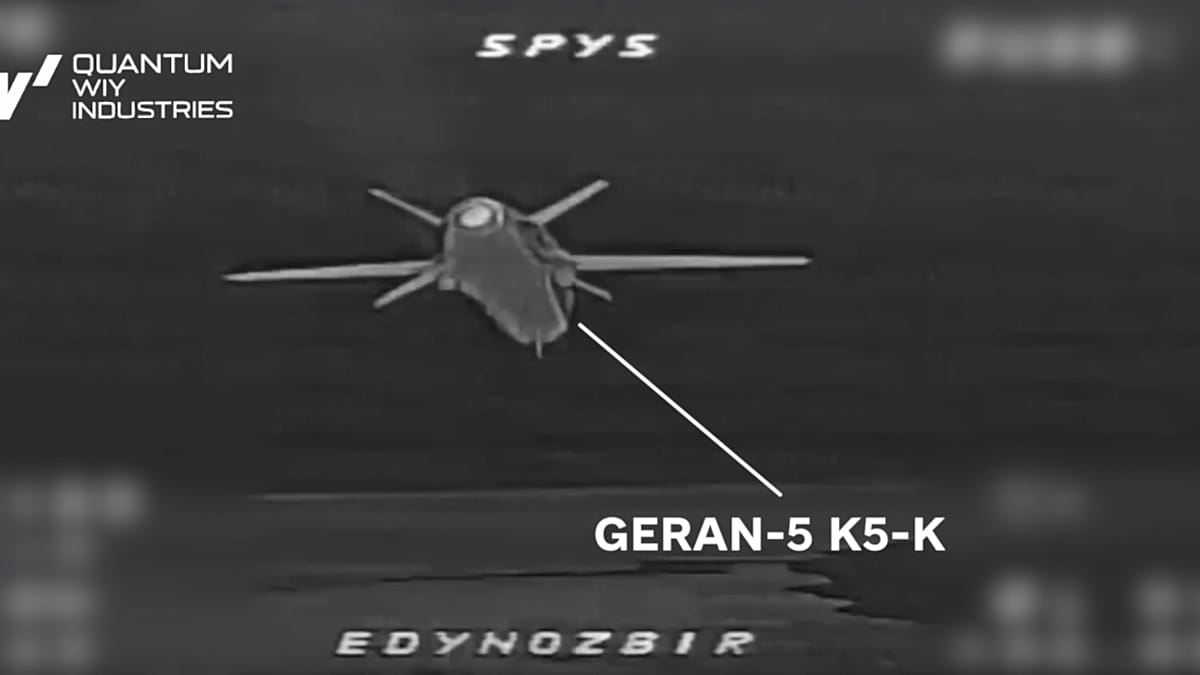
A German-Ukrainian defense venture announced on Monday that its SPYS interceptor drone successfully shot down a Russian jet-powered attack drone during combat trials in Ukraine. The interception marks a notable step in the ongoing effort to counter Moscow's evolving aerial threats.
Quantum Systems, a German defense firm based in Gilching, Bavaria, and Ukraine's WIY Drones jointly run the venture behind the SPYS system. In a press release, the companies said the interceptor had downed a Russian Geran-5 K5-K drone—a jet-powered variant of the widely used Geran-5 loitering munition.
Adapting to a shifting threat
Sven Kruck, co-CEO of Quantum Systems, stressed the need for continuous innovation. "We need to keep developing and scaling interceptors to protect Ukrainian cities and critical infrastructure. Russia keeps adapting its attack systems, so we work closely with Ukrainian brigades to adjust our systems accordingly," he said. "You can never stand still."
The SPYS interceptor is designed to engage both attack and reconnaissance drones, shielding military positions, mobile units, and critical infrastructure. According to WIY Drones, the system can reach speeds of up to roughly 450 kilometers per hour and operate at altitudes up to 4 kilometers.
Ukraine's military intelligence agency, the GUR, reported in early November that Russian forces had begun deploying the K5-K variant in strikes on Ukrainian cities from the start of autumn. The GUR noted that, based on its aerodynamic design and tactical-technical characteristics, the K5-K "can already be classified as a compact cruise missile." It can exceed 450 km/h and fly at up to 6 kilometers in altitude.
The successful interception comes as Russia intensifies its aerial campaign against Ukrainian urban centers. Recent weeks have seen deadly strikes on the Kyiv region and other areas, underscoring the urgent need for effective counter-drone systems.
Quantum Systems and WIY Drones have been collaborating since 2023, with the German company supplying reconnaissance drones to Ukraine and the Ukrainian firm contributing combat experience. The SPYS system is part of a broader push to develop affordable, high-speed interceptors that can be deployed quickly near the front lines.
The announcement also highlights the growing role of European defense cooperation in Ukraine. Germany has been a key supplier of military aid, including air-defense systems and drones. The joint venture reflects a model where Western technology meets frontline feedback to produce rapidly iterated solutions.
Analysts note that the K5-K's jet propulsion makes it faster and harder to intercept than propeller-driven drones, posing a new challenge for Ukrainian air defenses. The GUR's classification of the variant as a compact cruise missile suggests it may be used for precision strikes on high-value targets.
While the SPYS interception is a single event, it demonstrates the potential of drone-on-drone combat in modern warfare. As Russia continues to adapt its tactics, Ukrainian forces and their international partners are racing to field countermeasures that can keep pace.
The development also carries broader European security implications. With EU sanctions targeting Russian military capabilities and incidents in the Baltic region heightening tensions, the ability to counter Russian drones is seen as vital for the continent's defense posture.
Quantum Systems has not disclosed further details about the interception, such as the exact location or date, but said more tests are planned. The company is also exploring ways to scale production of the SPYS system to meet demand from Ukrainian brigades.