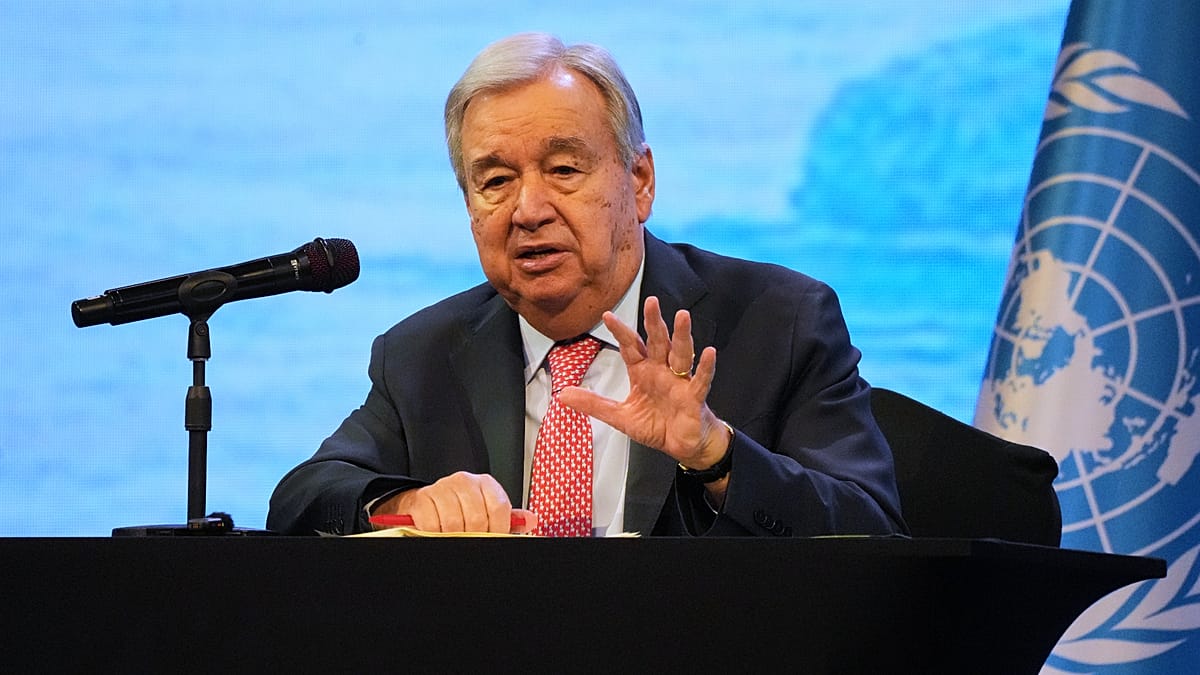
UN Secretary-General António Guterres has issued a stark appeal to the world's governments: within the next twelve months, they must agree on a common set of rules to govern artificial intelligence. Speaking at the Bridgetown Special Summit on AI Safety in Barbados, he warned that without coordinated action, humanity risks losing control over a technology that is reshaping economies, societies, and security.
“Today I call for member states to coordinate efforts and to develop within the next year a globally inclusive and principles-based multilateral framework for AI risk management, backed by independent and credible oversight,” Guterres said. His remarks come as his tenure at the UN draws to a close, and he has increasingly used his platform to push for guardrails on AI, even evoking the spectre of “killer robots” if the technology is left unchecked.
An outdated global architecture
Guterres argued that the institutions of global governance, including the UN itself, were designed for a world that no longer exists. “When one looks at different other institutions of global governance ... they correspond to the reality of the world in 1945,” he said in response to a question from AFP. “It's clear that institutions need to be reformed in order to adapt themselves to the realities of today's world. That applies to the UN, and that applies to the international financial architecture, that applies to the world trade system.”
His call for reform resonates strongly in Europe, where policymakers in Brussels, Berlin, and Paris are already wrestling with the challenge of regulating AI. The EU's landmark AI Act, which entered into force last year, is often cited as a global benchmark, but its implementation remains uneven across the 27 member states. Meanwhile, the UK, Switzerland, and Norway—though outside the EU—are developing their own approaches, creating a patchwork of rules that could complicate cross-border innovation.
Guterres suggested that a starting point could be for countries to agree on shared safety measures, a common testing regime, and basic requirements for independent oversight. Such measures, he argued, would provide a foundation for more comprehensive governance later.
Diverging views among tech leaders
The urgency of Guterres's appeal is underscored by the deep divisions among the technology industry's most influential figures. In September, the CEOs of Anthropic, OpenAI, and SpaceX—Dario Amodei, Sam Altman, and Elon Musk—publicly called for a slowdown in AI development, citing existential risks. In contrast, Nvidia's Jensen Huang and Meta's Mark Zuckerberg have pushed for rapid advancement, arguing that the benefits outweigh the dangers.
These conflicting positions reflect a broader geopolitical reality: the United States and China, the two dominant AI powers, are locked in a race for technological supremacy, and neither seems willing to accept binding international constraints. In Washington, regulators have shown little appetite for intervention. In September, President Donald Trump hosted a group of American tech executives who agreed only to a voluntary code of conduct on AI safety—a move that critics say falls far short of what is needed.
For Europe, the stakes are particularly high. European companies and research institutions are leaders in AI ethics and safety, but they risk being squeezed between the American and Chinese giants. As Meta's AI chief has warned, handing society over to machines without adequate safeguards would be a catastrophic mistake. European leaders have echoed that sentiment, with French President Emmanuel Macron calling for a more assertive European role in shaping global AI norms.
Guterres's proposal for a UN-led framework faces formidable obstacles. The UN's decision-making processes are slow and consensus-driven, and the Security Council's permanent members—including the US and China—hold veto power. Yet the secretary-general insisted that the alternative is unacceptable. “We need to ensure that humanity retains control over the technology,” he said, “not the other way around.”
The coming year will test whether the international community can translate rhetoric into action. For Europe, which has positioned itself as a standard-setter in digital regulation, the challenge is to bridge the gap between its own ambitions and the realities of global power politics. As NATO's policy chief has noted, the security implications of AI are already being felt, from cyberattacks to disinformation campaigns. A failure to act now could leave the world—and Europe in particular—vulnerable to the very risks Guterres warns about.