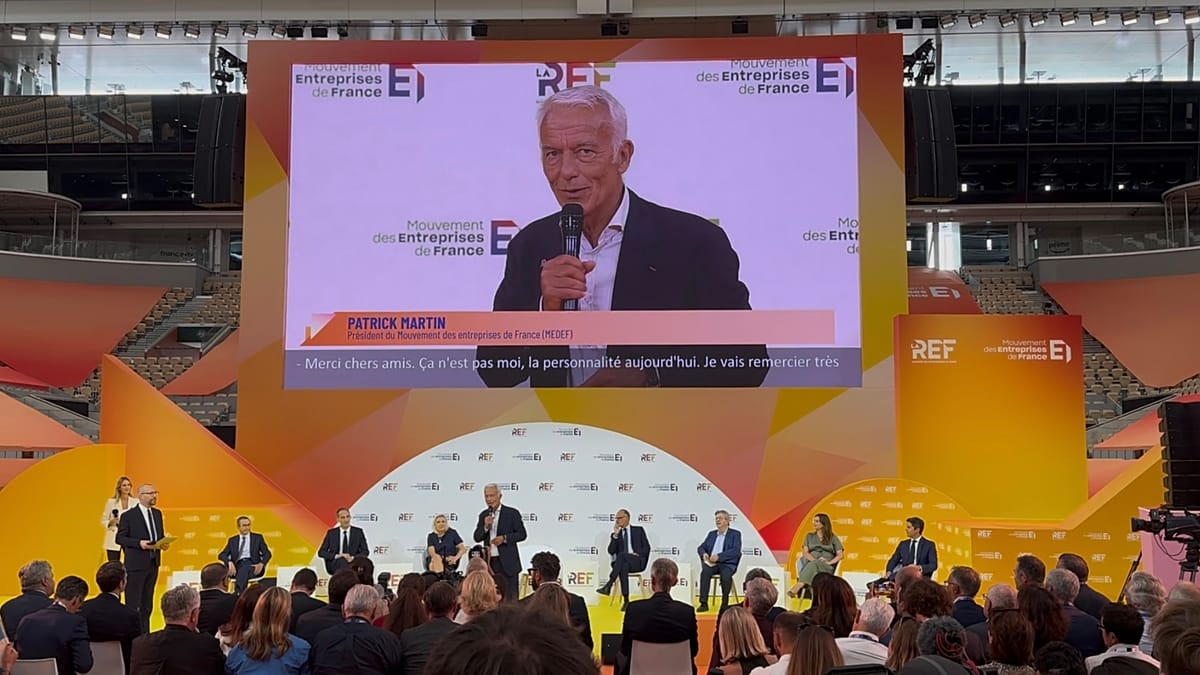
Seven leading candidates in France's presidential election squared off on Thursday in a debate hosted by MEDEF, the country's largest employer federation, at the Roland-Garros stadium in Paris. With less than eight months until the vote, the economy, public debt, and pension reform dominated the exchanges, offering a preview of the campaign's central battlegrounds.
The field included two former prime ministers under Emmanuel Macron: centrist Gabriel Attal and centre-right Édouard Philippe. They were joined by hard-left leader Jean-Luc Mélenchon, far-right figure Marine Le Pen, centre-left MEP Raphaël Glucksmann, conservative Bruno Retailleau, and Green party leader Marine Tondelier. The setting—a tennis venue—was fitting for a contest where candidates traded sharp blows over fiscal policy and France's role in Europe.
Europe at the heart of the clash
On Europe, the candidates offered starkly different visions. Mélenchon was the most confrontational, declaring he would "disobey anything coming from Europe that conflicts with the interests of the French people." He argued that the EU's foundational treaty must be amended, warning that otherwise "we will perish politically, socially, and industrially, since we are not in a position to resist."
Le Pen took a different tack, telling business leaders she would cut France's contribution to the EU budget by €5 billion from the current €29 billion planned for 2026. She also pledged to scrap thousands of European norms, saying, "Every time the European Union sets a minimum norm, we go above and beyond—we want to be the top student in the class."
Philippe focused on external competition, arguing that China's advantage was hurting French industry. He proposed quotas requiring Chinese companies to produce a share of goods on French soil and called on European partners to "speak the language of power to China and the United States." He also noted that neighbours like Germany, Italy, and Spain were compensating for France's lack of competitiveness.
Glucksmann pushed back, saying, "I've never met any French entrepreneurs who've told me that the main threat comes from German or Dutch competition. Everywhere you look, people are talking about China. The main challenge for the next president of the Republic is to bang his fist on the table in Brussels." He also accused Le Pen of harbouring an "anti-Europe ideology."
Debt and deficit: divergent prescriptions
All candidates acknowledged France's precarious fiscal position—one of the highest budget deficits in the eurozone—but their remedies diverged sharply. Philippe labelled Mélenchon's proposal to cancel a large portion of the public debt as "dangerous." Mélenchon had renewed his call for the central bank to write off its holdings of French government debt, a stance that drew immediate criticism.
Attal mocked the idea, asking, "You're proposing to cancel out debt, but you still want to keep raising taxes—is that pure sadism?" Mélenchon countered that his critics were "caricaturing" his plans, insisting there was room for "manoeuvre." He also warned business leaders that failing to raise wages would trigger a recession, adding, "That is your responsibility."
Le Pen promised a €125 billion cost-cutting plan to tackle the debt, to be presented "before the budget debate" once the draft finance bill is tabled. The debate underscored how deeply the candidates differ on the role of the state and the pace of fiscal consolidation.
Pension reform remains a flashpoint
The contentious issue of pension reform also divided the room. Macron's plan to raise the retirement age from 62 to 64 had sparked mass protests and a political backlash, leading the National Assembly to suspend the reform until January 2028—meaning the next president will inherit the issue.
Tondelier firmly opposed raising the retirement age, while Mélenchon defended retirement "initially at age 62" and then, "as soon as possible," at 60. Le Pen backed reverting to 62 for most people, with 60 for those who started working at 20 or younger. Retailleau said he would detail his plan in the coming days, suggesting the retirement age should be tied to "life expectancy" and noting that France works three weeks less per year than many European neighbours. Philippe argued that France must "do what all the other countries in Europe, whether right-wing or left-wing, have agreed to do: work longer."
The debate came a day after MEDEF leader Patrick Martin called for breaking the "straitjacket" that is "suffocating" France, criticising the government's "heavy-handed control" and "obsession with micromanagement." With the election approaching, the candidates' economic visions will likely remain a central focus, as voters weigh competing promises on debt, pensions, and Europe.