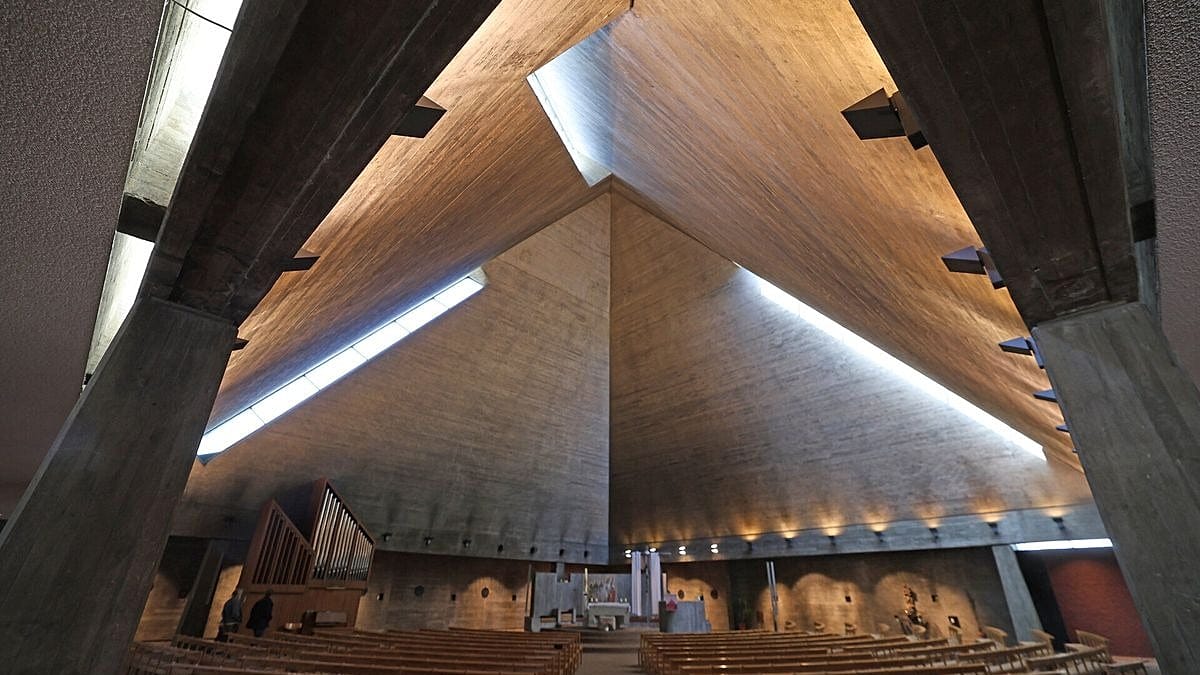
In the Sanderau district of Würzburg, the parish church of St Andrew stands as a monument to post-war modernism. Consecrated in 1968, its concrete form has long been a fixture of the neighbourhood. But later this decade, its interior will undergo a transformation: where pews once held worshippers, climbing walls will soon challenge boulderers. The project, announced in April 2026 by the Diocese of Würzburg and the operators of the “Rock Inn” bouldering centre, will also include a yoga room, a café, and a children’s area. If all goes to plan, St Andrew will become Bavaria’s first “climbing church” when it opens in summer 2027.
The decision to repurpose the church reflects a broader dilemma across Germany. The country is home to an estimated 44,000 to 45,000 church buildings, many of which define the character of villages, towns, and cityscapes. Yet as congregations shrink and maintenance costs rise, the question of how to preserve these structures grows more urgent. For St Andrew, the answer came after years of struggle. Father Tobias Fuchs, who oversees the parish alongside neighbouring St Adalbero, explained that the burden had become unsustainable. “We simply can’t manage any more,” he said, citing the loss of a volunteer caretaker due to age and mounting expenses.
A National Trend of Repurposing
St Andrew is far from alone. The Diocese of Würzburg has internally designated nearly 80 of its churches with the code “E”, indicating that they are earmarked for long-term alternative use. Financial director Gerald Düchs stressed that each case is handled individually, with parish involvement, to minimise the pain for local communities. The diocese already has experience with such conversions: in the 1970s, churches in Erbshausen were turned into flats, in Mespelbrunn into a parish centre, and in Hausen near Aschaffenburg into an artist’s studio. In Würzburg itself, the historic Spitäle now serves as an art gallery, and the Neubaukirche of the Old University functions as a banqueting hall.
Nationwide, the pressure is mounting. According to the German Bishops’ Conference, liturgical use has been completely discontinued in 611 Catholic churches since the year 2000. Of those, only 201 were sold out of church ownership. Many others remain in church hands but are used for social facilities, care homes, housing, or archives. The trend is not limited to Catholicism; Protestant churches face similar challenges across the country.
The Church does not have free rein over what comes next. The Diocese of Würzburg requires that any new use be compatible with Christian values. Markus Hauck from the Episcopal Ordinariate explained that cultic use by non-Christian religious communities is excluded “out of consideration for the religious feelings of Catholic believers.” This follows guidelines from the German Bishops’ Conference, which states that demolition should be a last resort. Conversions should, where possible, be reversible, so that future generations could theoretically return the spaces to sacred use. Liturgical signs and objects may not be used decoratively in commercial concepts.
For St Andrew, architect Roland Breuning of the Archicult office is designing a restrained intervention. The bouldering walls will be placed on an inserted gallery, allowing the original structure to remain largely untouched. “Overall, the aim is to treat the existing rooms as gently as possible and to design any new structures so that they can be removed,” Breuning said in the press release.
Before any climbing begins, the church must be officially profaned—deconsecrated under canon law. Bishop Franz Jung will seek advice from the Council of Priests and the General Episcopal Council, and the diocesan art commission will issue an opinion. The profanation will be carried out at the end of a final solemn Mass by a member of the cathedral chapter. “This Mass ends with the clearing of the church interior and the presentation of the profanation certificate,” Hauck explained. If all parties consent, this step could take place in summer 2026. The German Bishops’ Conference has its own liturgical rite for the occasion, designed to express gratitude and look toward the future.
St Andrew belongs to a particularly vulnerable category: churches built between 1950 and 1970. These post-war structures often lack the historical cachet of older buildings and face high maintenance costs. The church was listed as a historic monument in February 2026, ruling out demolition. For many parishioners, that at least ensures the striking building will survive, even if its purpose changes.
The transformation of St Andrew is a microcosm of a continent-wide conversation about the role of religious spaces in secularising societies. Across Europe, from the UK to the Balkans, churches are being reimagined as libraries, concert halls, and even climbing centres. In Germany, where the number of churchgoers continues to decline, the trend is accelerating. The challenge is to balance preservation with practicality, and to honour the past while embracing the future.