At the Computex technology conference in Taipei, the show floor buzzed with innovations that extended well beyond Nvidia's headline-grabbing announcements. From AI-driven robot baristas to military drones, the event offered a glimpse into technologies that could reshape daily life and security across Europe and beyond.
Robot Barista and Surgical Assistants
Intel showcased a robot barista named Ella, powered by its Series 3 processor. The company claims this is the first multi-agent physical AI store: three AI agents handle customer conversation, system operations, and store-level intelligence, all on a single Intel system-on-chip. While robotic coffee makers are not new, the integration of multiple AI agents marks a step toward autonomous retail environments.
Taiwanese manufacturing giant Foxconn presented robots that go beyond simple button-pushing. One model can drill with one hand while loading and unloading objects with the other, and is already deployed in Foxconn's own factories. For healthcare, Foxconn introduced Scrub Nurse, a robot that works alongside surgeons in operating rooms, handing them tools in response to voice commands. The company frames this as a reimagining of human-robot collaboration.
These developments resonate with European trends: Croatia recently launched Europe's first commercial robotaxi service in Zagreb, and Amazon is investing €10 billion in Europe, adding 25,000 jobs and warehouse robots. The continent is clearly embracing automation in both service and industrial sectors.
Defence Technology on Display
Given Taiwan's proximity to China—roughly 180 km—and Beijing's insistence on eventual reunification, it was no surprise that defence technology featured prominently. Rayvatek, a Taiwanese company, displayed unmanned surface vehicles (USVs) and unmanned aerial vehicles (UAVs) equipped with Nvidia chips and AI capabilities. Taiwan's National Chung-Shan Institute of Science and Technology (NCSIST) also presented three AI-enabled military robot dogs capable of autonomous patrols and remote-controlled firepower.
These systems highlight the island's focus on asymmetric defence, a strategy that European nations are also exploring. The European Union has been debating the role of autonomous systems in security, and the technologies shown at Computex could inform those discussions.
AI Translation Earbuds and Creative Cases
Transbuds, a company with operations in both China and Taiwan, demonstrated translation earbuds that link a translation app to a coding app, enabling live translations that can mimic the user's voice in another language. The product is not yet available in Europe or the United States due to regulatory hurdles, but the company is working to refine the technology for tasks such as AI agents making restaurant bookings without human assistance.
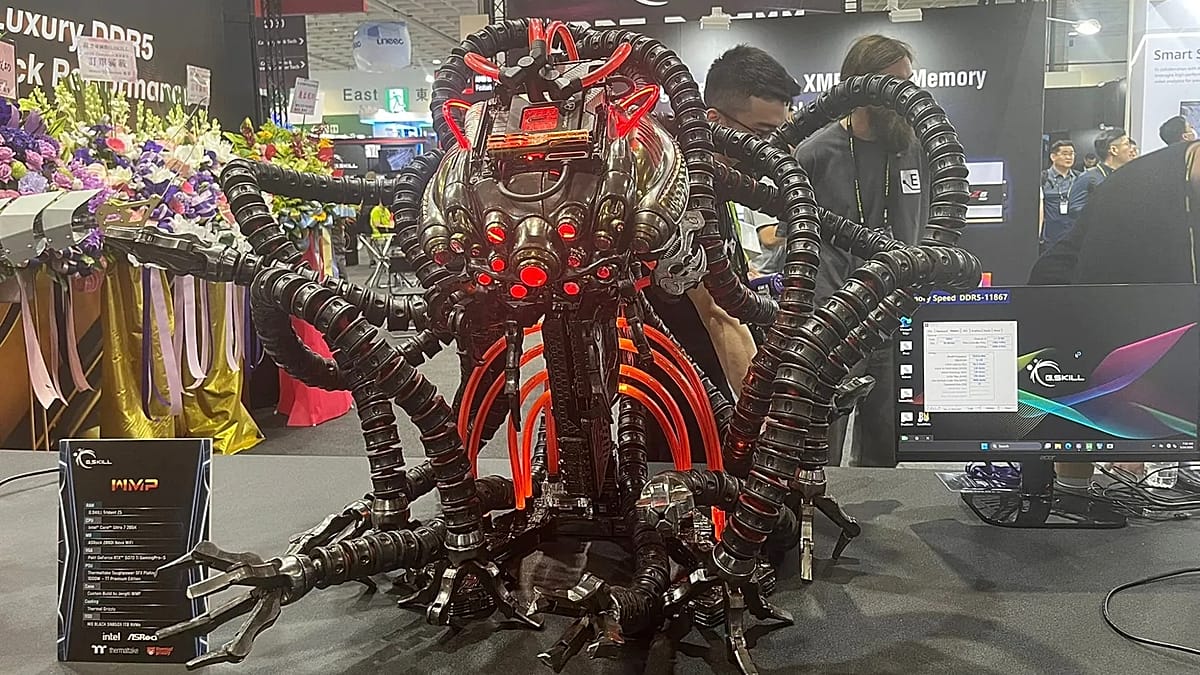
On the lighter side, the annual tradition of creative computer cases continued with designs ranging from large moving sharks to steam-blowing spaceships. Hong Kong-based Chessnut offered an electronic chess set where pieces move on their own, powered by an AI application that tracks moves and allows users to play against the computer.
For European readers, the convergence of AI, robotics, and defence at Computex underscores the global race for technological leadership. As Asus unveiled its AI City blueprint and Nvidia-powered laptops at the same event, it is clear that the innovations from Taipei will have ripple effects across the continent, from automated factories in Germany to drone surveillance in the Baltic states.