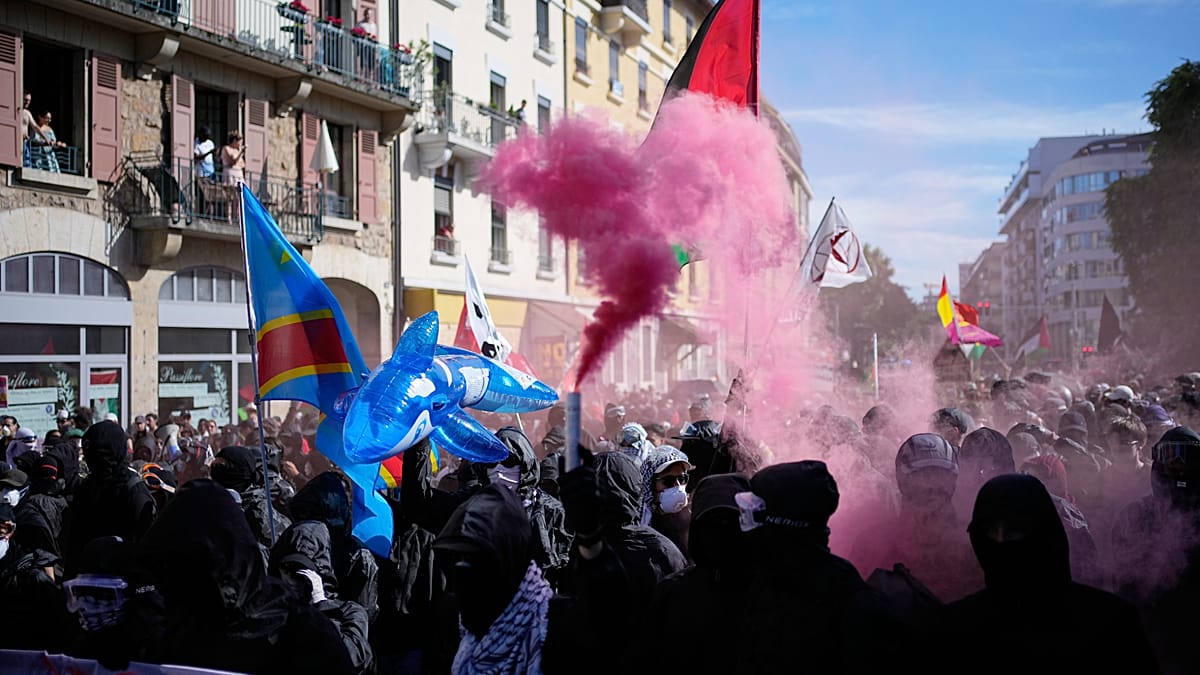
On Sunday, an estimated 20,000 people gathered in Geneva, Switzerland, to protest the G7 summit of wealthy nations, which opens Monday in the French resort town of Évian-les-Bains. The demonstration, organized by a coalition of environmentalists, feminists, anti-imperialist groups, independent media advocates, and Palestinian rights supporters, turned violent in the afternoon near the United Nations headquarters.
Geneva police spokesman Alexandre Brahier confirmed that around 600 so-called “Black Bloc” militants were among the crowd. Protesters threw bottles, stones, pieces of cement, and firecrackers at officers, who responded with tear gas and water cannons. A car was set ablaze, and a bank’s windows were smashed, according to local media reports. The standoff extended into the evening.
Security Preparations Across the Border
French and Swiss authorities have deployed thousands of police to secure the three-day summit. France alone will mobilize more than 13,000 police and gendarmerie officers, with over 800 border control agents—up from the usual 60—stationed at crossings. Roads have been blocked, unauthorized gatherings banned, and financial support pledged for businesses that may suffer from unrest.
In Évian-les-Bains, many shops have boarded up their windows with wooden panels. Resident Robin Hedz expressed frustration, calling the situation a “mess” and noting the “wood-wall everywhere,” while recalling the property damage that marred the 2003 G8 summit in the same region.
The summit is the first major international gathering since the United States and Israel launched military operations against Iran on February 28. Leaders are expected to discuss the Middle East, Ukraine, and global economic imbalances. Most will fly into Geneva Airport before traveling to Évian.
For more context on the summit’s agenda, see our related coverage: G7 in Évian: Iran deal, AI summit, and Trump's delayed arrival set the stage.
The protests in Geneva echo broader European discontent with global governance structures. Similar demonstrations have occurred across the continent, including mass protests in Brussels over alleged police brutality and surges in Paris following the murder of an 11-year-old.
As the G7 convenes, the juxtaposition of elite diplomacy and grassroots opposition underscores the tensions within European societies over issues of inequality, climate action, and foreign policy. The coming days will test whether the summit’s outcomes can address the grievances voiced on the streets of Geneva.