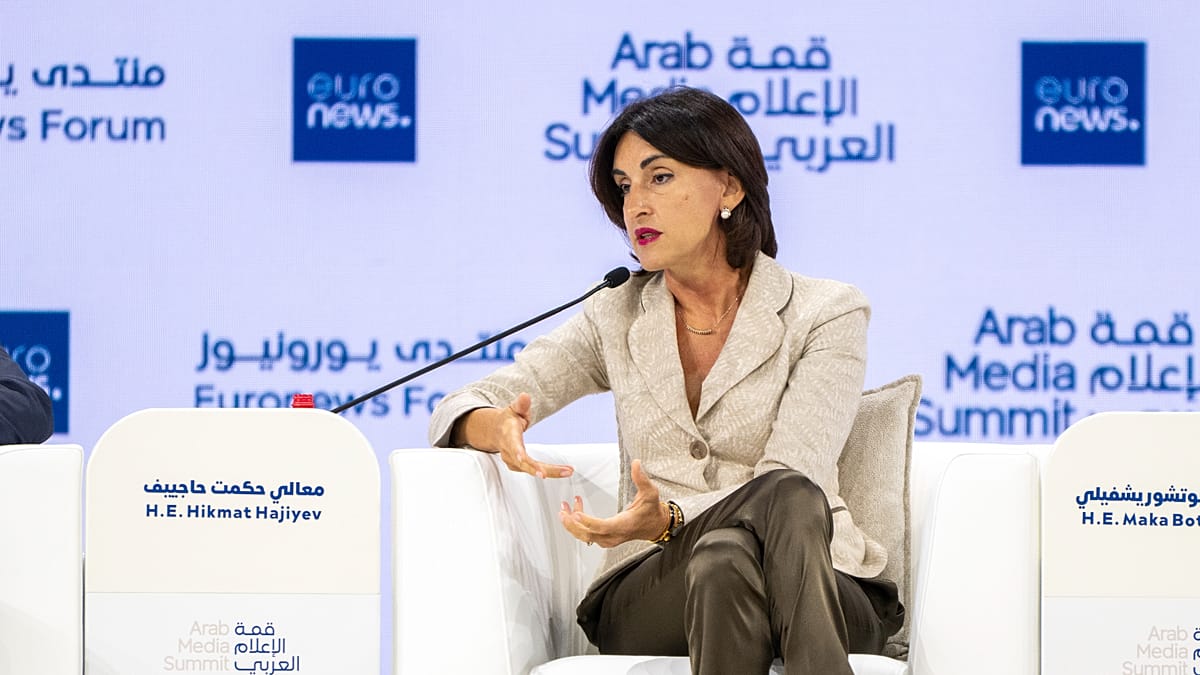
Georgia's top diplomat has reignited the debate over EU enlargement, telling Euronews that Brussels needs Tbilisi as much as Georgia needs the Union. In a panel at the Arab Media Summit in Dubai, Foreign Minister Maka Botchorishvili said the bloc's commitment to expansion, particularly in the South Caucasus, remains an open question.
“It is a big question to our European partners if they are serious about enlargement, especially in the South Caucasus and Georgia,” Botchorishvili said. She argued that Europe lacks experience in the region, adding: “We both need to learn, we both need to exchange, and for that we need very intensive dialogue and working together.”
The minister, who also serves as vice premier, repeated her government's long-standing demand that Brussels treat Tbilisi with respect. While Georgia is ready to discuss accession, she said, “we expect that European partners will also realise it is important to have intensive dialogue and mutual respect with partners, which are very important for our common security and prosperity.”
Relations between Tbilisi and Brussels have soured sharply in recent years. The EU has accused Georgia's government of democratic backsliding and drifting toward Moscow, while Tbilisi insists it remains committed to its European path—but on its own terms. The accession process has effectively stalled, with Brussels freezing funds and high-level contacts.
A delicate balance
Botchorishvili acknowledged the tension, describing Georgia's position as “a very delicate issue” shaped by both geopolitical and historical factors. “European aspirations and identity are very deeply rooted in Georgia's history and identity,” she said, but added that the same values that drive that aspiration also define Georgian identity, making the issue sensitive.
She framed Tbilisi's approach as a balancing act between regional and international priorities. When pressed on accusations that Georgia is pro-Russian, particularly given that Russian troops remain in the breakaway regions of Abkhazia and South Ossetia, the foreign minister acknowledged the security threat but chose to focus on opportunities.
“There are plenty of opportunities if you focus on preserving peace and stability, preserving economic development, and that's what we are doing today,” she said. She dismissed what she called “false narratives” about Georgia, pointing to the country's economic performance: “Georgia has best economic growth in the region, in Europe, it's around 8%, which is impressive and is the best answer to all the false narratives.”
That growth, she argued, makes Georgia indispensable to European interests. “The South Caucasus is important for Europe's security and prosperity, and Georgia is the important place where not only energy passes through, but many other things which are important for European security from different perspectives.”
Georgia's role as a transit hub has grown as global supply chains shift. Botchorishvili highlighted the Middle Corridor, the trade route linking Asia and Europe via the Caucasus and the Black Sea, as a key element of European connectivity. “It is not just a physical corridor, but it represents everything meeting together and from a European perspective, it is important for European security and prosperity.”
The minister also blamed a “massive disinformation campaign against Georgia” on its geopolitical significance, saying “some actors” have exploited the issue “for different political purposes or reasons.”
The comments come as the EU's enlargement policy faces broader questions, from the Western Balkans to Ukraine. Von der Leyen's recent EU address touched on these themes, but concrete progress remains slow. For Georgia, the path to membership appears as uncertain as ever, with Tbilisi and Brussels locked in a standoff over democratic standards and foreign policy direction.