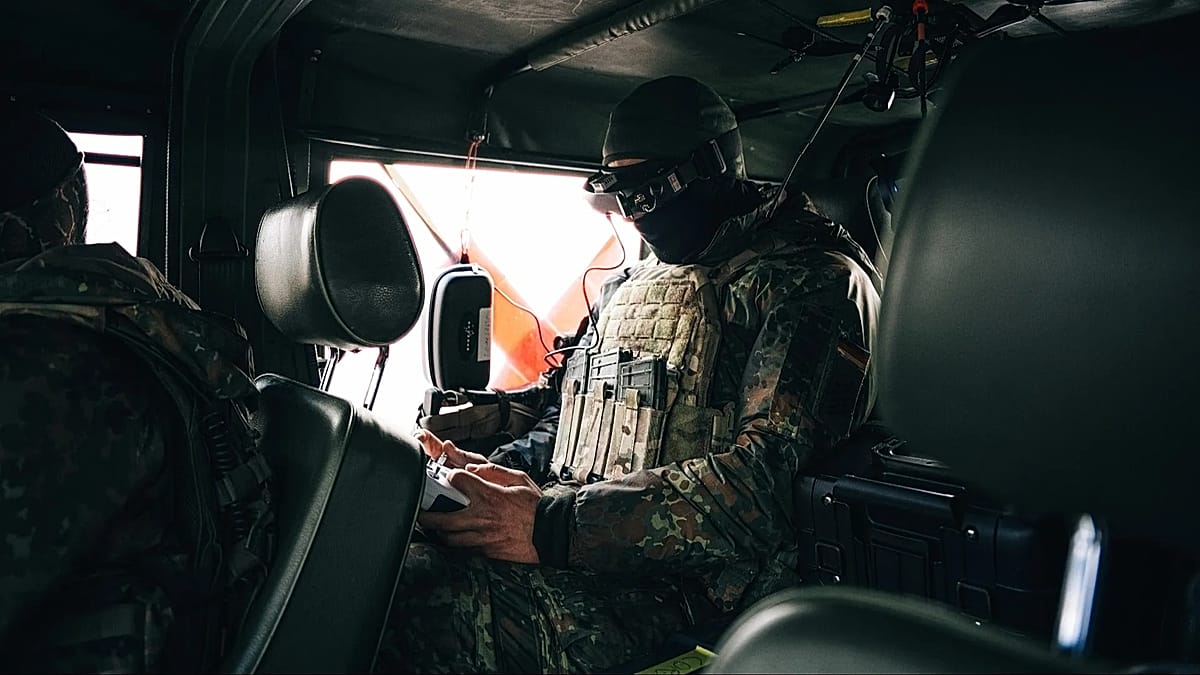
At a training ground in Seedorf, Lower Saxony, a fundamental shift in military doctrine is being tested. During last month's multinational Grand Quadriga 2026 exercise, soldiers from the Bundeswehr were not merely operating drones—they were building them from commercially available parts and 3D-printed components. This hands-on development, conducted alongside the army's Cyber Innovation Hub (CIHBw), represents a deliberate move to decentralise innovation and accelerate the German military's adaptation to a new era of warfare.
From User to Co-Developer
The programme, known internally as 'Spark Cells', establishes small, agile innovation units directly within army formations. Soldiers from units like Airborne Engineer Company 270 and Paratrooper Regiment 31 worked on assembling first-person view (FPV) drone prototypes, testing them in simulators and real-world conditions, and refining designs based on immediate tactical feedback. The goal is to enable troops to independently adapt, repair, and even create systems tailored to specific battlefield problems.
"What we are seeing is a move away from the soldier as a pure user towards an active designer," a spokesperson for the CIHBw told European Pulse. "That's a decisive factor for an adaptive and resilient armed force." The underlying philosophy is one of urgency: "The future doesn't wait for authorisation. If there is a concrete problem in the field, the fastest way to find a solution is often the most direct one. Soldiers know their requirements best."
Founded in 2017 and formally established as the Bundeswehr's innovation unit in 2020, the CIHBw acts as a bridge between frontline troops, technology startups, and established defence contractors. Its model bypasses traditional, lengthy procurement cycles by rapidly prototyping with the soldiers who will ultimately use the technology. Organisationally, it reports to the Federal Ministry of Defence in Berlin.
Data as the New Ammunition
The tactical experiment in Seedorf reflects a strategic recognition forged on the battlefields of Ukraine. The conflict has starkly demonstrated the centrality of unmanned systems and real-time data to modern combat. Ukrainian forces have reported capturing Russian positions using only drones and ground-based robots, a tactic that would have been unthinkable a decade ago.
In an interview, Bundeswehr Army Chief of Staff Lieutenant General Dr Christian Freuding framed data as a critical combat resource. "Those who can see more, and process information faster and more effectively, can build a clearer picture of the battlefield, make decisions more quickly and act with greater precision," Freuding stated. "In short: they win." He explicitly called data "a form of ammunition."
The CIHBw spokesperson echoed this, noting drones are no longer a mere supplement but a "structurally defining element of modern warfare." This transformation affects reconnaissance, strike capabilities, and the entire decision-making cycle. "Those who control airspace at a tactical level gain speed, transparency and precision at a strategic scale," the spokesperson added.
This evolution in warfare necessitates a parallel evolution in the soldier's skill set. The Bundeswehr now emphasises that technological literacy, improvisation, and networked thinking are as vital as traditional martial skills. The modern soldier, the logic goes, must be a co-developer, capable of questioning and refining the tools of war. This cultural shift is as significant as the technological one.
"Technological literacy, improvisation and networked thinking are now as vital as traditional skills."
— CIHBw spokesperson
A Hybrid Model for Defence Innovation
The German military is careful to position this grassroots innovation not as a replacement for the defence industry, but as a crucial complement. The aim is a "hybrid model" that combines centrally procured, large-scale systems with decentralised adaptation and small-scale development within the ranks. This approach is designed to reduce dependencies, increase flexibility, and inject "speed and operational relevance" into the acquisition process.
According to the CIHBw, the key question is no longer whether soldiers should develop their own solutions, but how to organise this capability effectively. The Spark Cells are designed to ensure innovation flows both from the top down and from within the ranks, identifying needs early and feeding successful field-tested approaches back into the broader military system.
This German initiative arrives amid a wider European reckoning with defence technology. The war in Ukraine has accelerated investment in unmanned systems across the continent, from the Baltic states to Poland. Meanwhile, adversaries are leveraging new technologies in sophisticated ways, such as the use of AI-generated deepfakes to target soldier morale. The Bundeswehr's experiment represents one national response to this rapidly changing threat landscape, seeking to build institutional agility from the ground up.
The exercise in Seedorf is more than a technical demonstration; it is a test of a new military culture. By empowering soldiers as developers, the Bundeswehr is betting that adaptability and speed of innovation will be decisive advantages in future conflicts. As Europe continues to grapple with security challenges, from supporting Ukraine to bolstering its own defences, this German model of soldier-led innovation may offer a template for others on the continent.



