Berlin has stepped in to urge Croatia to resolve its bilateral disputes with Montenegro, warning that unresolved grievances could derail the EU accession of the bloc's most advanced candidate, according to four officials with direct knowledge of the matter.
Earlier this week, Zagreb circulated an eight-point list of demands it wants settled before Podgorica can finalise its membership bid. Behind the scenes, German officials have been working to ensure that enlargement does not lose momentum, with Chancellor Friedrich Merz's government positioning itself as an honest broker.
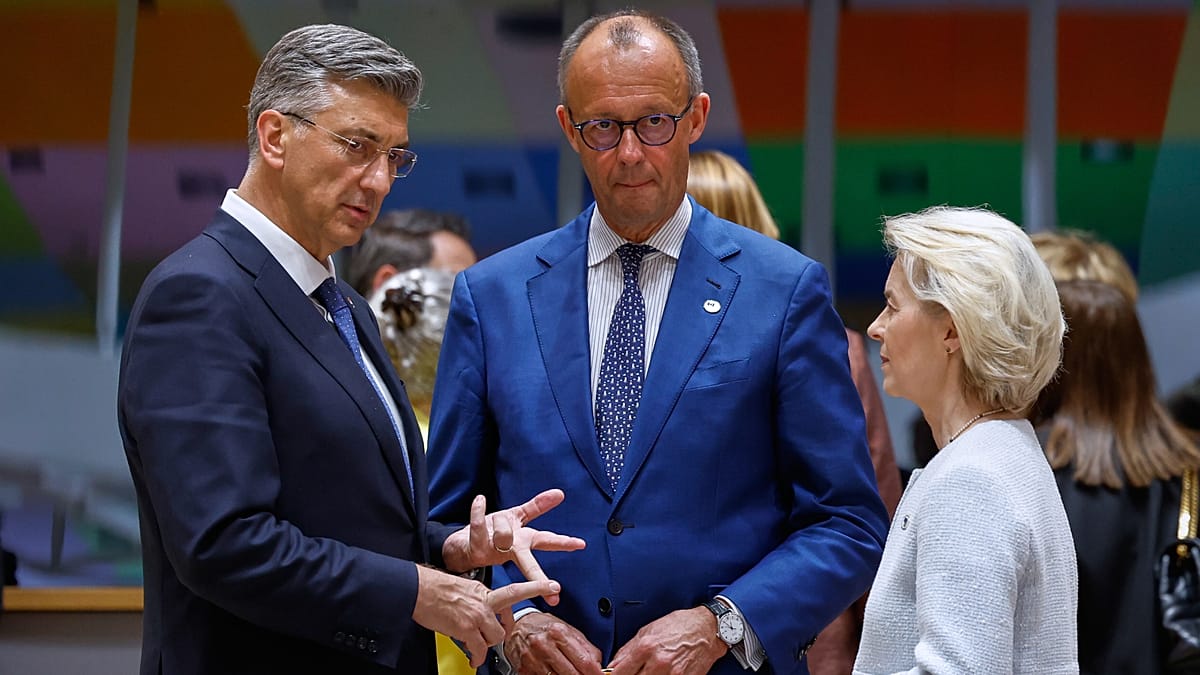
“There are issues which we have signalled to our Montenegrin neighbours for years,” Croatian Prime Minister Andrej Plenković told reporters ahead of the European Council summit in Brussels on Thursday. “In the last two years, there has been no progress whatsoever,” he added, insisting that Zagreb has been “extremely constructive” in the accession talks.
Bilateral grievances and EU pressure
The disputes largely stem from the legacy of the Yugoslav wars of the early 1990s, including property claims and contested borders. They threaten Montenegro's ambition to become the EU's 28th member state by 2028. Croatia's stance has drawn public criticism, including from EU foreign policy chief Kaja Kallas, who said on the margins of the European Council that the accession process should not be hijacked by bilateral issues.
Zagreb has been accused of raising the disputes at the last minute to exert maximum pressure on Montenegro. Croatia counters that the issues are long-standing and that it has made only a handful of symbolic requests. Zagreb points out that the investigation of war crimes and reparation of victims are targets Podgorica needs to fulfil to close its accession work.
In recent weeks, the European Commission has been participating in talks between the two countries, and several member states have worked to keep enlargement from stalling. France, for domestic reasons, wants to avoid trouble with enlargement, while Luxembourg has taken aim at using the accession process to resolve bilateral issues. All three governments have been actively talking with Croatia to pressure it into resolving the issues, but the strongest push comes from Germany.
Berlin has also offered to mediate, though the offer has not yet been put into practice. EU officials read Germany's move as Berlin taking ownership of the process. Germany has been pushing for new ways to enlarge the EU, including a special “associate candidate” status for Ukraine, the notion of “gradual integration” of candidate countries and stronger democratic safeguards for newcomers. Montenegro would be the first country to join under the current enlargement methodology.
The Berlin Process, an intergovernmental initiative launched in 2014 to promote regional cooperation among Western Balkan countries, is chaired this year by Podgorica, which has worked closely with the German government through the forum in recent months.
Montenegro's accession also comes against a broader geopolitical backdrop, in which Brussels is increasingly using enlargement to anchor its immediate neighbours to the West amid growing tensions with Russia. As Podgorica is first in line, a disruption caused by what some regard as futile bilateral issues could have a devastating effect on the other “frontrunners”, namely Albania, Moldova and, most notably, Ukraine, whose accession bid will likely be closely linked to the eventual peace negotiations with Moscow.
EU officials fear the tide could quickly turn against enlargement if Montenegro's accession is not finalised soon. A string of elections is scheduled in key member states next year, including in France, where far-right leader Marine Le Pen, traditionally a sceptic of EU expansion, is the favourite to win the presidential race.
Germany's intervention reflects a broader concern that bilateral disputes should not be allowed to derail a process that is central to the EU's strategic interests. As one diplomat put it, “Enlargement is too important to be held hostage by unresolved historical grievances.”