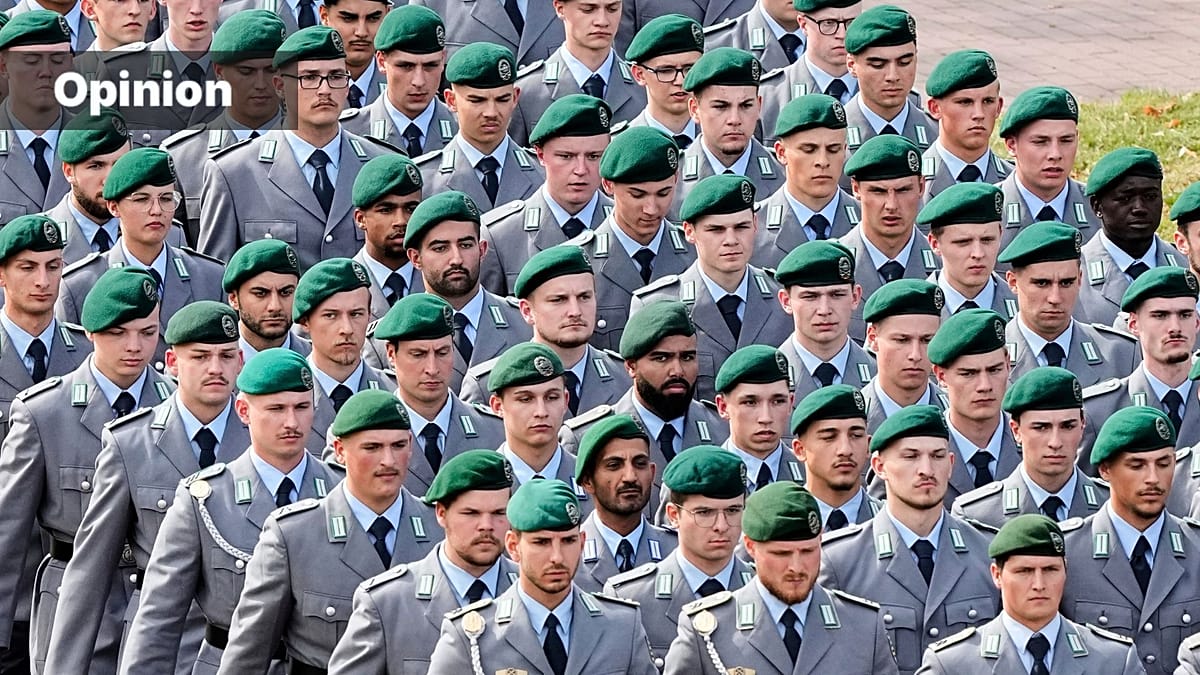
As Russia continues its war in Ukraine and the United States steps back from its role as Europe's security guarantor, Germany has moved to the forefront of continental defence. Berlin has become Kyiv's largest military donor in Europe and is pouring billions into its own armed forces. Yet a persistent narrative holds that Germans themselves are not prepared to fight.
Headlines regularly cite opinion polls showing that a majority of Germans would not take up arms in the event of an attack. Such reports unsettle allies, encourage adversaries, and erode public confidence. But a closer look at the data, compiled by the Centre for Military History and Social Sciences of the Bundeswehr (ZMSBw), paints a far more nuanced picture.
Scale and Context Matter
It is true that willingness to defend one's country is higher in Nordic and Baltic states. But comparing raw percentages ignores critical differences. Finland, with fewer than six million people, and Lithuania, with under three million, have conscription systems and recent experience of Russian aggression. Germany, with 83 million inhabitants, relies on a professional volunteer force.
When population size is factored in, Germany's defence potential looks different. According to ZMSBw data, 54% of German men and 21% of women say they would be willing to defend the country with a weapon. Among those aged 20 to 40—the cohort most likely to serve—the figures rise to 54% of men and 23% of women. In absolute terms, that translates to more than five million men and over two million women. There is no evidence of an absolute shortage of willing citizens.
Moreover, defence is not only about frontline combat. As Ukraine has shown, a country's resilience rests on contributions from the state, civil society, and industry. Surveys in Germany indicate a very high willingness to engage in civil protection roles—significantly higher than the willingness to bear arms. Not everyone needs to serve in the military to make a vital contribution.
Threat Perception and Institutional Trust
Resilience begins with recognising a threat. Since 2022, more than 60% of Germans view Russia as a direct military threat to Germany's security, up from just a quarter to a third before the invasion. This consensus cuts across all socio-demographic groups and political affiliations. A clear majority supports major financial investment in defence (64%) and the reintroduction of military service (53%).
Contrary to the image of a deeply sceptical public, trust in the Bundeswehr has remained strong. Since 2000, at least three-quarters of respondents have reported a positive view of the armed forces. A similar proportion trusts the institution and sees it as a normal part of society. Nothing about this fundamentally positive attitude changed after 2022—it was already there.
The Myth of German Pacifism
The notion of 'German pacifism' is a narrative that reveals more about those who promote it than about the strategic culture of the German public. Empirical studies based on ZMSBw data show that even before 2022, no more than 27% of Germans held pacifism as a guiding principle in foreign and security policy. The idea that Germany is a nation of pacifists is a distortion.
Germany's defence capabilities are often underestimated because the debate focuses on a narrow metric—willingness to fight—while ignoring the broader societal and structural factors that underpin national resilience. As Europe faces a new security landscape, the evidence suggests that German society is more prepared than the headlines suggest.