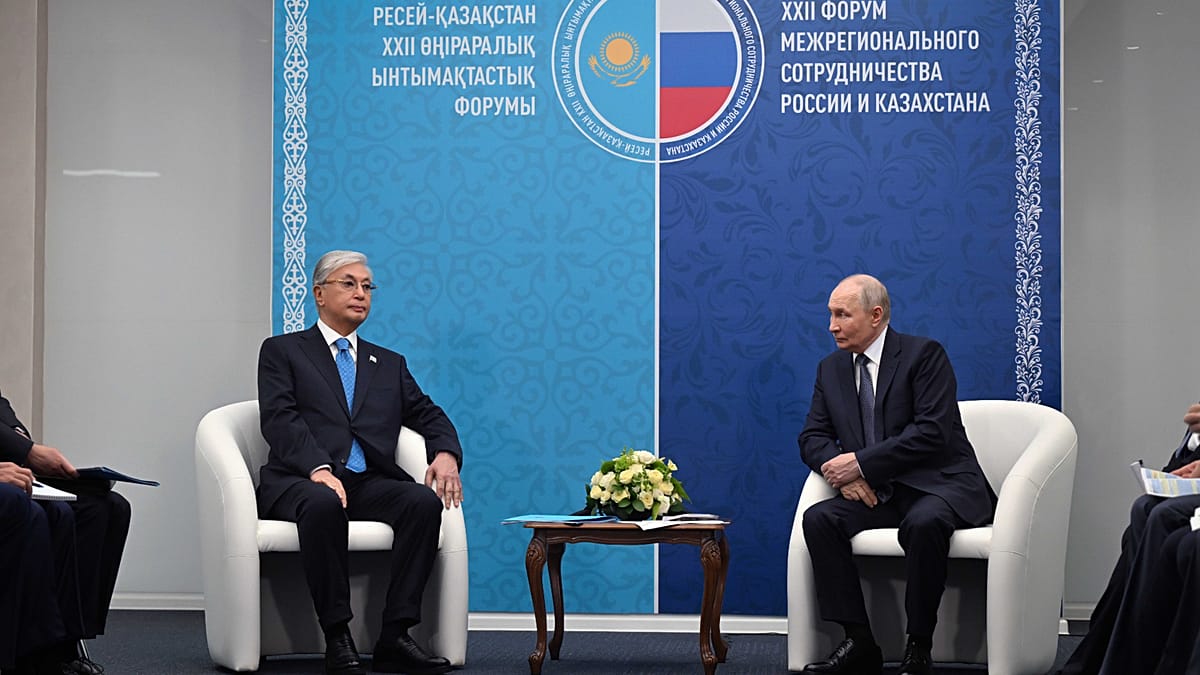
Kazakh President Kassym-Jomart Tokayev used a face-to-face meeting with Vladimir Putin in the Siberian city of Omsk to urge the Russian leader to freeze the war in Ukraine and revive negotiations under what he called the “Istanbul 2.0” format. The appeal, made during the Russia-Kazakhstan Interregional Cooperation Forum on Saturday, drew a swift and positive response from Kyiv.
“Perhaps it is time to freeze this conflict and return to the Istanbul Formula 2.0, because significant results were achieved there,” Tokayev told Putin. “Then, under guarantees from the great powers, including Russia, we could move toward the long-awaited peace.”
Ukrainian Foreign Minister Andrii Sybiha wrote on X that Kyiv “appreciates President Tokayev telling Putin it is time to stop the war. A realistic, timely, and wise message.” He added that Ukraine has proposed halting hostilities along the current frontlines and turning to diplomacy, but that the Kremlin continues to reject this path.
Tokayev also expressed respect for the Ukrainian people, their language and culture, and acknowledged that the nature of the conflict remains unclear to many observers. “No one knows how to resolve this situation because both sides have their own positions. It is a shame, young people are dying,” he said as Putin listened.
The Kazakh leader noted that he has received “many signals from Europe and the US regarding the conflict between the Russian Federation and Ukraine.” He also praised Putin’s “diplomatic flexibility” during a meeting with US President Donald Trump in Anchorage in August 2025. Putin responded by saying he would keep Tokayev informed of developments on the Ukrainian front.
Kremlin rejects freeze proposal
Despite the public exchange, the Kremlin quickly dismissed Tokayev’s suggestion. Spokesman Dmitry Peskov stated that “Tokayev has repeatedly spoken about the issue of Ukraine. He has a consistent position. This does not mean that we agree. But Kazakhstan is our closest partner and our closest ally.” He added that Moscow has not been effective enough in explaining the root causes of the war and will redouble its efforts to do so.
The rejection underscores the limits of Central Asian influence on Russian decision-making, even as Kazakhstan maintains close economic and political ties with Moscow. The episode also highlights the growing unease among Russia’s neighbours about the prolonged conflict, which has disrupted trade routes, energy supplies and regional stability.
Tokayev’s intervention comes amid broader diplomatic efforts to de-escalate the war. Ukraine has consistently called for a ceasefire and a return to negotiations, while Russia has insisted on its maximalist demands. The Istanbul format, which produced a draft peace agreement in March 2022, has been repeatedly cited by both sides as a potential framework, though talks collapsed after the discovery of mass graves in Bucha and subsequent allegations of war crimes.
For a deeper look at the diplomatic front, see our fact check on Kremlin claims about Boris Johnson sabotaging the peace deal.
Economic ties remain central
The meeting in Omsk followed Putin’s visit to Kazakhstan in May, where the two leaders discussed expanding trade, investment and regional cooperation. During Saturday’s forum, Tokayev and Putin reviewed a broad range of issues, including industrial cooperation, transport links and cross-border development.
Putin described the interregional forum as an important mechanism for strengthening bilateral relations. “Last year, trade turnover reached almost $28 billion, and during the first five months of this year it increased by more than 4%, according to our statistics. Our cooperation is well diversified, covering metallurgy, mechanical engineering, energy, pharmaceuticals and many other sectors,” he said.
Tokayev highlighted Russia’s role as one of Kazakhstan’s largest trading partners. “In 2025, bilateral trade reached around $28 billion, and this year’s trend remains very positive. This is a significant volume, especially given today’s difficult geopolitical environment,” he noted.
The economic interdependence between the two countries complicates any attempt by Astana to distance itself from Moscow’s war. Kazakhstan relies on Russian pipelines for its oil exports and on Russian-controlled transit routes for its trade with Europe. At the same time, the war has prompted Kazakhstan to diversify its foreign policy, strengthening ties with China, the European Union and Turkey.
For more on the broader security implications, read our analysis of Latvia's warning about Russian hybrid warfare and the escalating pressure on Baltic states.
Tokayev’s call for a freeze may not shift Putin’s calculus, but it signals that even Russia’s closest allies are growing impatient with a war that shows no signs of ending. As the conflict grinds into its fifth year, the human and economic toll continues to mount, and the search for a diplomatic off-ramp remains as urgent as ever.