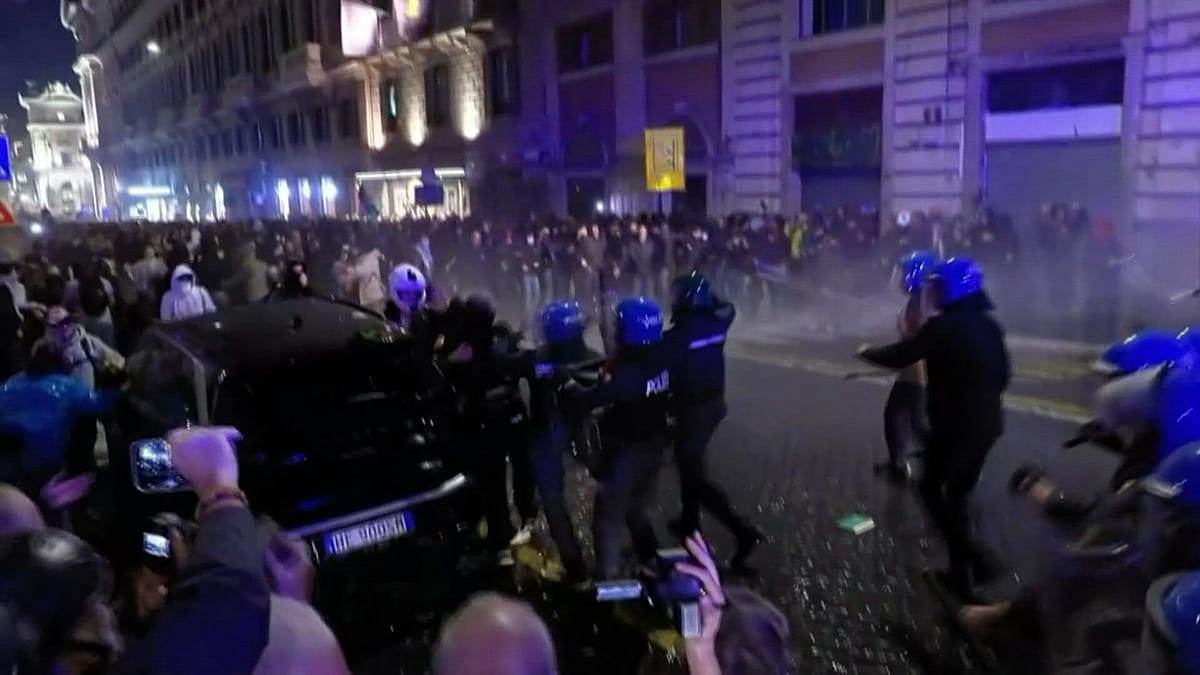
Rome witnessed violent confrontations on Saturday as young demonstrators clashed with police during ongoing protests over the rising cost of living, stagnant wages, and deteriorating public services. The clashes marked a sharp escalation in a wave of youth-led demonstrations that have swept across Italy in recent weeks.
Security forces were deployed in large numbers in the capital as tensions boiled over, with protesters hurling objects and police responding with baton charges and tear gas. The scenes echoed similar unrest in other European cities, where frustration over economic hardship has increasingly spilled onto the streets.
Nationwide unrest
The protests are not confined to Rome. In Milan, around 3,000 people gathered in the city centre, bringing traffic to a standstill as they marched through the streets. Demonstrators carried banners demanding higher wages, better job prospects for young people, and improved public services, reflecting a broader discontent with the economic policies of the Italian government.
The demonstrations come amid a wider European context of social unrest driven by inflation and austerity measures. Similar protests have erupted in France, where police have used tear gas to disperse crowds in Lyon, and in Serbia, where students have flooded the streets of Belgrade ahead of a snap vote. The Italian protests are part of this continental wave of discontent, as young people across Europe feel increasingly squeezed by economic pressures.
In Rome, the clashes occurred near the city's main university district, a traditional flashpoint for student activism. Witnesses reported that some protesters threw bottles and firecrackers at police lines, while officers attempted to push the crowd back with shields and batons. Several people were seen being detained, though official figures on arrests were not immediately available.
The Italian government has faced mounting criticism over its handling of the cost-of-living crisis, with opposition parties accusing it of failing to support vulnerable households. Prime Minister Giorgia Meloni's administration has defended its policies, arguing that targeted measures are in place to help those most in need. However, many young Italians remain unconvinced, pointing to high youth unemployment and precarious working conditions.
The protests have also drawn attention to the broader issue of public services, particularly healthcare and education, which have suffered from years of underfunding. In Milan, demonstrators chanted slogans calling for increased investment in schools and hospitals, while in Rome, some protesters occupied a building to highlight the shortage of affordable housing.
The unrest in Italy is part of a pattern seen across Europe, where governments are grappling with similar challenges. In France, police have faced criticism for their handling of protests, with a police union even suing the government over riot response failures. The situation in Italy, however, appears to be intensifying, with organizers vowing to continue the demonstrations until their demands are met.
As the evening wore on, the situation in Rome remained tense, with police maintaining a heavy presence in the city centre. The clashes have raised concerns about the potential for further violence in the coming days, as more protests are planned in other Italian cities. The government has called for calm, but the underlying grievances driving the demonstrations show no signs of abating.
The Italian protests are a stark reminder of the economic challenges facing Europe's youth, and the growing willingness of young people to take to the streets to demand change. Whether the government will respond with meaningful policy shifts remains to be seen, but the pressure is mounting.