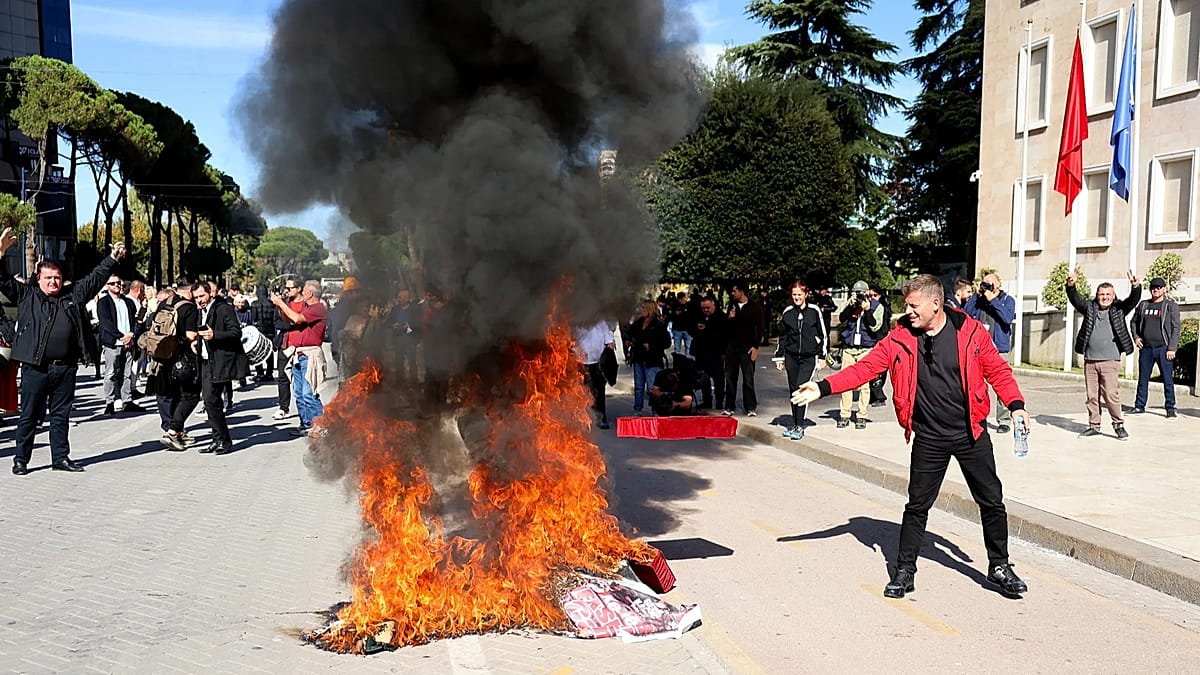
Saturday in Tirana saw a sharp escalation in political tensions as opposition supporters gathered outside the prime minister's office, setting fire to pillows that Edi Rama had placed there as a symbolic invitation to dialogue with students. The act, carried out by members of the Democratic Party, was a deliberate rebuke of the prime minister's overture, and it set the tone for a day of dual protests in the Albanian capital.
After roughly ninety minutes outside the prime minister's building, the demonstrators moved toward the Ministry of Education, where a separate student-led protest had been announced for 2 p.m. local time. University lecturers are also expected to join the mobilisation, reflecting a broader wave of discontent that has been building for weeks.
Heavy police presence and a water cannon
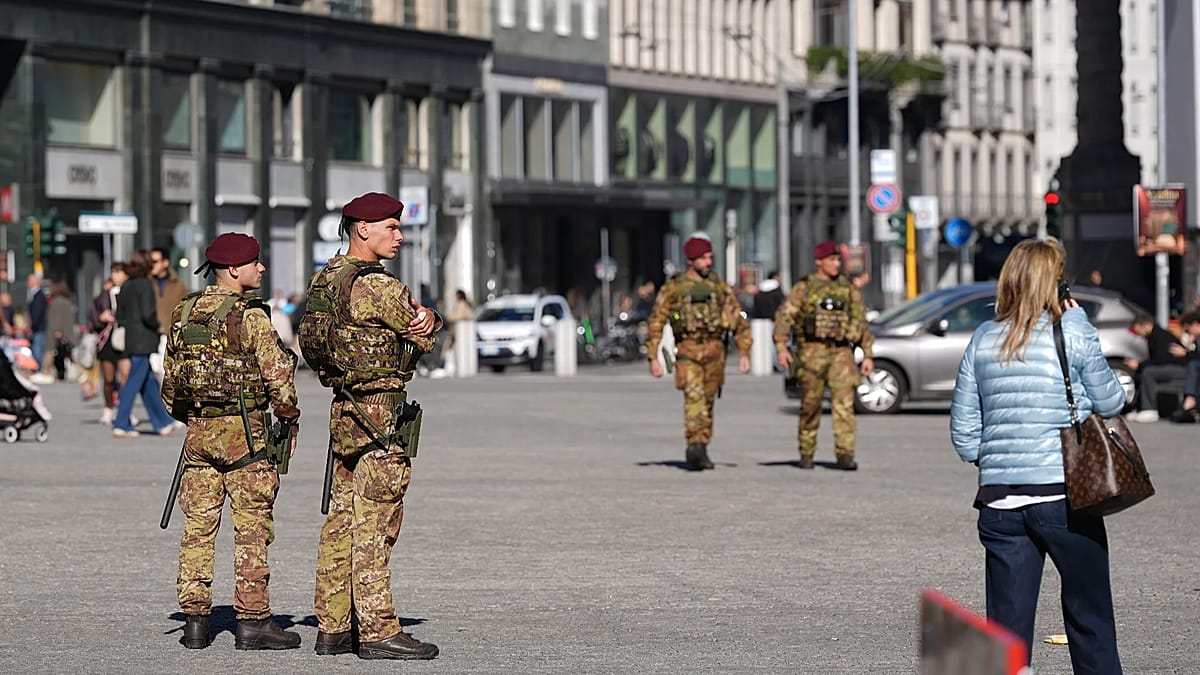
Security forces have been visibly reinforced around the Ministry of Education ahead of the student gathering. A water cannon and units from Albania's Rapid Intervention Forces (FNSH) have been deployed near the building, following calls on social media urging students to participate. The heavy police presence underscores the authorities' concern that the protests could turn violent, especially after recent clashes in the capital.
Prime Minister Rama, who has faced mounting criticism over his handling of the protests, acknowledged the public's frustration. In a statement, he said his government was preparing a response to the concerns expressed through the demonstrations. "Within a matter of hours or days, we will present our overall reflection on what a significant portion of society is trying to convey," Rama said, adding that the public sympathy for the protests reflects a desire for the government to become more attentive.
However, Rama also issued a stern warning against any resort to violence, pledging a sustained response from the authorities. "All those who glorify violence, all those who echo violence, and all those who perpetrate violence must understand that just as the urban terror was intense, concentrated, and prolonged, so too will the response from the state be prolonged and persistent," he said.
The prime minister's remarks come amid a broader context of political instability. Earlier this week, the Albanian parliament descended into chaos as MPs clashed over the student protests, a scene that has become emblematic of the deepening rift between the government and the opposition. The chaotic parliamentary session highlighted the extent to which the crisis has paralysed normal political discourse.
Rama has also sought to frame the protests as part of a larger pattern of external interference, blaming what he calls a "hybrid war" against his government. In a recent address, he blamed hybrid war for the unrest, a narrative that has further polarised the political landscape. Critics, however, argue that the government's own policies and perceived authoritarian tendencies are the root cause of the discontent.
The protests in Tirana are not occurring in a vacuum. Across Europe, governments are grappling with similar challenges, from civil unrest in France to the ongoing fallout from the war in Ukraine. The situation in Albania, however, is unique in its intensity and its symbolic dimensions, such as the burning of the pillows.
As the afternoon wore on, the atmosphere outside the Ministry of Education remained tense but largely peaceful. Students, many of them carrying banners, called for better funding for universities, higher wages for lecturers, and a more transparent governance model. The police, for their part, maintained a visible but restrained presence, though the water cannon remained on standby.
The coming days will be crucial. Rama has promised a comprehensive response to the protesters' demands, but it remains unclear whether that will be enough to defuse the situation. The opposition, emboldened by the public support for the protests, shows no signs of backing down. For now, Tirana remains a city on edge, with the spectre of further unrest looming large.