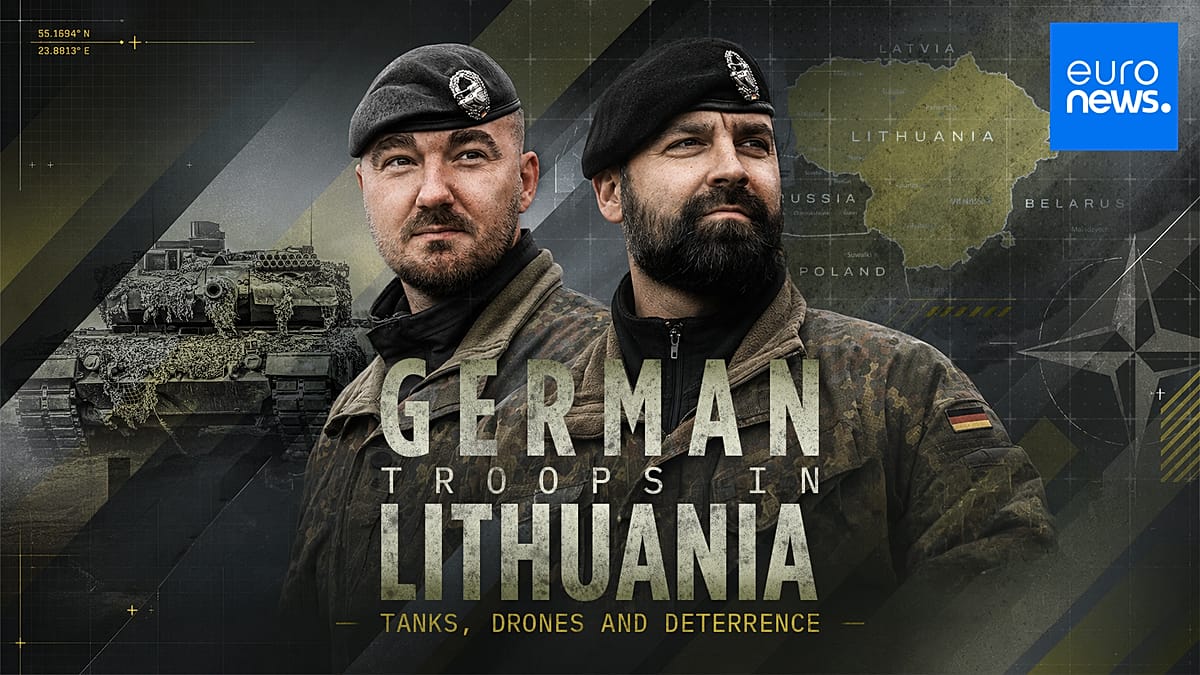
Just a few kilometres from the Belarusian border, the sandy heathland of Pabradė has become a stage for NATO's most ambitious defensive exercise in the Baltics. For six weeks, nearly 3,000 troops—most of them German—have been drilling with drones, electronic warfare systems, Leopard 2 tanks, artillery, and attack helicopters. The scenario is unambiguous: repel a conventional aggressor attacking Alliance territory.
The exercise, dubbed Freedom Shield I, is the first major test for Germany's 45th Armoured Brigade, better known as the Lithuania Brigade. Berlin's decision to permanently station around 4,800 soldiers in Lithuania by the end of 2027 marks a historic shift for the Bundeswehr—the first time a fully combat-ready brigade will be based outside Germany. The unit will be spread across two locations and comprise five battalions, with a clear mission: deter Russia.
Volunteers and the mission's pull
Who are the soldiers choosing to leave Germany for the eastern flank? Euronews spent time with Tank Battalion 203 in Augustdorf, which is slated to relocate to Lithuania by 2027. Corporal Kevin, a driver nicknamed "Rogi," has signed up until 2029. Staff Sergeant Kevin, a tank commander, has volunteered for six years. Both spoke of a sense of purpose, not fear.
Lieutenant Colonel Oliver Kaufmann, the battalion's commander, insists that the high proportion of volunteers is a strength. "I want soldiers by my side who believe in the mission and who are ready to take on this important responsibility together," he told Euronews. But the numbers tell a more complicated story. According to Bild, only about 60% of the brigade's planned strength has been filled by volunteers, leaving a shortfall of roughly 2,000 troops. Units already stationed in Lithuania, including the multinational battlegroup deployed since 2017, are at 92% staffing. Tank Battalion 203 and Panzergrenadier Battalion 122, however, are still about 40% short.
The shortfall has reignited debate in Berlin about whether the Bundeswehr can rely on volunteers alone. Defence Minister Boris Pistorius has repeatedly stressed the mission's importance, but the reality of filling the ranks may eventually require conscription or other incentives. For now, the military is betting on the mission's appeal.
The decision to go permanent came after Russia's full-scale invasion of Ukraine in 2022. Then-Chancellor Olaf Scholz promised Lithuania a robust brigade, telling the Bundestag: "I promised our friends in Lithuania that Germany would lead a robust Bundeswehr brigade, with a presence on the ground in Lithuania and the ability to be reinforced immediately with troops from Germany in the event of a crisis. That is solidarity between friends and allies in action."
Initially, Berlin planned only a brigade headquarters in Lithuania, with combat troops rotating from Germany. That changed in the summer of 2023, following Yevgeny Prigozhin's failed mutiny and the relocation of Wagner fighters to Belarus. The government said those events added "further momentum" to the debate, though they were not the sole reason. By autumn 2023, Pistorius and General Carsten Breuer announced the historic permanent deployment.
The stakes are existential for the Baltic states. A plaque on Vilnius City Hall, currently hidden behind construction sheeting, carries a quote from Chancellor Friedrich Merz: "Lithuania's security is also our security. Protecting Vilnius means protecting Berlin." The sentiment is echoed in Pabradė, where soldiers train with a seriousness that was unthinkable a decade ago.
For the soldiers themselves, the mission is personal. "It is our mission to provide protection for the eastern flank," Pistorius said. The men and women of the Lithuania Brigade are the physical embodiment of that promise. As one officer put it, "War has never been this close." The training is not just about readiness—it is about sending a signal that NATO's eastern border is not a line on a map, but a place where Europe's defence begins.
The brigade's establishment also has broader implications for European security. It is a test of NATO's ability to adapt to a new era of great-power competition. As the alliance grapples with calls for a Baltic security coordinator, the German deployment is a concrete step toward a more permanent defence posture. The question now is whether the rest of the alliance will follow suit.