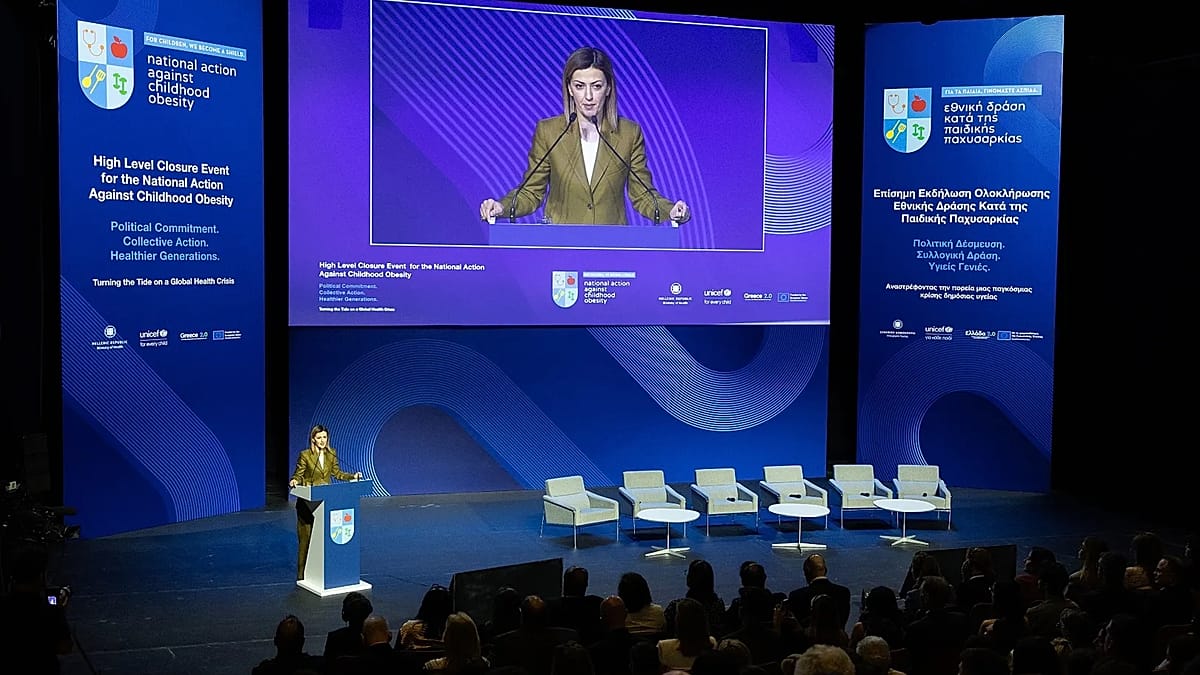
Greece has emerged as a European benchmark in the fight against childhood obesity, with the World Health Organization (WHO) now citing the country as a model for Southern Europe. The recognition follows the official close of the National Action against Childhood Obesity, a comprehensive initiative implemented by the Greek Ministry of Health in partnership with UNICEF and financed through the EU-backed recovery plan “Greece 2.0.”
Deputy Minister of Health Irini Agapidaki presented the programme’s results in Athens, noting that Greece had long held some of the continent’s most troubling statistics on child weight and related health conditions. “For years, our country was faced with a reality that did none of us credit. Greece’s unenviable first places in Europe were not just depressing figures in some report. They were a clear warning about the health of the next generation,” she said. “We decided not to sit idly by.”
Measurable Outcomes Across the Country
The initiative operated on multiple levels, reaching urban centres such as Athens and Thessaloniki as well as remote regions including Evros, Alexandroupoli, Grevena, Corfu, Rhodes, and Crete. More than 1,900 overweight or obese children received personalised nutritional counselling through 13,000 one-to-one sessions with 60 dietitians-nutritionists. According to official data, eight out of ten children who completed the programme achieved a normal body mass index. Among those who were obese and had clinical conditions such as diabetes, hypertension, or hypercholesterolaemia, four in ten improved their health indicators and significantly reduced their medication.
The programme also trained 1,124 paediatricians and health professionals and created a dedicated digital referrals platform. The frequency of weight and height recording during paediatric visits rose from 69% to 72.5%, signalling stronger preventive monitoring across the healthcare system.
School-Based Interventions and Community Engagement
A key component was the “Food for Action” initiative, rolled out nationwide via an interministerial circular. Some 7,656 teachers and parents registered for digital toolkits and seminars, while 31 schools operated as “Health Hubs” involving 3,492 children and 1,390 parents. Physical education teachers—694 in total—were trained to use sport as a vehicle for promoting healthy behaviour.
Accessibility was a priority: specially adapted educational materials were designed for children with disabilities and special educational needs. More than 130,000 healthy meals and fresh fruit were distributed to pupils in 435 primary schools. Through “The Journey of Food” workshops, 99,328 adolescents participated in 4,900 sessions across 1,625 schools, collecting and redistributing over 20 tonnes of surplus food to vulnerable families in 23 municipalities.
Free sports activities drew more than 135,000 children. Participation in organised sport increased from 52.5% to 60%, and the share of children active for at least one hour daily rose from 49.9% to 52.8%. Large-scale festivals of exercise and nutrition took place in over 40 municipalities across all 13 regions, attracting 18,345 pupils.
Shifting Parental Awareness
The programme also targeted parental knowledge. Awareness of WHO recommendations on healthy eating for children and adolescents jumped from 29.4% to 43.7%, a rise of 16.3 percentage points. Awareness of physical activity guidelines increased from 28.4% to 42.5%, a gain of 14.1 percentage points. Some 73.5% of parents reported receiving a service under the national action, indicating broad reach.
Agapidaki emphasised the shift in mindset: “The most encouraging thing is that Greece moved from denial to action, as more than 75% of parents have now been informed about or involved in the programme. This shows that the initiative has reached the whole country.”
The WHO’s designation of Greece as a model country places Athens at the centre of policy discussions on child health in Southern Europe. The approach—combining nutritional counselling, school-based education, sports promotion, and digital tools—offers a template that other member states may adapt. As Europe grapples with rising rates of childhood obesity, Greece’s experience demonstrates that coordinated national action, backed by EU funds and international expertise, can produce tangible results.