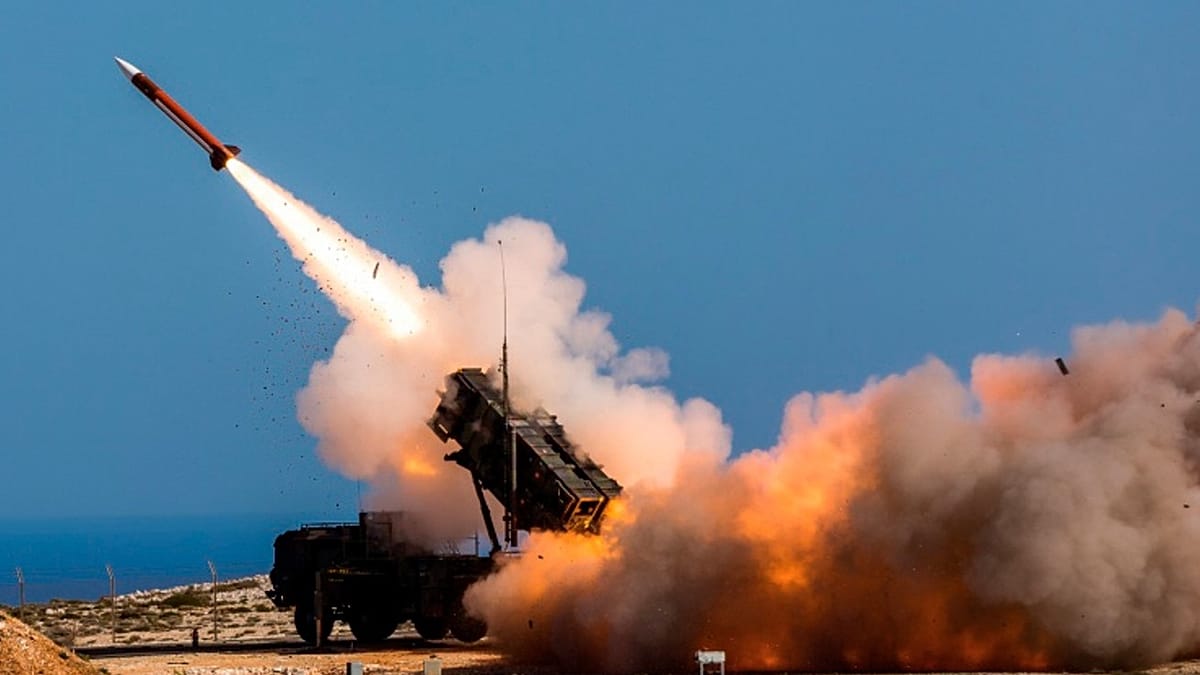
Greece has shifted one of its Patriot missile interceptor batteries to the island of Crete, a move widely seen as a precaution against potential Iranian strikes on American military installations in Europe. The deployment, reported by Greek media on Monday, underscores the heightened security concerns rippling through the eastern Mediterranean as tensions over the Strait of Hormuz continue to simmer.
The battery was transported from the island of Karpathos, in the Dodecanese, to Crete, where the sprawling US naval and air facility at Souda Bay serves as a linchpin for NATO operations in the region. Images broadcast by Greek television showed the Patriot system mounted on a truck, waiting to be loaded onto a barge for the short sea crossing.
Souda Bay is not just a Greek installation; it is a critical hub for allied forces, providing logistical support for missions across the Middle East and North Africa. Its protection has become a priority for Athens and Washington alike, particularly as the security environment in the broader region deteriorates.
Reported Iranian threats
The redeployment follows a report in the Financial Times last week, which cited Iranian sources as saying that Tehran would fire missiles at US targets in Europe if President Donald Trump intensified military pressure over the Strait of Hormuz. The strait, a vital chokepoint for global oil shipments, has been a flashpoint in US-Iranian relations for years, and the threat of direct conflict has periodically spiked.
While the Greek defence ministry has declined to comment on the reported transfer, the move signals that Athens is taking the threat seriously. The Patriot system, which is designed to intercept ballistic missiles and aircraft, would provide an additional layer of defense for Souda Bay, which has long been a potential target due to its strategic value.
Analysts note that the deployment is also a signal of Greece's commitment to its NATO allies, even as it navigates a complex relationship with Washington. Greece has hosted US military assets for decades, and the base at Souda has been instrumental in supporting operations in Libya, Syria, and beyond. The decision to bolster its defenses reflects a broader European concern about the ripple effects of a potential US-Iranian confrontation.
The move comes at a time when Libyan groups have escalated threats against Mediterranean rescue ships, adding another layer of instability to the region. While the two issues are not directly linked, they both highlight the volatile security landscape that European nations must contend with.
For Greece, the deployment is a logistical and strategic balancing act. The country has been modernizing its military in recent years, but resources remain stretched. Moving a Patriot battery from Karpathos to Crete leaves the eastern island with reduced air-defense coverage, though officials are likely to argue that the threat environment justifies the shift.
The Souda base has been a cornerstone of US-Greek cooperation, and its protection is seen as vital not only for bilateral ties but also for the broader NATO posture in the eastern Mediterranean. As one defence analyst put it, "Souda is the anchor of the alliance's southern flank."
The reported Iranian threats are part of a wider pattern of Tehran using its missile capabilities as leverage in diplomatic standoffs. While European leaders have urged restraint on all sides, the possibility of a miscalculation remains a concern. The Greek move is a tangible reminder that even distant geopolitical crises can have immediate consequences on European soil.
As the situation evolves, European observers will be watching closely to see whether other NATO members follow suit with similar defensive measures. For now, the Patriot battery on Crete stands as a quiet but unmistakable signal of preparedness.