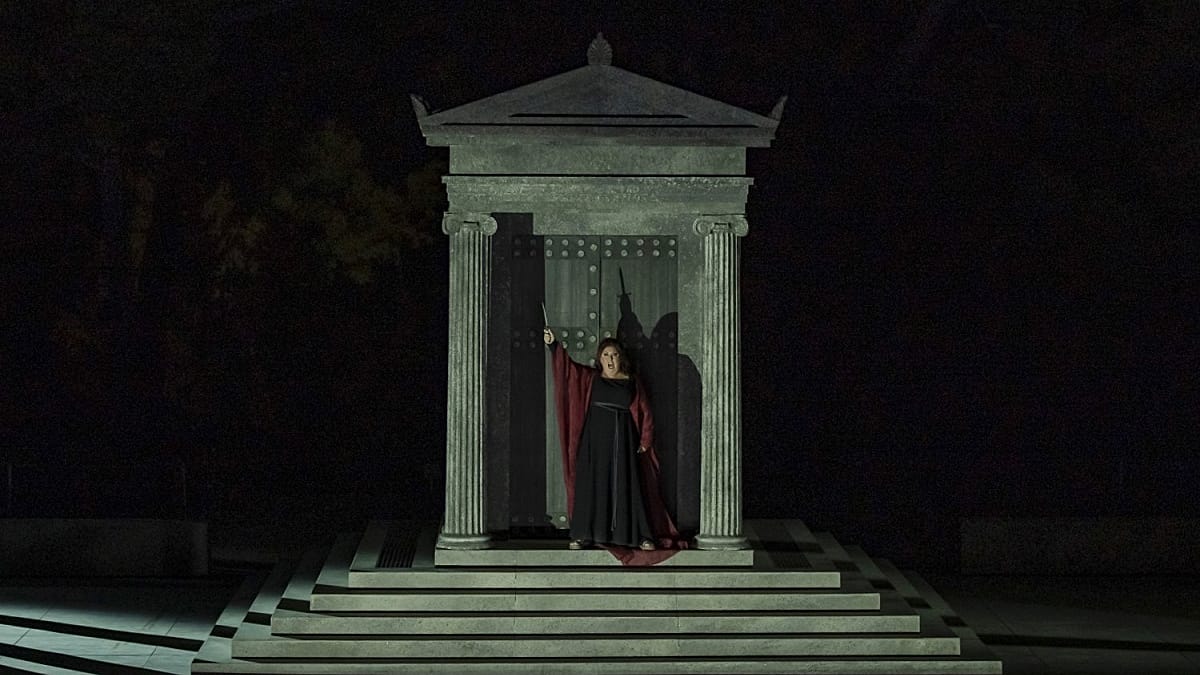
On Saturday 20 June, the Ancient Theatre of Epidaurus in the Peloponnese witnessed a remarkable cultural event: a revival of Luigi Cherubini's Medea by the Greek National Opera that drew approximately 10,000 spectators and ended with a prolonged standing ovation. The performance was a painstaking reconstruction of the historic 1961 production that had starred Maria Callas on the same stage.
Tickets for the revival sold out as early as February, underscoring the enduring fascination with both the opera and its legendary interpreter. The production forms part of the Greek National Opera's current thematic season, The opera of the future through the matrix of the past, which explores how historical performances can inform contemporary staging.
Reconstructing a Lost Masterpiece
The 1961 production was originally directed by Alexis Minotis, with sets and costumes by Yannis Tsarouchis and choreography by Maria Hors. It had premiered in 1958 at the Dallas Opera, travelled to London's Royal Opera House in 1959, left its indelible mark at Epidaurus in 1961, and concluded its run at La Scala in Milan in 1962.
Reconstructing the staging proved exceptionally challenging because no video recording of the original exists. Giorgos Koumendakis, the Greek National Opera's artistic director, explained that the team relied on black-and-white photographs from the Historical Archive of the Greek National Opera, the Cultural Foundation of the National Bank of Greece, and private collections. “Those images helped us recreate the set,” Koumendakis said. “It was different with the costumes, because we had around 150 of Yannis Tsarouchis' original costumes from that period. If you look at the result today, you can't tell the difference between the original and what we have created now.”
The Italian soprano Anna Pirozzi took on the title role, a part that demands both vocal power and dramatic intensity. “This role is very difficult, among other things because you have to act it,” Pirozzi said. “It's not enough simply to sing it. You have to interpret it. You have to inhabit the woman who is Medea, the sorceress and the terrible murder she commits at the end, when she kills her children. So you really have to put yourself in her place, to inhabit Medea's character 100%. That is very hard, especially here, in this theatre, where Maria Callas performed the role so magnificently.”
The revival is part of a broader trend across Europe of revisiting landmark operatic productions. In Brussels, for instance, the Amaterasu stage production recently celebrated 160 years of Belgium-Japan ties, blending traditional and contemporary elements. Meanwhile, the Edinburgh International Festival has announced that from 2026 it will enforce phone-free performances, aiming to preserve the immersive experience that venues like Epidaurus have long offered.
The success of the Epidaurus revival also highlights the importance of archival preservation. As European cultural institutions increasingly digitise their collections, the ability to reconstruct lost performances becomes more feasible. The Greek National Opera's research into Tsarouchis' original costumes and the black-and-white photographs demonstrates how meticulous archival work can breathe new life into historic productions.
For the audience at Epidaurus, the evening was a chance to connect with a pivotal moment in operatic history. The 1961 performance had cemented Callas' reputation as one of the 20th century's greatest dramatic sopranos, and the revival allowed a new generation to experience the same staging in the same acoustically remarkable theatre. The ovation that followed suggested that the production had succeeded in capturing the spirit of the original while standing on its own merits.