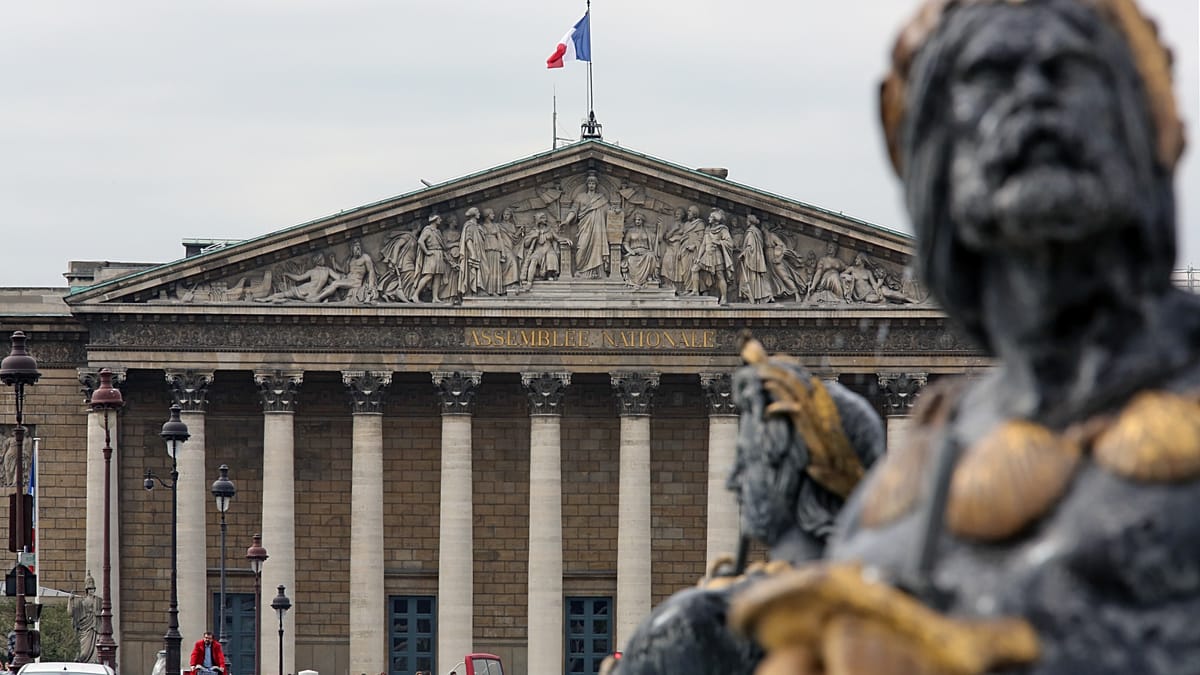
Plans to build a contemporary glass reception pavilion at the French National Assembly have ignited a fierce heritage battle in Paris, with a petition against the project approaching 100,000 signatures. The dispute, which has simmered for nearly two years, pits the institution's president, Yaël Braun-Pivet, against heritage campaigners and a cross-party group of politicians.
The project would replace the historic stone pavilion dating from 1888, located on the quays of the Seine beside the Palais-Bourbon, with a modern glass structure. The new building is intended to house a shop, a cafeteria, and educational spaces—functions that the heritage association Sites & Monuments argues are secondary for a parliament.
Julien Lacaze, president of Sites & Monuments, told European Pulse that the design would disrupt the architectural harmony of the area. “The problem is that this building would break that symmetry and introduce large quantities of a new material, namely glass,” he said. The site lies within a Remarkable Heritage Site (SPR) in the 7th arrondissement and is part of the UNESCO World Heritage listing for the banks of the Seine.
Lacaze points to several specific concerns: the pavilion would break the visual symmetry between the Madeleine church and the Palais-Bourbon's colonnade, introduce glass on a massive scale into a stone-dominated ensemble, and undermine the horizontality and unity of the quays. “Most serious of all is demolishing a historic building. Once something has been demolished and something that is out of keeping with a site has been built in its place, that is permanent. It cannot be reversed,” he lamented.
Alternative designs and rising costs
The association, founded in 1901 and recognised as serving the public interest, argues that more respectful alternatives exist. Lacaze cites a proposal by the Japanese firm SANAA, a Pritzker Prize winner, which suggested keeping the 1888 pavilion and adding a contemporary stone extension rather than glass. That option, he says, would have met the Assembly's functional needs without transforming the architectural landscape.
Beyond aesthetics, the project's cost has drawn criticism. The stated budget of €52.8 million is seen as excessive, especially amid broader fiscal restraint. “It is the French people's money. At a time when people are being told to tighten their belts, spending 53 million euros on a building with a shop and a cafeteria raises questions,” Lacaze said. Although the project is to be self-financed by the National Assembly, he insists the funds ultimately come from taxpayers.
The handling of the case has also come under fire. Lacaze claims that no public information was released for nearly a year after the architectural competition. An initial planning application was reportedly submitted in contradiction with the 7th arrondissement's Safeguarding and Enhancement Plan (PSMV), notably due to excessive height, encroachment on protected areas, and damage to heritage gardens. Faced with potential legal action, the permit was withdrawn, and authorities then initiated a targeted amendment to the PSMV to make the project compliant.
Lacaze accuses Braun-Pivet of pursuing the project for personal legacy. “What you can criticise [Yaël Braun-Pivet] for is not a lack of architectural culture. It is for not listening. There are highly prestigious consultative commissions, associations recognised as serving the public interest, architectural historians: all of them say this project should not go ahead. It is a question of ego,” he said.
Braun-Pivet, speaking to Franceinfo, said she was “overwhelmed by the criticism of a project that people do not know.” The petition, launched over a year ago, has gained renewed momentum in recent weeks, nearing 100,000 signatures at the time of writing.
The campaign has attracted support from political figures across the spectrum, including members of Les Républicains (LR) and La France insoumise (LFI), as well as former presidential candidate Ségolène Royal. The National Assembly did not respond to requests for comment.
Paris city hall, in an email, said the project “aims to modernise and improve conditions for receiving the public within the Palais-Bourbon by increasing the space dedicated to them” and that it must now “be the subject of a planning application, which will be processed by the state and during which the City will be consulted in an advisory capacity.”
Lacaze disputes this, asserting that the City has already taken a position in favour of the project. He points to a resolution by the Paris Council on 16 July approving the draft amendment to the PSMV, which he says is required to make the project compliant. “There was a resolution by the City of Paris that approved the draft amendment,” he said, adding that the municipal majority has clearly backed the project.
The controversy echoes broader debates across Europe about balancing modernisation with heritage preservation. In Paris, where tourism remains a key economic driver—the city consistently ranks among the world's top destinations—the outcome of this dispute could set a precedent for how historic sites are adapted for contemporary needs.