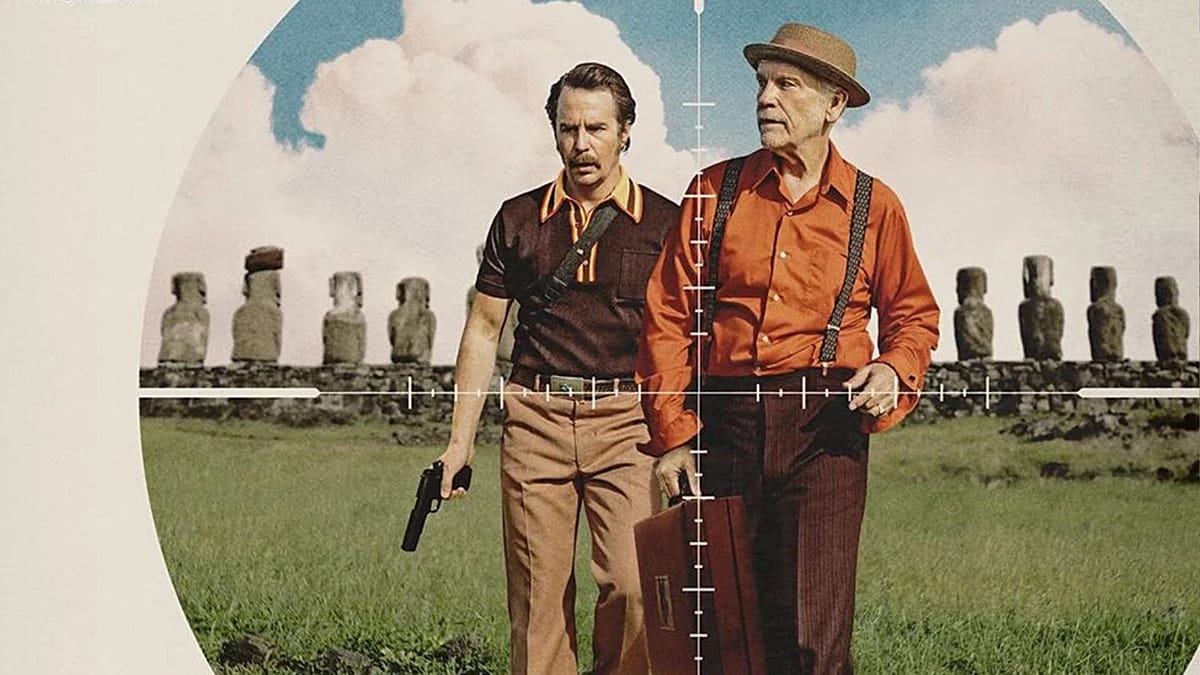
Martin McDonagh has built a career on pairing lonely, damaged souls who find a twisted kinship in a world that seems determined to deny them redemption. His latest black comedy, Wild Horse Nine, returns to the template of his debut In Bruges, but swaps the medieval Belgian city for Easter Island on the eve of the 1973 Chilean coup. Instead of bickering hitmen, we get a squabbling duo of CIA operatives on a holiday that is anything but restful.
John Malkovich plays Chris, a seasoned but increasingly forgetful agent whose cognitive decline is so severe he relies on Memento-style notes to get through the day. Sam Rockwell is Lee, a man who can dispatch a target while munching a burger without missing a beat. The pair are ostensibly on vacation, taking in the Moai statues and trading barbs with two pro-Allende students (Mariana di Girolamo and Ailín Salas) they keep encountering. But beneath the tourist veneer lies a darker purpose: Chris, riddled with cancer and haunted by the regimes he has helped topple, has asked Lee to put him out of his misery, Of Mice and Men style. He has forgotten that request, but not his ambition to dictate a memoir into a tape recorder—a prospect that terrifies their boss MJ (Steve Buscemi), who fears Chris's confessions, especially 'the Dallas parts' implicating him in JFK's assassination, could unravel the agency.
Familiar territory, but a satisfying greatest hits
McDonagh doesn't stray far from his established playbook. Wild Horse Nine feels like a curated compilation of his greatest hits: the narrative structure of In Bruges, the profanity-laced dialogue of Three Billboards Outside Ebbing, Missouri, a cheeky Tom Waits cameo reminiscent of Seven Psychopaths, and the quiet melancholy that underpinned The Banshees of Inisherin. When the balancing act works, his acerbic wit and recurring themes of salvation and mortality coalesce into a bittersweet whole. When it falters, the script veers into self-indulgent monologues and tangential digressions—a criticism that has dogged his work before.
For the most part, McDonagh pulls it off, loading his tirades with unexpected depth. A breakfast speech about why 'gay countries' produce better cheese than the US draws laughs but also feeds into a pointed commentary on American interventionism, past and present. Yet the politically charged backdrop—the CIA's role in destabilising Chile—remains underexplored. The female characters, particularly di Girolamo's Monica, are frustratingly underused, relegated to symbolising Chris's lost idealism rather than driving the narrative. It's a missed opportunity that could have amplified the film's critical edge.
Malkovich's triumphant return
The film's success hinges on the chemistry between its leads, and that chemistry is electric, largely thanks to Malkovich. After years of forgettable supporting roles, he delivers his most compelling performance since Being John Malkovich—or perhaps his villainous turn in Johnny English, which remains a masterpiece of comic timing. Whether he's admitting to caring more about Chilean moths than Chilean people, lashing out at anyone in his vicinity, or musing on the lack of songs about suicidal birds, Malkovich savours every line. His precise elocution suits McDonagh's prose perfectly, especially when he repeatedly enunciates the word 'cahoots'—a term derived from the French 'cahute', meaning a small shack, evoking images of huddled schemers.
Malkovich's ability to inhabit eccentric, amoral, melancholic, and soulful registers simultaneously creates a pessimistic poetry that is hard to resist. He already won the Volpi Cup for Best Actor at Venice, where the film premiered, and he is a strong contender for Oscar glory next year. His last nomination came in 1993 for In the Line of Fire, where he played an assassin targeting the US president—a symmetry the Academy tends to appreciate.
While Wild Horse Nine may tread familiar ground, it offers a sardonic, occasionally moving experience that reaffirms McDonagh's place as a master of dark comedy. For those who relish his particular blend of wit and despair, this is a film to savour. And for those following the broader European cultural landscape, it's a reminder of the continent's enduring fascination with American power and its discontents—a theme that resonates from defence debates in Brussels to the symbols of protest seen across European cities.