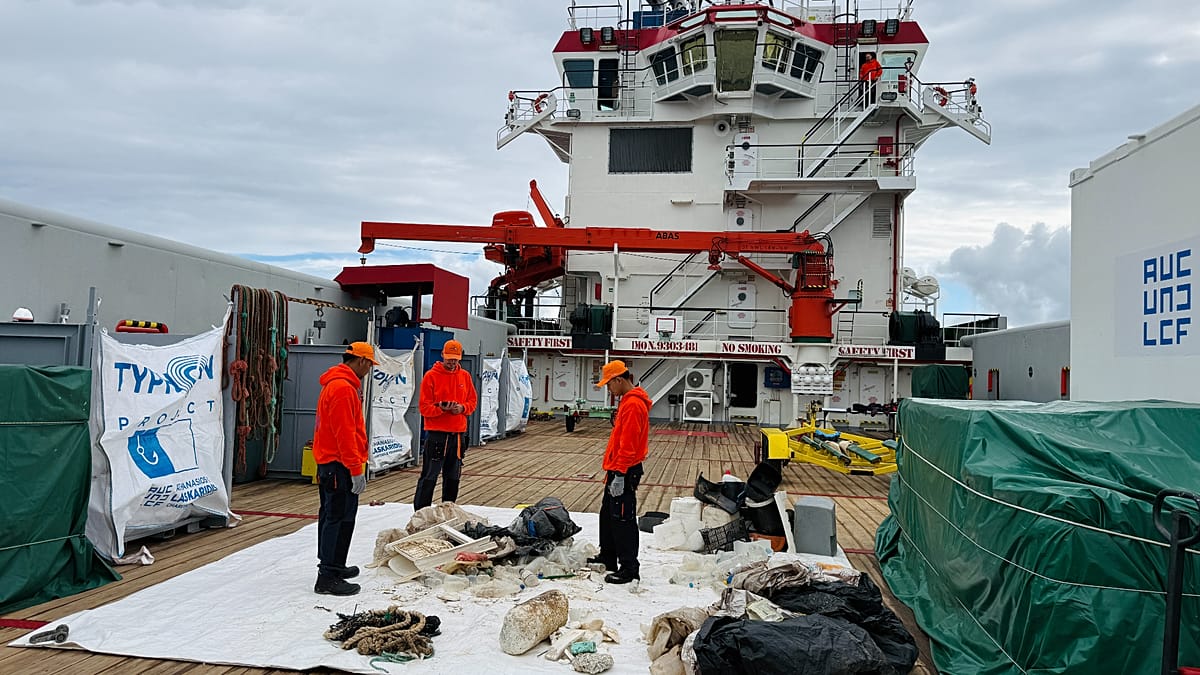
Greece, with the longest coastline in the Mediterranean, is renowned for its pristine beaches and idyllic islands. Yet many of its most remote shores are plagued by rubbish, much of it carried by sea currents from far away. Enter the Typhoon, a 72-metre vessel dedicated to cleaning up these hard-to-reach areas.
Since July 2019, the Typhoon Project has completed over 10,000 clean-up operations, retrieving 1,140 tonnes of waste—enough to fill roughly 22 Olympic-sized swimming pools or 1,160 large shipping containers. The 20-member crew works daily, collecting, sorting, and documenting between 500 and 1,000 kilograms of litter from shores that are not connected to roads or businesses.
Most of the waste is not left by beachgoers but arrives via ocean currents. For instance, a beer can with a Spanish advertisement for a 1990s World Cup was found on the islet of Patroklos in the Saronic Gulf, about 65 nautical miles from Athens.
More than a clean-up: building a database
The project, an initiative of the Public Benefit Foundation 'Athanassios C. Laskaridis', goes beyond simple collection. The team uses five inflatable boats to access the shores, then sorts and transports the waste for recycling. Crucially, they also record every item meticulously.
“One part of the project is collecting the waste, but the second is collecting the data. We carry out detailed recording of all the waste. We know exactly what quantity there is, how many kilos, how many items from each beach. At the moment we have the largest database on marine pollution in the Mediterranean, and we are developing it every day,” says Thanasis Besios, manager of the Typhoon Project.
By February 2023, the first cycle of clean-ups had covered the island and most of the mainland coastline. The foundation, active for about nine years, focuses on environmental protection, supporting micro-entrepreneurship, and charitable donations.
Peggy Xirotagarou, Executive Director at the foundation, underscores the scale: “With the Typhoon we have collected more than 1,140 tonnes of waste. To help people picture it in their minds, we are talking about 22 Olympic-size swimming pools or around 1,160 large containers.”
From sea to land: tackling inland pollution
The problem extends beyond the sea. In many parts of Greece, illegal landfills still operate, and waste often finds its way into waterways. “By observing the waste we were finding on the shores, we realised that a large proportion came from inland. So, in 2024, we created a new programme, called Cyclone. It involves large-scale clean-ups in lakes, rivers and archaeological sites. We have created three large teams in different parts of Greece, where every day we collect more than 1,000 kilos of waste,” says Xirotagarou.
The Typhoon Project also collaborates with academic institutions. It works with the Laboratory of Marine Geology and Physical Oceanography at the University of Patras to study benthic waste in the Saronic and Thermaic Gulfs, and with the Marine Remote Sensing Research Group of the University of the Aegean to map plastics using modern technology.
Education is another pillar. The team organises activities with schools on the islands it visits. “In every place we visit, we have a holistic approach. Our work is not limited to clean-ups. There are educational programmes that we have designed and run. So in every place we go we also bring the schools in. We go into the classrooms and take the children to the beaches to raise their awareness. Because that is the ultimate goal. For them to become responsible citizens and for this reckless use of single-use plastics to stop,” Xirotagarou explains.
The Typhoon Project’s achievements highlight the persistent challenge of marine pollution in the Mediterranean, a region shared by many European nations. Similar efforts are underway elsewhere, such as addressing pollution in Europe's popular swimming spots. The data collected by the Typhoon team could inform policies across the continent, where innovative monitoring techniques are also being explored. As Greece continues to battle this environmental crisis, the Typhoon Project stands as a model for coordinated action.