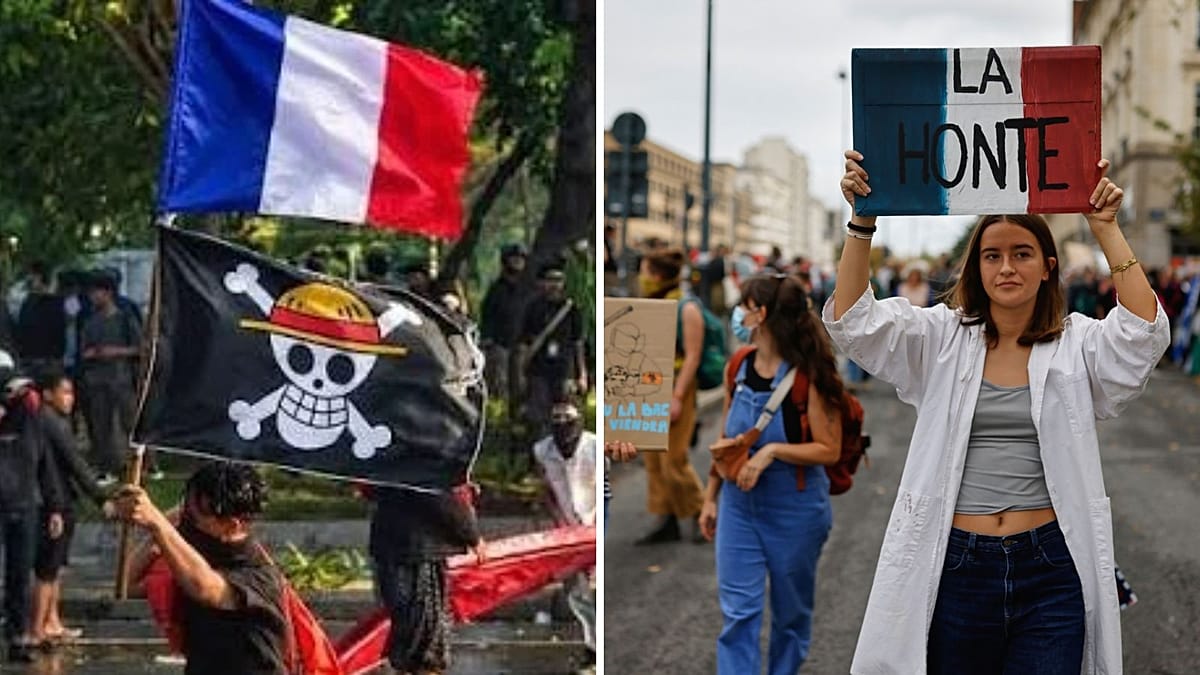
When young Europeans take to the streets, they increasingly carry more than just placards and slogans. Among the banners in recent French demonstrations, a black flag bearing a grinning skull in a straw hat has become a familiar sight. For fans of the Japanese manga One Piece, this is the Jolly Roger of the Straw Hat Pirates — a symbol that has quietly evolved into a rallying cry for a generation.
The flag first surfaced during the September protests in France and has reappeared in the current wave of student-led demonstrations. It has also been spotted in Belgium, Italy and Greece, suggesting a continental resonance that goes beyond any single cause. The image has been carried at rallies against police brutality, government social media bans, and in pro-Palestinian marches, uniting disparate movements under one visual banner.
Why this symbol?
One Piece, created by Eiichiro Oda, has been serialised since 1997 — a year that also marks the birth of the oldest Gen Z members. The story follows a crew of pirates who fight against oppressive rulers and systemic corruption, championing the underdog. With over 500 million copies in print and translations in 40 languages, it holds a Guinness World Record and has spawned an anime, films and a Netflix live-action series. In France, it is a publishing phenomenon, with volumes regularly topping bestseller lists.
The Jolly Roger's appeal lies in its narrative core: freedom and resistance against tyranny. For young activists, it offers a ready-made iconography that is both recognisable and hard to suppress. Unlike a political logo, a fictional emblem is not easily co-opted or banned. As one protester in Paris put it, “It’s a symbol that says we’re on the side of the rebels, not the rulers.”
The flag has appeared in protests from Nepal to the Philippines, but its European adoption is particularly telling. In France, where demonstrations have often been met with heavy-handed police tactics — a subject of intense media scrutiny — the skull offers a playful yet pointed rebuke. It also connects to a broader trend of pop culture becoming political shorthand, as seen in the nonsensical slogans that have defined recent student actions.
Pop culture as protest language
The use of the Jolly Roger is not an isolated case. Over the past 15 years, several fictional symbols have crossed into real-world activism. The Guy Fawkes mask from V for Vendetta became the face of Anonymous and the Occupy movement. The three-finger salute from The Hunger Games has been used in Thailand and Hong Kong. The scarlet cloaks of The Handmaid's Tale have been worn at women's rights marches from Buenos Aires to London. And the Joker's visage has appeared at anti-establishment protests in various forms.
What sets the One Piece flag apart is its sheer ubiquity and its positive, almost utopian undertone. While other symbols often evoke dystopia or menace, the Straw Hat Pirates represent a quest for freedom and camaraderie. For a generation that communicates through memes and cultural references, it is a natural fit.
The phenomenon also reflects a deeper shift in how political messages are crafted. Traditional party symbols and union banners are giving way to a more fluid, internet-native visual language. As one sociologist noted, “Pop culture provides a shared vocabulary that transcends borders and languages. It allows young people to express solidarity without needing a formal ideology.”
This is not without its critics. Some argue that reducing political protest to a manga logo trivialises serious issues. Yet the flag's persistence suggests it resonates because it is both playful and earnest. It signals a desire for change without the cynicism of conventional politics.
As protests continue to spread across Europe — from inflation-driven unrest to violent clashes in the Balkans — the One Piece skull offers a unifying emblem for a generation that often feels unheard. Whether it will endure beyond the current wave of demonstrations remains to be seen, but for now, it has become a symbol of defiance that is as recognisable as any political banner.
In the end, the Jolly Roger's journey from manga page to protest line underscores a simple truth: culture and politics are inseparable. For young Europeans, the stories they grew up with are not just entertainment — they are a lens through which they view and challenge the world.