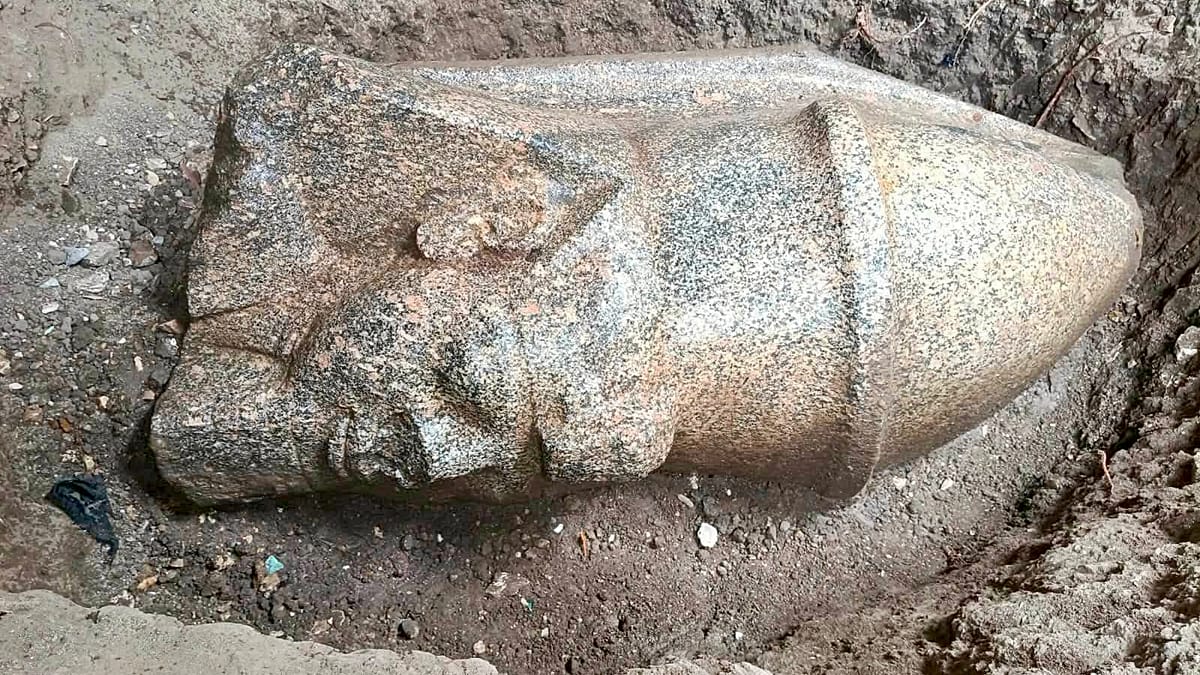
In the Nile Delta village of Behbeit el-Hagar, a cucumber farmer's routine work has turned into a significant archaeological find. Khaled Khalil, who grows cucumbers in a greenhouse on his land, stumbled upon a stone bearing ancient carvings. He alerted antiquities officials, and a rescue excavation by Egypt's Supreme Council of Antiquities has since revealed the head of a colossal statue of Pharaoh Ramses II, measuring 1.6 metres in height.
The discovery has drawn attention not only for its historical value but also for its unlikely origin. Gharbia governor Alaa Abdel Moaty, during a visit to the farmer's home, joked, “See? Cucumbers bring antiquities,” as reported by Egyptian outlet Youm7.
Colossal finds at Behbeit el-Hagar
The newly uncovered head depicts Ramses II wearing the double crown of Upper and Lower Egypt. Archaeologists also found part of the statue's back pillar bearing the pharaoh's Horus name, one of his formal royal titles. Based on the head's proportions, Hisham el-Leithy, secretary-general of the Supreme Council of Antiquities, estimated that the complete statue could have stood about 8.5 metres tall, including its base.
Excavations also yielded a second statue fragment, about 2.4 metres long, with its legs and base missing but the face well preserved. It wears the royal nemes headdress, part of which is also missing. While the identification is not yet confirmed, archaeologists believe it may also depict Ramses II because of the facial resemblance to the first head.
A separate pink granite block, roughly 1.3 metres long, carries hieroglyphic inscriptions including the titles “King of Upper and Lower Egypt” and “Son of Ra.” These inscriptions add to the historical context of the site.
Historical significance and ongoing research
Ramses II ruled Egypt for over six decades, from around 1279 to 1213 BC, during the 19th Dynasty. His colossal statues still stand at Abu Simbel, one of the most famous monuments of his reign. The new finds at Behbeit el-Hagar, known for the ruins of a large temple dedicated to the goddess Isis, may offer fresh insights into the area's religious and political landscape.
Excavations and studies are continuing to determine how the newly discovered pieces relate to one another and to the surrounding site. The Egyptian Ministry of Tourism and Antiquities is overseeing the work, and Tourism and Antiquities Minister Sherif Fathy personally thanked Khalil for his report. As a reward, the farmer and his wife were given a trip to perform Umrah, the Muslim pilgrimage to Mecca.
This discovery echoes other recent archaeological finds in Egypt, such as the reclassification of an ancient crocodile fossil after CT scans, and it underscores the ongoing potential for unexpected discoveries in the region. For European readers, the story also resonates with broader themes of agricultural land and heritage, similar to how European farmers are adapting to climate-driven crop losses and how Dutch farmers are turning to rice as conditions change.
The find at Behbeit el-Hagar is a reminder that history can surface in the most ordinary places, and that the collaboration between local communities and archaeologists is vital for preserving our shared past.