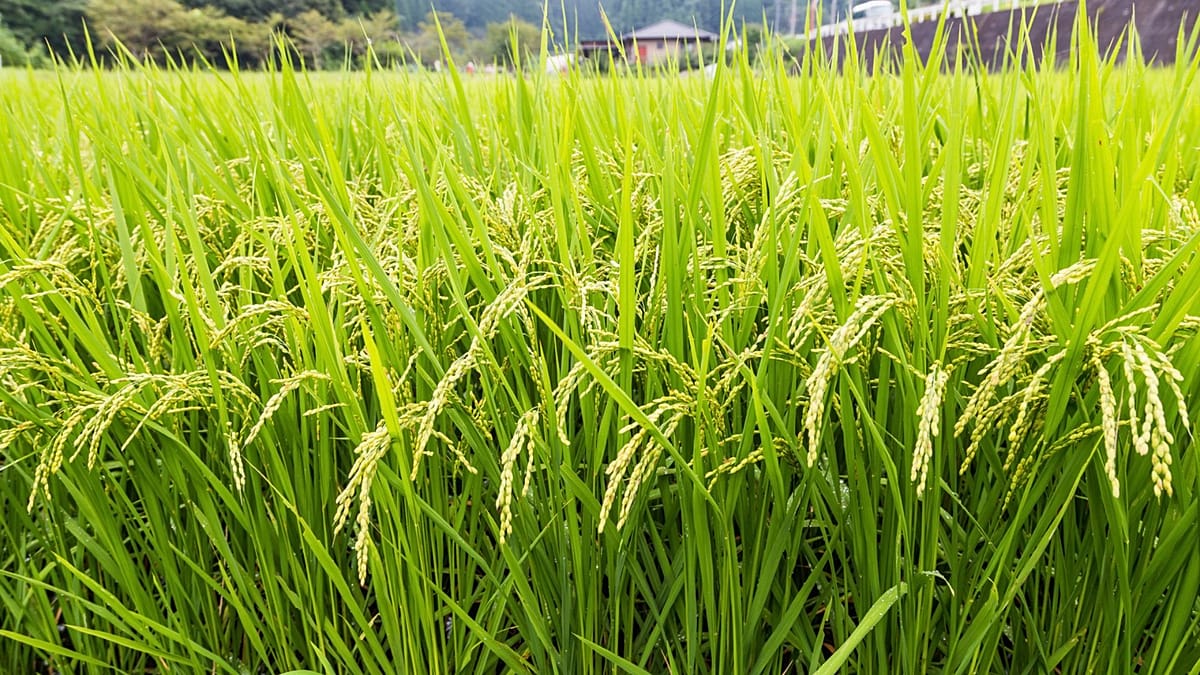
In a low-lying field between Amsterdam and The Hague, a combine harvester works through a crop that has never before been grown commercially in the Netherlands: rice. The machine, operated by farmer Sander Roeleveld, is flanked by windmills and canals, a scene that once epitomised Dutch dairy farming. But Roeleveld, who calls himself a pioneer, is part of a small but growing movement to rethink what the country's wetlands can produce.
For centuries, cows have been the backbone of Dutch agriculture, but the country's peat soils are drying out, releasing carbon dioxide and causing the land to sink. Now, researchers and farmers are betting that rice—a crop that thrives in flooded fields—could offer a way out. The pilot project, covering just 0.6 hectares, is testing around 30 rice varieties from Russia, China, Japan, and Uzbekistan to see which performs best in the cool, wet Dutch climate.
A solution to a sinking problem
Roughly one-tenth of the Netherlands is peatland, most of which has been drained for pasture. As the peat dries, it oxidises and releases greenhouse gases, while the ground subsides by up to several centimetres a year in the worst-affected areas. According to Wageningen University, emissions from Dutch peat soils account for about 2–3% of the country's total greenhouse gas output. The only way to halt this cycle is to keep the fields wet—but until now, that meant they were useless for farming.
"Basically it started with just a crazy idea," says Julian Helfenstein, a researcher at Wageningen University and Research, who is leading the project with colleagues from Leiden University. The idea is to grow rice in flooded peatlands, which not only stops the peat from degrading but also produces a valuable crop. "Rice is an opportunity for this part of the world to adapt to climate change," Helfenstein explains, "but also to mitigate climate change because it stops this peat from degrading and emitting all the CO2 because you can keep it wet."
The issue extends beyond the Netherlands. Peatlands are widespread across northern Europe, including Germany, Belgium, and the Baltic states. Helfenstein and his team are closely monitoring the emissions of CO2 and methane from rice paddies compared to conventional grassland, to ensure the cure is not worse than the disease. "So far the results are promising," he says.
For Roeleveld, the motivation is simple. "My goal is to show that more things are possible on wetland than just grass," he says. "Of course, when you have had cows for 600 years, it's really hard to imagine that you want to do something else than having milk from your cow," he laughs. "I just want to show that things can be changed for the benefit of the future."
Philippe Terheggen, chairman of the Land van Ons association that provided the fields, is both excited and sobered by the development. "It's extraordinary," he says. "We would never have thought maybe 20 years ago that we would be able to grow rice in the Netherlands. But it's also scary because it tells you what is possible... now the climate has changed."
From polder to paddy
The project is still in its infancy, but early signs are encouraging. The team hopes to harvest around three tonnes of short-grain rice, suitable for sushi or risotto. Guusje van der Vossen, from the Wij Land association that helps farmers transition to sustainable practices, says local restaurants have already expressed interest in premium Dutch-grown rice. The current crop comes from a variety originally from northern Japan, which seems best adapted to Dutch conditions.
Van der Vossen is one of the few people to have tasted Dutch rice, from an experimental batch last year. "It tasted delicious, to be honest," she says, adding that the aim is to make sushi—and maybe even sake. "It was a bit chewy, but also great."
The shift from cattle to rice is not just a novelty; it represents a broader rethink of how Europe's low-lying regions can adapt to a warming world. As extreme weather becomes more frequent, farmers across the continent are being forced to innovate. In Spain, for example, farmers are pressing for emergency aid as costs rise. The Dutch rice experiment offers a glimpse of a future where agriculture works with nature, not against it.
Helfenstein, who spends his days studying environmental problems, finds the project refreshing. "As an environmental scientist, you're always pointing to the problems. And it can be a bit depressing, like, 'Oh, here's more climate change, here's more pollution'," he says. "And then here's an opportunity for science to work also towards a solution. So I find that thrilling."
For now, the rice paddies remain a pilot, but the potential is clear. If the experiment succeeds, it could offer a blueprint for other peatland regions across Europe, turning a liability into an asset. As the climate continues to warm, the Dutch may find that their future lies not in the pasture, but in the paddy.