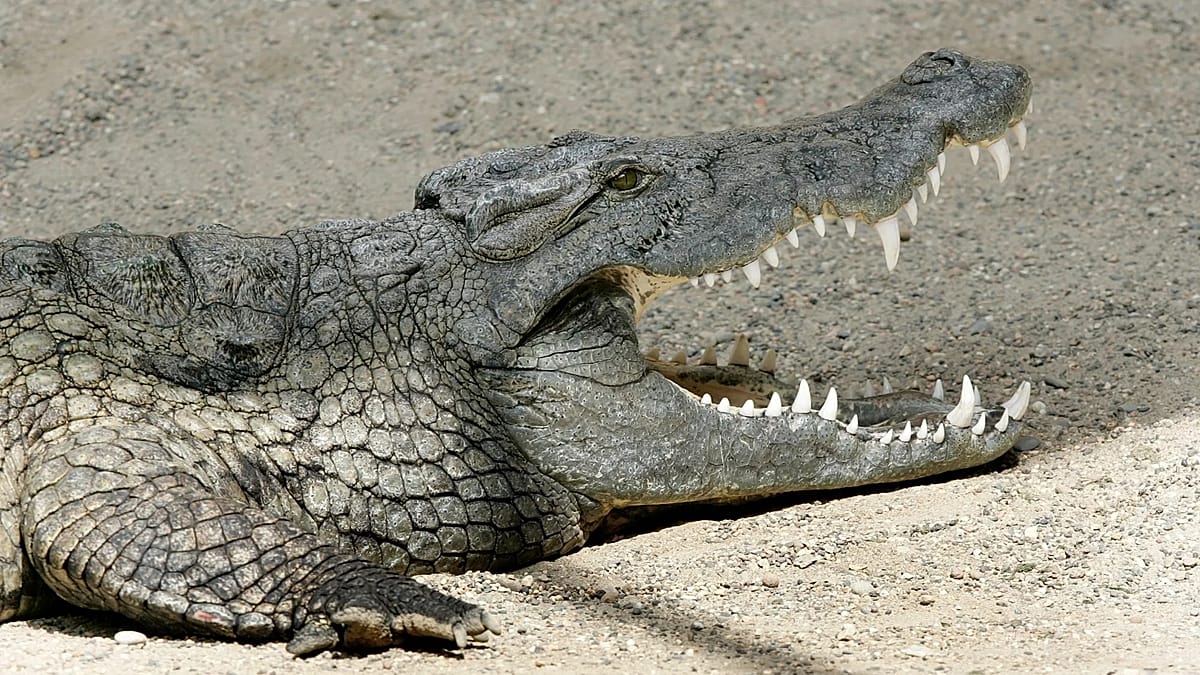
Nearly a century after its discovery, a fossilised crocodile skull from Egypt has been re-examined with modern imaging technology, leading researchers to place it in a brand-new genus. The animal, now named Herugavialis cairensis, lived about 45 million years ago, when much of what is now the Sahara was submerged under warm, shallow seas.
The skull was originally described in 1927 as Tomistoma cairense, placing it in the same genus as the living false gharial, a long-snouted crocodilian found in Southeast Asia. But a fresh analysis using CT scans has revealed structural differences in the skull, including raised, projecting eye sockets, that set it apart from its modern relatives. The findings, published in Royal Society Open Science, prompted the team to assign the species to a separate genus, overturning a classification that had stood for almost a hundred years.
The fossil comes from the Mokattam Formation, the same limestone deposit from which the Great Sphinx of Giza was carved. Like the iconic monument, the skull is missing the tip of its snout, a quirk that inspired the researchers when choosing the new name. The genus name Herugavialis honours Heru, the Egyptian god often associated with the sky and kingship, while the species name cairensis refers to Cairo, the city near where the fossil was found.
Paul Burke of the Swedish Museum of Natural History led the study, co-led by Philip Mannion of University College London. Mannion noted in a statement that the resemblance between the fossil's missing snout tip and the Sphinx's absent nose helped inspire the name, adding a touch of cultural resonance to the scientific work.
Rewriting the crocodile family tree
The reclassification is more than a naming exercise. It sheds light on the evolutionary history of a group of crocodilians known as gavialoids, whose only surviving members are the Indian gharial and the false gharial. Both are characterised by long, narrow snouts adapted for catching fish, but their fossil record shows that their relatives once had a much wider distribution, with more than 40 species recognised across the globe.
During the Eocene epoch, the Mediterranean region was a mosaic of shallow seas and islands, providing rich habitats for these aquatic predators. Herugavialis lived alongside at least two other species of long-snouted crocodiles, indicating a diverse community of these reptiles in what is now Egypt.
The researchers suggest that climatic shifts played a key role in the rise and fall of these animals. Cooling periods and falling sea levels would have reduced the extent of suitable coastal and marine habitats around the Mediterranean, while later warming phases may have allowed their diversity to recover. This pattern echoes broader trends seen in other prehistoric marine life, such as the planetary boundaries that scientists warn are being breached today, though the ancient changes were natural rather than human-induced.
The study also highlights the value of re-examining museum specimens with modern technology. CT scanning allows researchers to peer inside fossils without damaging them, revealing details that were invisible to earlier generations of scientists. This approach has already led to other discoveries, such as ancient Maya dental skill revealed by a jade-inlaid molar, and it continues to reshape our understanding of prehistoric life.
For Egypt, the find adds another layer to its rich palaeontological heritage, which includes not only dinosaurs and ancient whales but also a diverse array of crocodilians. The Mokattam Formation, already famous for the Sphinx, now proves to be a treasure trove for understanding the evolution of these reptiles.
As the team continues to analyse the fossil, they hope to learn more about how Herugavialis lived and interacted with its environment. The missing snout tip, while a curiosity, does not obscure the bigger picture: this ancient crocodile is helping scientists piece together a complex story of adaptation, extinction, and survival that spans tens of millions of years.
The research was a collaborative effort involving scientists from Egypt, the UK, Sweden, and Germany, reflecting the international nature of modern palaeontology. It also underscores the importance of preserving and studying fossil collections, which hold clues to our planet's deep past and, perhaps, to its future.