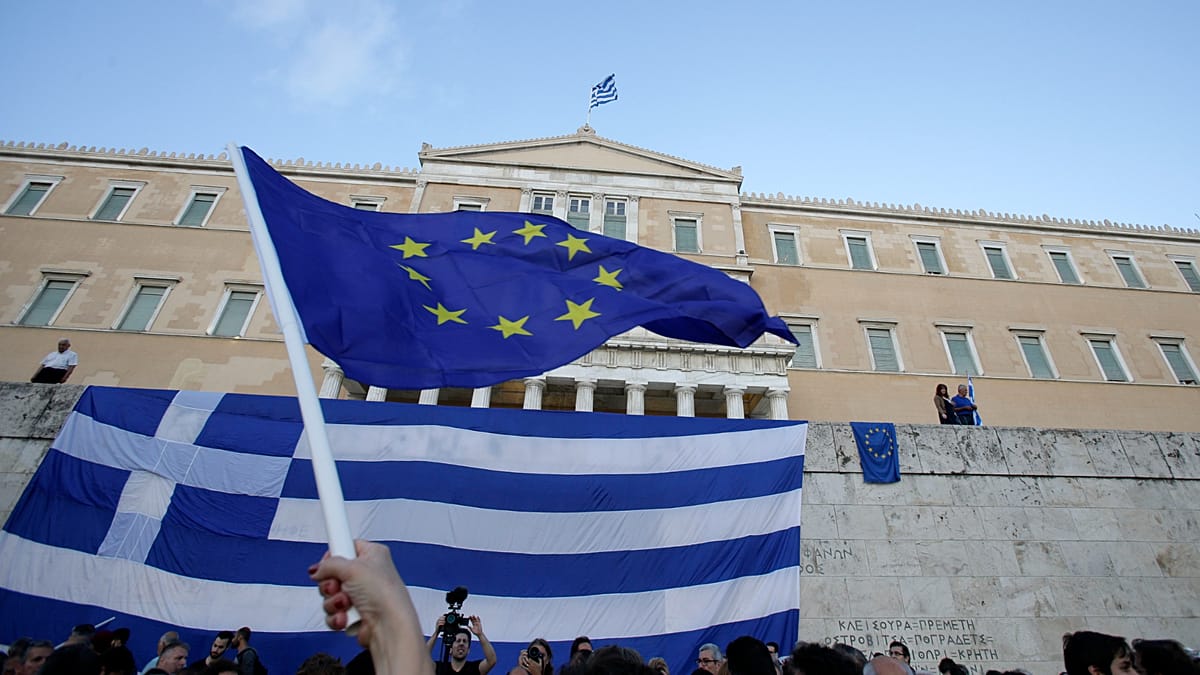
On 29 June 2015, Greeks woke to find their banks closed and ATMs limited to €60 per day. The Athens Stock Exchange remained shut for weeks. Capital controls, typically associated with emerging-market crises, had been imposed on a eurozone member. By February 2016, the Athex Composite had plunged over 90% from its 2007 peak, and the FTSE Athex Banks index had collapsed by 99.6%. Greek equities were written off as an asset class.
A decade later, that narrative has been rewritten. The Athens Composite Index has delivered a total return of roughly 146% over the past five years, outperforming the Nasdaq 100's 116% gain and the S&P 500's approximate 73% return. The Euro STOXX 50 managed barely one-third of Greece's performance. This is the story of how Europe's cautionary tale became one of the most successful turnaround trades in modern finance.
Banking Sector Cleanup Drives the Rally
The recovery began with Greece's four largest lenders: National Bank of Greece, Eurobank, Piraeus Bank, and Alpha Bank. By late 2016, their combined non-performing loan ratio peaked near 47%, the highest in the European Union. Most other troubled European banking systems peaked at between 5% and 8%. Greek banks were not facing a credit problem; they were carrying a depression on their balance sheets.
The cleanup unfolded in two stages. First, the Hellenic Asset Protection Scheme, known as Hercules, allowed banks to securitise and offload roughly €57 billion of bad loans through state-backed guarantees on senior tranches. Second, organic profitability returned as deposits stabilised, cost bases were restructured, and net interest margins recovered. By 2025, the combined net profits of the four largest Greek banks reached close to €5 billion. Shareholder payouts followed: Piraeus, Eurobank, and Alpha Bank distributed around 55% of earnings, while National Bank of Greece pushed its total payout ratio to 86%, supported by aggressive buybacks.
Konstantinos Hatzidakis, then Greece's minister of economy and finance, wrote in the IMF's Finance & Development journal in June 2025: "We have cleaned up bank balance sheets and curbed nonperforming loans. This major milestone has enabled lenders to regain their essential role in financing the real economy." He highlighted rising deposits, stronger capital buffers, and the successful sale of the Hellenic Financial Stability Fund's bank stakes to long-term foreign investors as "a tangible vote of confidence."
Fiscal Transformation: The Quiet Engine
Less visible but equally important has been the overhaul of Greece's tax administration. In a paper published by the IMF last week, economists Andrew Okello, Stoyan Markov, and Chenghong Wang described this transformation as "one of the quiet engines behind Greece's broader economic recovery." The reform process unfolded in three overlapping stages.
Between 2010 and 2012, under Troika supervision, the focus was on stabilising government revenues. VAT digitalisation was an early breakthrough: only 65% of registered taxpayers filed VAT returns on time in 2010, compared with 96% by 2014. From 2013 to 2017, institution-building took centre stage. Greece consolidated 288 local tax offices into 119 and established the Independent Authority for Public Revenue under a landmark 2016 law. By 2017, the authority had its own budget and independently selected management board. During that period, the tax-to-GDP ratio rose from 25.8% to 27.6%.
From 2018 onwards, real-time electronic invoicing, point-of-sale connectivity, and digital analytics systems were introduced. VAT revenues climbed from 7.1% of GDP in 2010 to around 9.5% in 2025. Overall, Greece's tax-to-GDP ratio rose from 20.5% in 2009 to roughly 28% in 2025. The result has been a dramatic fiscal turnaround: Greece recorded a primary surplus close to 5% of GDP in both 2024 and 2025, making it one of only a handful of EU countries running a fiscal surplus.
Sovereign spreads over German bunds, which once exceeded 30 percentage points during the crisis peak, have returned to levels last seen before the 2008 financial crisis. According to the IMF's March 2026 Article IV statement, Greece's public debt-to-GDP ratio fell by around 10 percentage points in 2025 alone, reaching roughly 145%, down from a peak near 210% in 2020. The IMF estimates the cumulative decline at roughly 65 percentage points from the pandemic-era peak.
Credit-rating agencies eventually followed. Scope Ratings restored Greece to investment grade in August 2023, followed by DBRS later that year, S&P in October 2023, and Fitch in December 2023. Moody's, the final holdout, upgraded Greece to Baa3 in March 2025 and reaffirmed the rating in April 2026. For the first time in over a decade, all major agencies classify Greek sovereign debt as investment grade.
The third pillar of the rally was valuation. Greek equities entered the recovery period trading at deeply depressed levels, offering a margin of safety that attracted contrarian investors. As the economy stabilised and reforms took hold, the market repriced accordingly. While the Nasdaq 100 rode the artificial intelligence supercycle, Greece's gains were rooted in a fundamental economic transformation.
This turnaround has broader implications for Europe. It demonstrates that even a member state that experienced a sovereign debt crisis, capital controls, and a banking collapse can recover through sustained reform. For investors, the lesson is that markets can reward patience and structural change. For policymakers, Greece's experience offers a template for fiscal discipline and institutional modernisation. As the IMF economists noted, the quiet engine of tax reform has been central to this success, and its effects are likely to persist.