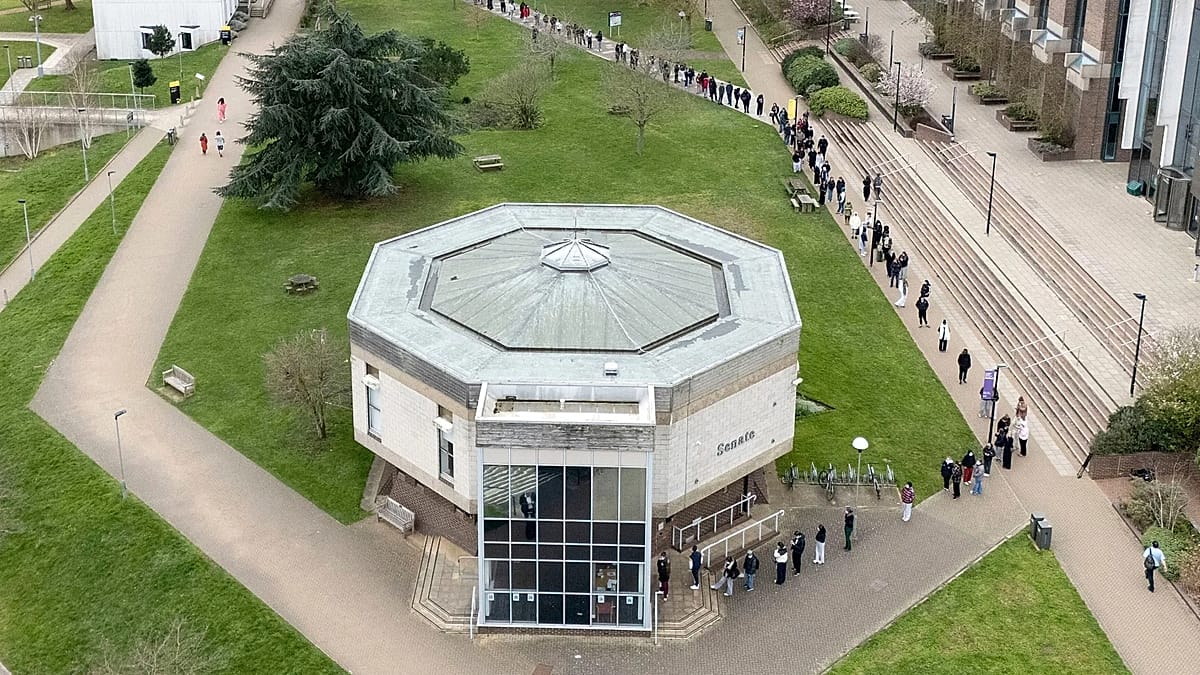
Two British universities have formally merged to create what they call the UK's first 'super-university'. The University of Greenwich in London and the University of Kent in southeast England announced on Monday that they have completed their union, establishing the London and South East University Group, known as LASE.
The new entity is designed to be expandable, with the possibility of other universities joining in the future. With a combined student body of over 50,000, LASE becomes the third-largest university in the UK by enrolment.
Despite the merger, both institutions will retain their individual names and academic structures. Students will continue to apply, study, and graduate from their chosen campus, while LASE will operate as an overarching group with its own chancellor, governing body, and senior executive team.
A new model for higher education
The official launch of LASE is scheduled for 7 September, with celebrations planned across its four campuses in Greenwich, Avery Hill, Medway, and Canterbury. Professor Jane Harrington, the founding vice-chancellor and CEO of LASE, promised a 'truly spectacular launch' and said further details would be revealed at that time.
Harrington expressed gratitude to all those involved in the merger, noting the 'tireless work over the last year' to develop a new university model that has never been attempted before. She highlighted the smooth transition and the strength of the senior executive team as key foundations for fulfilling LASE's potential as the UK's first super-university.
The merger comes at a time of significant economic strain for British higher education. In May, a parliamentary education select committee warned that universities across the UK are facing serious financial difficulties, with the possibility of a major institution collapsing. The committee's report stated that the higher education sector in England is confronting a financial crisis that poses a real risk of institutional insolvency.
This move reflects a broader trend of consolidation in European higher education, as institutions seek to achieve economies of scale and enhance their competitiveness. While the UK is not part of the EU, its universities remain deeply interconnected with the continent through research collaborations and student exchanges.
For students and staff, the merger promises continuity rather than disruption. Academic divisions will remain distinct, and the group's governance structure is designed to preserve the identities of both founding universities while enabling shared strategic direction.
Observers will be watching closely to see whether this 'super-university' model delivers the financial stability and academic excellence that its architects envision. As European universities grapple with similar pressures, LASE could serve as a test case for future collaborations across the continent.