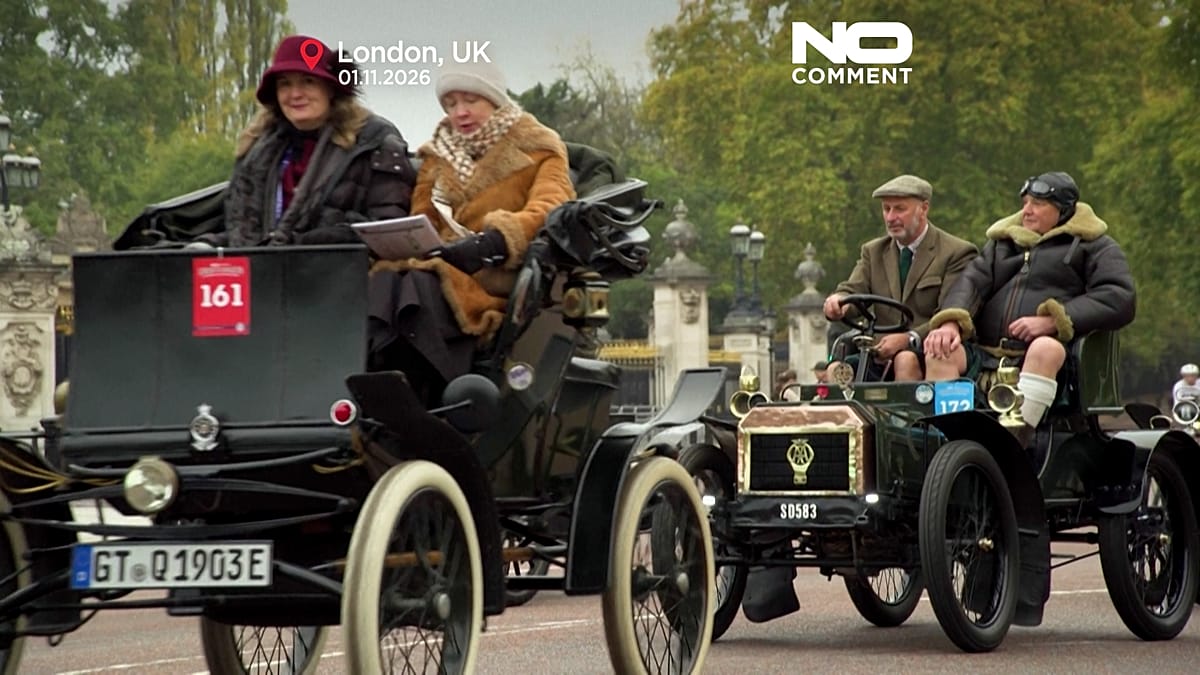
On a crisp November morning, the streets of London echoed with the chug of engines that predate the modern era. The annual London to Brighton Veteran Car Run saw dozens of pre-1905 vehicles set off from Hyde Park, retracing the route that has become a pilgrimage for motoring enthusiasts across Europe. This year's edition carried particular weight, marking 140 years since the birth of the motor car in Britain.
The event, which has run since 1927, commemorates the Emancipation Run of 1896, when the Locomotives on Highways Act raised the speed limit for 'light locomotives' from a walking pace to 14 mph. That legislative shift effectively liberated the automobile, and the modern run honours that moment with a parade of steam-powered carriages, electric broughams, and early petrol-driven machines.
Among the participants were vehicles from as far back as the 1880s, including a steam carriage that puffed its way through the capital's traffic. The route winds from Hyde Park through south London, past the suburbs of Croydon and Redhill, before descending the North Downs into Brighton, where the seafront becomes a living museum of motoring history.
A rolling museum of European engineering
The run is not merely a nostalgic spectacle; it is a testament to the ingenuity of European manufacturers. Many of the cars on display were built in France, Germany, and Italy, reflecting the continent's shared role in the development of the automobile. French marques like De Dion-Bouton and Panhard et Levassor were prominent, alongside British names such as Daimler and Lanchester. The diversity underscores how the motor car was a collaborative European project long before the EU existed.
For the drivers, the challenge is not speed but endurance. The veteran cars, with their brass fittings and wooden wheels, must complete the 60-mile journey without breaking down—a feat that requires careful preparation and a touch of luck. Many participants spend months restoring their vehicles, sourcing period-correct parts, and tuning engines that run on a mix of petrol and oil.
"It's a living history lesson," said one participant, a retired engineer from Munich, who had brought his 1903 Mercedes-Simplex. "You feel every bump in the road, and you smell the oil and the exhaust. It's a completely different way of travelling."
The event also draws a continental crowd. Enthusiasts from the Netherlands, Belgium, and Scandinavia travel to London to take part, and the finish line on Brighton's Madeira Drive is a carnival of international number plates. The run has become a fixture in the European motoring calendar, a chance to see machines that rarely leave their museums or private collections.
Beyond the spectacle, the run highlights the evolution of transport policy. The 1896 Act was a British response to a European-wide debate about how to regulate the new technology. France had already embraced the automobile, and Britain's cautious approach was seen as a brake on innovation. The Emancipation Run was a direct challenge to that caution, and its legacy is a road network that now connects the continent.
This year's event also coincided with broader discussions about the future of motoring. As European cities push for car-free zones and electric vehicles become the norm, the veteran run offers a counterpoint—a reminder of the romance of the open road. Yet the organisers are keen to stress that the event is not anti-modernity. "We celebrate the past, but we also look forward," said a spokesperson. "The same spirit of innovation that drove these pioneers is driving today's engineers."
For spectators, the run is a free and accessible spectacle. Families lined the route in south London, waving flags and cheering as the old cars chugged past. In Brighton, the seafront was packed with onlookers, many of whom had travelled from across the UK and Europe to see the finishers. The atmosphere was festive, with brass bands and period-dressed volunteers adding to the Edwardian ambience.
The London to Brighton run is more than a parade; it is a moving museum of European industrial heritage. As the last car crossed the finish line, the sun set over the English Channel, and the veterans were loaded onto trailers for the journey home. But for one day, the roads belonged to the past, and the continent's motoring history was on full display.