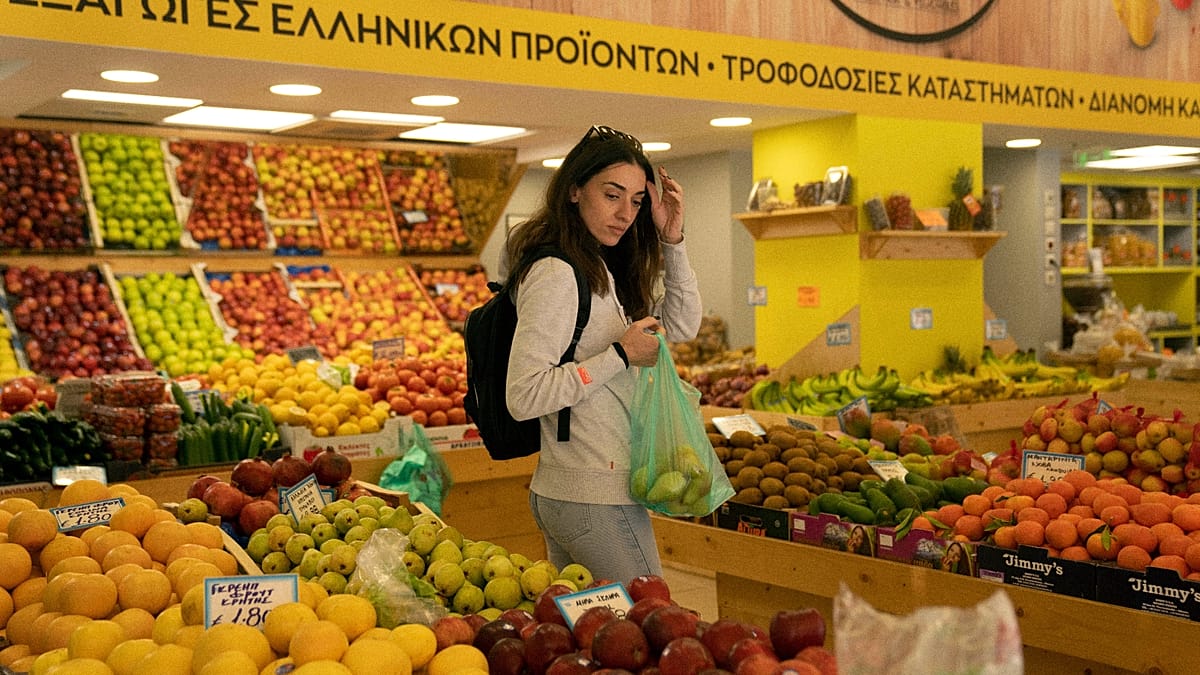
Food takes a significant slice of household budgets across Europe, but the cost of filling a shopping basket varies dramatically from one country to another. In the EU, food and non-alcoholic beverages account for 13.6% of household spending, compared with 23.6% for housing and utilities, according to Eurostat.
Using mid-2026 data from Numbeo, a crowdsourced cost-of-living database, the grocery index ranges from 57.2 in Moldova to 189.2 in Switzerland, with the EU average set at 100. That means groceries are 89.2% more expensive than the EU average in Switzerland, while they are 42.8% cheaper in Moldova. A basket costing €100 at average EU prices would set you back €189.20 in Switzerland and just €57.20 in Moldova.
Nordic countries dominate the expensive end
Three of the five most expensive countries are Nordic. Iceland ranks second at 183.6, followed by Norway (154.4), Luxembourg (134.9) and Denmark (128.4). Finland (119.7) and Sweden (116.6) also sit above the EU average.
Among Europe's five largest economies, France is the priciest for groceries, at 27.5% above the EU average. Spain (89.7) is the only one below the average. The UK (111.9), Germany (111.6) and Italy (110.2) cluster closely above it. Austria (124.5), Ireland (122), Belgium (117.6) and the Netherlands (116.4) are also above the EU average.
Within the EU, Romania is the cheapest country for groceries, with prices 33.3% below the average. Eastern European and Balkan countries, including EU candidates, also offer lower prices: North Macedonia (59.8), Bosnia and Herzegovina (67.9) and Serbia (68.8). Turkey (82.1) is below the EU average but has the highest food inflation in Europe.
Lower prices don't always mean greater affordability
Ilaria Benedetti, an associate professor at the University of Tuscia, points out that while food prices are lower in some countries, households spend a larger share of their budget on food. In Romania, groceries are cheap, but households spend 23.1% of their budgets on food and non-alcoholic drinks; in Bulgaria, that share exceeds 20%.
“Lower prices do not necessarily mean greater affordability,” says Prof. Jeremiás Máté Balogh from Corvinus University. He emphasises that wages and purchasing power matter: groceries can be cheaper in absolute terms but less affordable relative to what people earn after tax.
To illustrate the gap, Numbeo lists 19 items in its “Markets” category. Adding up the prices of 18 items (excluding cigarettes, which vary widely) gives an average EU basket cost of €69.84. The basket is most expensive in Switzerland at €137.90 and cheapest in Moldova at €41.10. It also exceeds €100 in Norway (€116.10), while Luxembourg (€99), Austria (€88.10) and Denmark (€87.70) are close behind.
France remains the most expensive among the five major economies: the basket costs €87.40 there, compared with €63 in Spain, €80 in Italy, €75.20 in Germany and €69.10 in the UK. The same 18 items can be bought for less than €50 in North Macedonia (€43.90), Kosovo (€45.50), Romania (€45.90), Georgia (€46.90), Poland (€49.60), Serbia (€49.70), Montenegro (€49.80) and Bosnia and Herzegovina (€49.80).
These rankings are based on nominal prices. When purchasing power is taken into account, the gap narrows, and the rankings may shift slightly if the basket is weighted differently.
Energy and labour costs are the main drivers
“Labour costs have likely become one of the most persistent drivers of grocery prices across Europe, but energy costs remain an important factor,” says Balogh. Higher energy, fuel and transportation costs continue to affect agricultural production, food processing and distribution.
Benedetti adds that energy is the main driver of recent food price rises, particularly fuel. Since the strikes on Iran at the end of February, the average price of diesel in the EU has risen from €1.59 per litre on 23 February to €2.24 on 28 September, the highest level since records began in 2005. “Diesel moves the whole food chain, from tractors to the lorries that supply supermarkets,” she notes.
She also warns that when inflation slows, prices do not necessarily fall. If inflation remains positive, they keep rising, only more slowly, from a higher level.
Why bread costs three times more in Denmark than in Bulgaria
“The price of food in a shop is only partly the cost of the food itself,” Benedetti explains. “It also includes wages, energy, rents, transport and taxes, which are much higher in richer countries.”
A 500g loaf of fresh white bread costs €3.18 in Denmark and €1.02 in Bulgaria — more than three times as much, according to Numbeo. A dozen eggs, a more standardised product, costs €4.52 in Denmark and €2.69 in Estonia, less than twice as much.
These price differences have broader implications for household budgets and inflation. As Europe's uneven price shock shows, the European Central Bank's single interest rate cannot address the divergent cost-of-living pressures across member states. Meanwhile, inflation protests have spread across Europe, highlighting the political sensitivity of food prices.