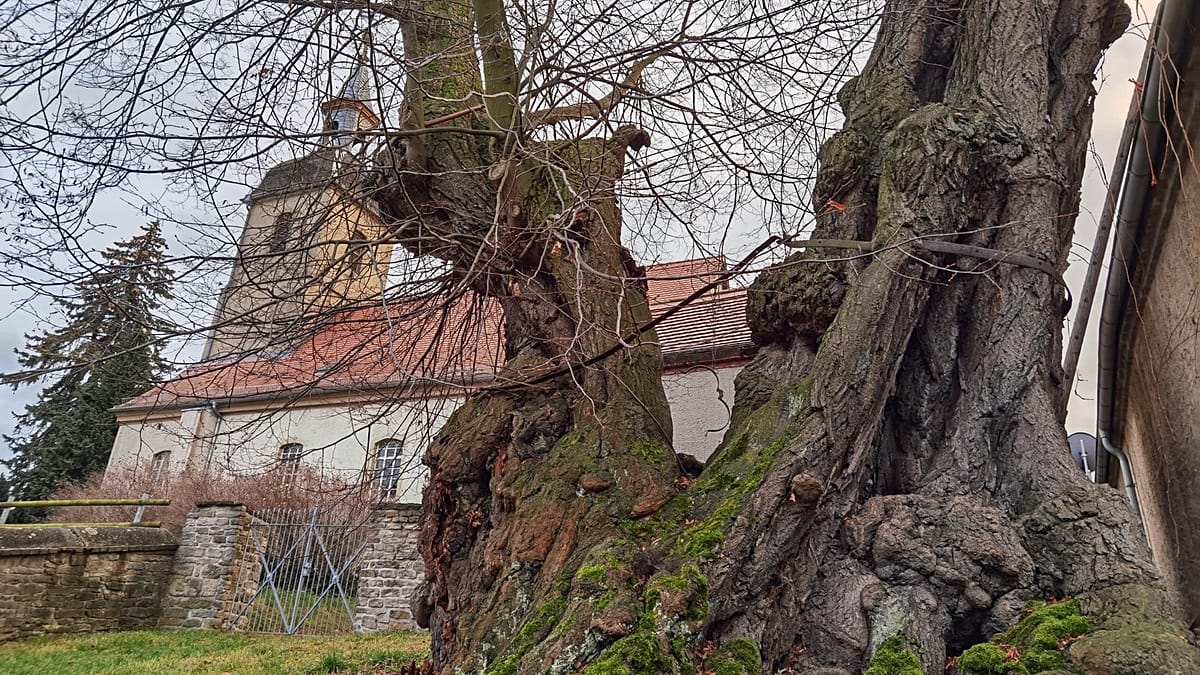
In the quiet village of Großpörthen, about five kilometres south-east of Zeitz in Saxony-Anhalt, stands a tree that has silently observed centuries of change. The mighty winter lime (Tilia cordata) beside the village church is estimated to be between 700 and 900 years old, with a trunk circumference of roughly 9.85 metres and a height of about twelve metres. Experts from the German Dendrological Society believe it is the thickest known winter lime in Germany.
But the tree's significance goes beyond its age. Known locally as the Prangerlinde (pillory lime), it once served as a site of public punishment. A rusty iron collar, still visible on the trunk today, is a stark reminder of a time when justice was meted out in the open, designed to humiliate as much as to penalise.
A relic of medieval justice
Iron collars were metal rings locked around a convicted person's neck, anchoring them to the tree for public display. This form of shame punishment is documented in German-speaking lands from at least the 14th century and remained in use well into the 18th century. The goal was to destroy the offender's reputation through public ridicule, often combined with corporal punishment. In some cases, offenders were forced to wear signs describing their crime.
The pillory was used for a wide range of offences, including petty theft, insults, slander, disturbing the peace, moral transgressions, and cheating on weights and measures. The tree in Großpörthen thus stands as a silent witness to a legal system that valued public shaming as a deterrent.
Prof. Dr. Andreas Roloff, a dendrologist associated with the national heritage tree project, notes: "The iron collar on the tree is rusty but otherwise well preserved."
Surviving the centuries
Determining the exact age of such an ancient tree is difficult, as the trunk changes over time. The lime's unusual position on a slope has caused significant thickening and overgrowth in the trunk and root area, complicating precise dating. Despite losing a large part of its trunk around the mid-20th century, the tree has recovered and is considered healthy.
Großpörthen's lime is now Germany's second-oldest tree, having recently been surpassed by a yew about 1,100 years old in the Allgäu region. The oldest lime in Germany stands in Upstedt, Lower Saxony, where a summer lime (Tilia platyphyllos) has been a court tree since the 13th century. However, there is no evidence that the Upstedt tree was ever used as a pillory, making Großpörthen's example particularly rare.
Such living monuments offer a tangible link to Europe's legal and social history. They remind us that justice was once a public spectacle, deeply embedded in community life. For those interested in exploring more of Europe's historical oddities, the medieval festival in Sighișoara brings Transylvania's past to life, while a Viking textile workshop discovery near Aarhus is rewriting economic history.
The pillory lime of Großpörthen is more than a botanical curiosity; it is a monument to the evolution of justice. As Europe continues to reflect on its legal traditions, this ancient tree stands as a silent, enduring witness.