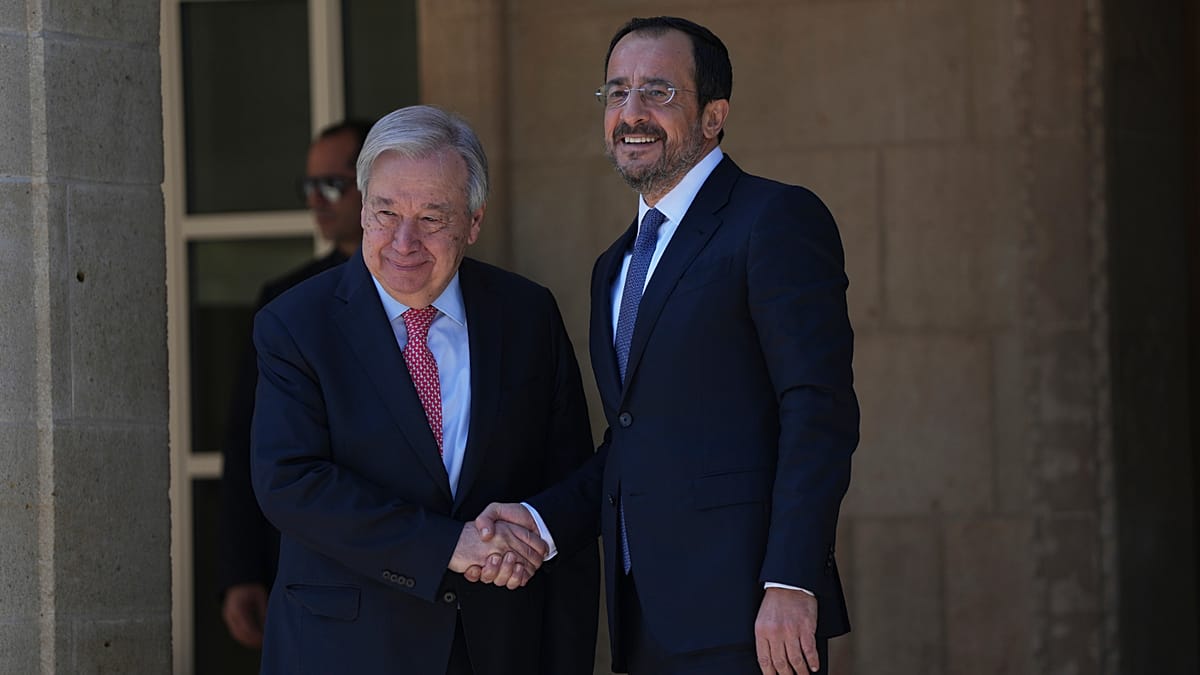
United Nations Secretary-General António Guterres has reiterated his determination to revive negotiations on the Cyprus dispute after holding separate meetings with the island's two main political leaders. The discussions, which took place in Nicosia and the Turkish Cypriot-administered north, are part of a broader UN effort to break the decades-long impasse.
Cyprus has been divided since 1974, when Turkey invaded the northern third of the island following a brief Greek-inspired coup. The internationally recognised Republic of Cyprus, a European Union member state, controls the predominantly Greek Cypriot south, while the Turkish Republic of Northern Cyprus — recognised only by Ankara — administers the north. A UN-patrolled buffer zone, known as the Green Line, cuts through the capital, Nicosia, and separates the two communities.
A Visit of Solidarity
Speaking to reporters after his meeting with President Nikos Christodoulides at the Presidential Palace in Nicosia, Guterres described his trip as a “visit of solidarity” with the people of Cyprus. He stressed that he remains “strongly committed” to supporting both Greek Cypriots and Turkish Cypriots in their search for a settlement.
“It depends obviously on the Cypriots themselves, but also the guarantors have a role to play,” Guterres said. “I will do everything I can to support the Greek Cypriots and the Turkish Cypriots in this very important moment.”
Under the 1960 treaties that established the Republic of Cyprus, Greece, Turkey and the United Kingdom serve as guarantor powers. Their role has been a recurring point of contention in past negotiations.
The UN chief emphasised that the current instability in the wider Middle East and Eastern Mediterranean makes progress on Cyprus particularly urgent. “If there is a moment in which the solution of the Cyprus problem is important, it is now,” he said, referring to regional turmoil and geopolitical shifts that could place the island at the centre of unwanted developments. A settlement, he added, would benefit not only Cyprus but the entire region.
Guterres was careful to note that the United Nations can facilitate and support the process but cannot impose a solution. “It is not my role to tell anyone what needs to be done,” he said. “I am here, with humility and full commitment, to support your efforts.”
For his part, Christodoulides welcomed the Secretary-General's engagement, calling it “yet another clear indication of his commitment” to resolving the Cyprus issue on the basis of UN Security Council resolutions. “We need good news in Cyprus. We need good news in the region. We need good news internationally, and we are counting on your support and your political commitment,” the Cypriot president said.
Christodoulides also warned that certain actors are undermining the international system established after the Second World War, and that the international community has a responsibility to ensure respect for international law, values and principles.
Meeting with the Turkish Cypriot Leader
Guterres later crossed the Green Line to meet Turkish Cypriot leader Tufan Erhürman in the northern part of Nicosia. The meeting lasted more than an hour. Afterwards, Guterres described the talks as “productive” and reiterated his commitment to efforts to resume negotiations.
Greek Cypriot government spokesman Konstantinos Letymbiotis characterised the meeting with Christodoulides as “substantive and sincere.” He said the Greek Cypriot side hopes the current diplomatic activity will lead to concrete developments and eventually to a broader UN-led conference involving the two Cypriot sides and the three guarantor powers.
The separate meetings do not yet constitute a formal resumption of negotiations. They are intended to assess whether sufficient common ground exists for the parties to move towards substantive talks. Guterres is also meeting representatives of civil society organisations and groups working on practical cooperation across the divide.
On Tuesday evening, Guterres will host Christodoulides and Erhürman for a private dinner, followed by a joint meeting with both leaders on Wednesday. The outcome of these discussions will determine whether the UN can convene a more formal negotiating round in the coming months.
The Cyprus dispute remains one of the longest-running frozen conflicts in Europe. Past UN-led efforts, including the 2004 Annan Plan, have failed to produce a settlement. The discovery of offshore natural gas reserves in the Eastern Mediterranean has added a new economic dimension to the dispute, while Turkey's increasingly assertive foreign policy under President Recep Tayyip Erdoğan complicates the geopolitical landscape.
For now, Guterres's visit signals that the UN is not ready to give up on Cyprus. But as he himself acknowledged, the ultimate responsibility lies with the Cypriots and the guarantor powers.