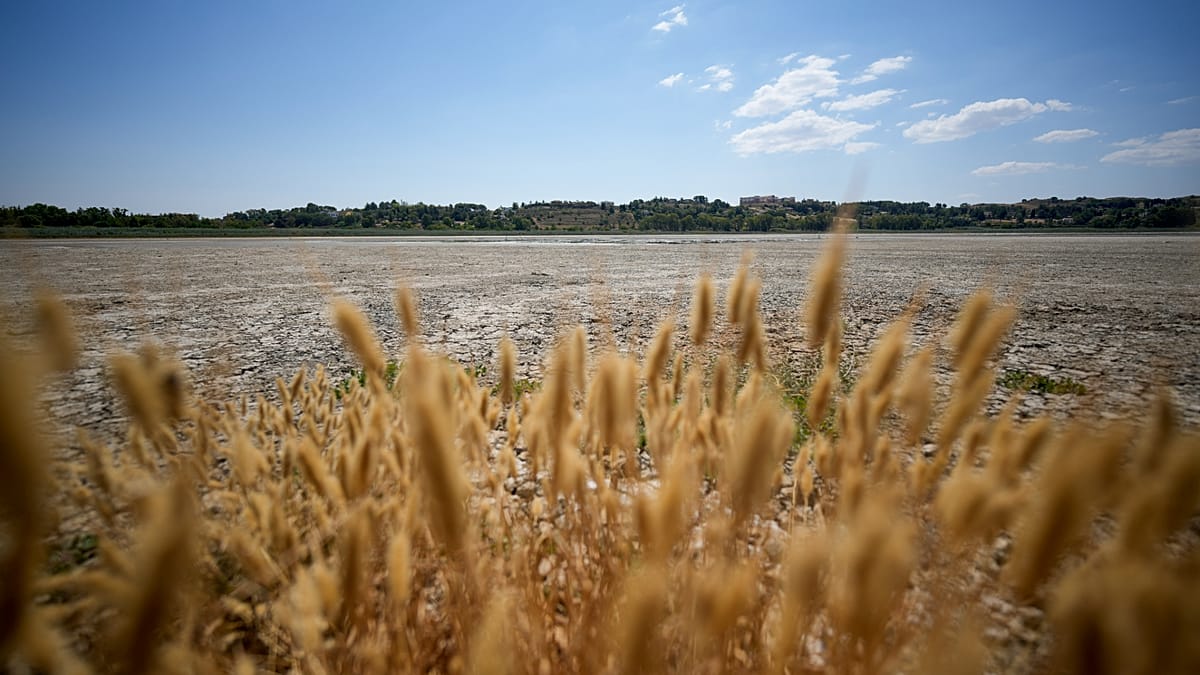
For years, European droughts were blamed on a simple lack of rain. But a new study by World Weather Attribution (WWA), an international collaboration of climate scientists, turns that assumption on its head: the real culprit is heat. Record-breaking summer temperatures are now the primary force behind the continent's drying soils, evaporating moisture faster than precipitation can replenish it.
The research, involving scientists from 12 European countries, analyzed rainfall trends, agricultural soil moisture, and a measure called potential evapotranspiration—essentially the atmosphere's thirst. Their conclusion is stark: while long-term rainfall patterns vary across Europe, extreme heat is transforming what were once manageable dry spells into severe, multi-month droughts.
Soil Moisture Disappearing at an Alarming Rate
In Western Europe, agricultural soil droughts are now five times more likely due to climate change. In Eastern Europe, where dry conditions have persisted for six months, the likelihood jumps to 11 times. The study found that climate change is not the main driver of reduced rainfall in the west, but it has made heatwave conditions—which dramatically increase evaporation—roughly 80 times more likely than in a world without global warming. In Eastern Europe, that figure is around 40 times.
“Europe’s climate is shifting fast,” said Dr. Sarah Kew, a climate scientist at the Royal Netherlands Meteorological Institute (KNMI). “While rain patterns remain mixed, our findings show that extreme heat is taking over as the primary driver of drought on our continent. We are seeing water supplies evaporate out of our soils and rivers faster than we would have in a world without climate change, turning what would have been manageable dry spells into severe droughts.”
Dr. Dominik Schumacher, from the Institute for Atmospheric and Climate Science at ETH Zurich, noted a fundamental change in how European droughts form. “Despite more wintertime rainfall across most of Europe, we now see an enhanced tendency for unusual soil drying already in spring, before summer has even begun,” he said. “That is our own doing: as temperatures climb, the atmosphere’s thirst increases quickly, sucking moisture out of rivers, lakes, reservoirs and the soil. This fundamentally changes how European droughts form—less and less through missing rain, and more and more through warmer air that prevents the rain from staying in the ground.”
The consequences are already visible. France is heading for its worst maize harvest in 50 years. Romania has lost more than a million hectares of crops. Rivers across the continent are running so low that shipping lanes are disrupted and energy production is under strain. These failures are not just agricultural problems; they ripple through the entire economy.
Food Prices and Vulnerable Households on the Front Line
“This isn’t just a crisis for farmers, it’s a crisis that trickles down to Europe’s most vulnerable,” said Merel Laauwen of Wageningen University & Research in the Netherlands. “Crop losses, low river levels, and water use restrictions threaten to drive up the price of basics like food and energy, hitting low-income households hardest. Although science is telling us that we will see more frequent and intense droughts in the future, drought management plans are still not mandated by the EU and we see inconsistent preparedness across European countries.”
The study also highlights a worrying trajectory. With global temperatures already 1.4°C above pre-industrial levels, these conditions are occurring now. If emissions push warming to 2.8°C, as currently projected, the likelihood of such intense evaporative conditions could double. “Scorching, dry summers” could become a yearly occurrence, warned Dr. Mariam Zachariah of the Centre for Environmental Policy at Imperial College London.
Simon Stiell, executive secretary of UN Climate Change, called Europe’s worsening droughts an “unignorable red alert that our planet is overheating as the climate crisis gets rapidly worse.” He urged faster adoption of renewable energy, electrification of economies, and investment in resilience to protect communities and economies.
The findings come as Europe grapples with broader climate challenges, including record heatwaves in Central Asia that underscore the global nature of the crisis. For European policymakers, the message is clear: the era of drought driven solely by rain shortage is over. Heat is now the dominant force, and adaptation must follow.