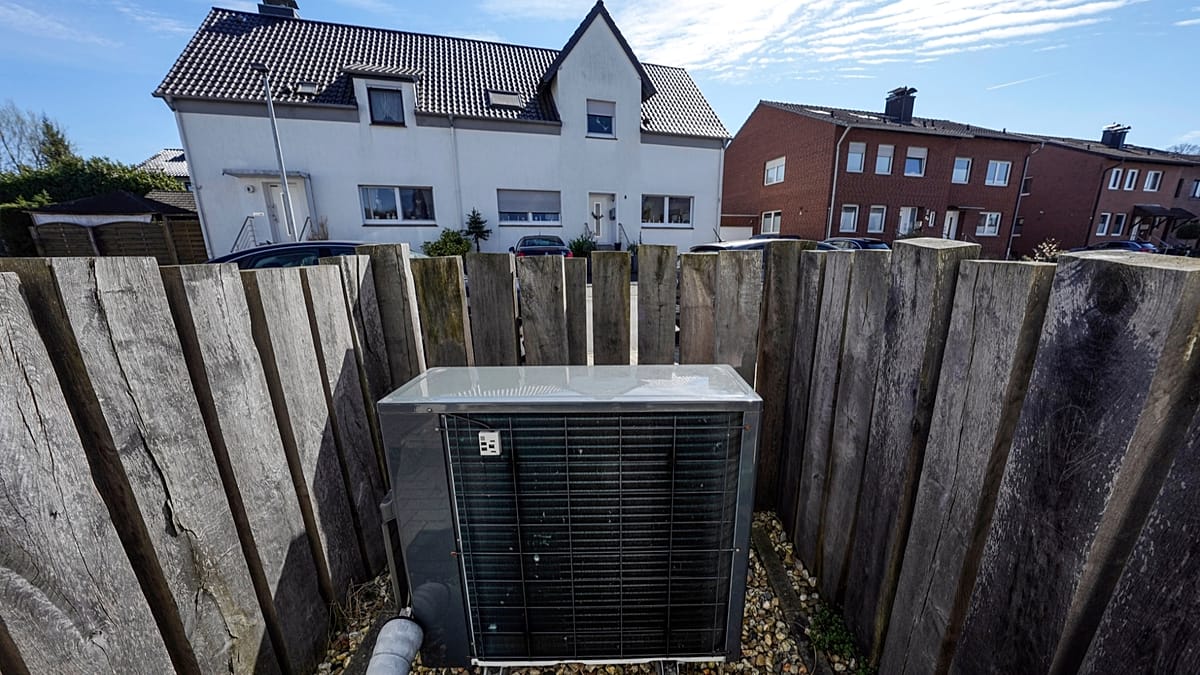
Across Europe, the shift away from fossil fuel heating is accelerating. New data from the European Heat Pump Association (EHPA) shows that heat pump sales rose by an average of 10.3 percent across 16 European countries in 2025, with 2.62 million residential units sold. This brings the total number of heat pumps installed on the continent to over 28 million, as the technology increasingly outsells traditional gas boilers in several key markets.
Germany overtakes gas boilers
In Germany, heat pumps have become the best-selling heating technology, accounting for 48 percent of all new heating systems sold last year — a 21 percent increase from 2024, with 299,000 units sold. Meanwhile, the share of gas boilers fell to 44 percent. “The new figures highlight how Germany can reduce its dependence on fluctuations in oil and gas prices,” says Corinna Enders of the German energy agency dena. The trend is bolstered by falling installation costs and government subsidy schemes, which have made the green technology more accessible to households.
Belgium also saw a seven percent rise in heat pump sales, reaching 11,000 units, driven by new restrictions on fossil fuel heating and a VAT reduction on heat pumps. In the United Kingdom, historically one of Europe’s slowest adopters, sales grew by 27 percent to 125,000 units, thanks in large part to the government’s Boiler Upgrade Scheme, which offers eligible households a £7,500 (around €8,658) grant for air source or ground source heat pumps.
Scandinavia leads, but southern Europe catches up
Scandinavia remains the most saturated market, with more than 30 heat pumps sold per 1,000 households across three key nations as of 2025. Norway leads with 662 heat pumps per 1,000 households, followed by Finland (548), Sweden (509), and Denmark (229). These cold-climate countries have disproved the common misconception that heat pumps are ineffective in low temperatures, a factor that has historically deterred adoption in other parts of Europe.
Among the 16 countries surveyed, France ranks fifth with 216 heat pumps per 1,000 households, ahead of Belgium (196), Italy (184), and Switzerland (179). The technology’s versatility is increasingly recognized across diverse climates, from the Nordic chill to Mediterranean winters.
Poland struggles with disinformation
Not all markets are thriving. In Poland, heat pump sales declined last year, a trend the Ministry of Climate and Environment attributes to a “wave of disinformation” about how the technology works, which is hindering the modernization of the country’s heating system. This contrasts sharply with the broader European trend and highlights the challenges of combating misinformation in the energy transition.
Geopolitical shocks fuel further growth
The ongoing conflict involving Iran and the effective closure of the Strait of Hormuz have sent shockwaves through global energy markets, further boosting heat pump adoption. In the UK, sales rose more than 50 percent in the first three weeks of March compared to the previous month, according to energy firm Octopus Energy. Across 11 European countries, residential heat pump sales spiked by 25 percent in the first quarter of 2026, with 575,000 units sold in France, Germany, and Poland on average.
As Europe doubles down on home-grown, clean energy, heat pumps are emerging as a key tool for reducing dependence on volatile fossil fuel imports. The technology’s ability to provide efficient heating even in cold climates, combined with supportive policies and falling costs, suggests the boom is likely to continue. For a continent seeking energy security and climate resilience, the numbers are clear: the heat pump era has arrived.