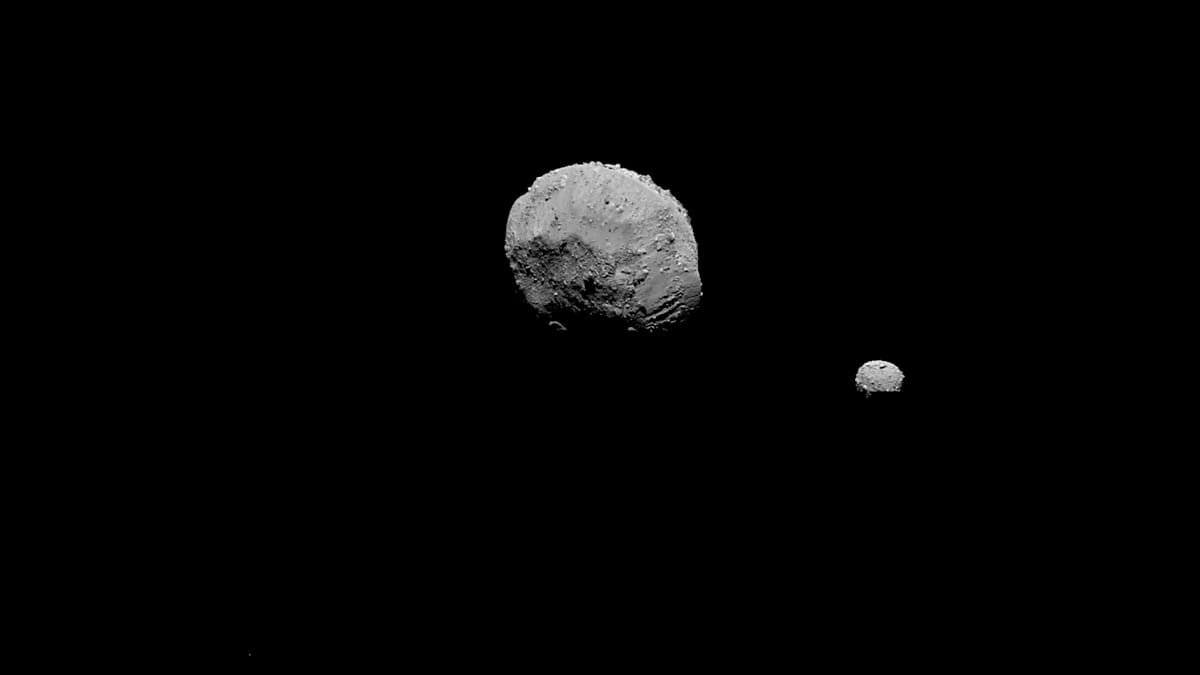
New images from the European Space Agency's Hera spacecraft have given scientists their clearest look yet at the aftermath of humanity's first planetary defense test. The footage shows the asteroid Dimorphos circling its larger companion Didymos, with a vast crater—roughly the size of a sports stadium—clearly visible on its surface.
The crater was carved out in September 2022, when NASA's Double Asteroid Redirection Test (DART) probe slammed into Dimorphos at high speed. The impact, which was designed to test whether a kinetic strike could alter an asteroid's trajectory, shortened Dimorphos's orbit around Didymos by about 33 minutes. Now, Hera's close-up survey is revealing the consequences in unprecedented detail.
A close-up look at a cosmic collision
Hera, which launched in October 2024 and arrived at the binary system in late 2026, has been conducting a detailed survey of Dimorphos and Didymos. The newly released images show the small moonlet tumbling as it orbits, and briefly passing into Didymos's shadow—a motion that scientists are using to refine their models of the system's dynamics.
The side of Dimorphos that was struck by DART has been flattened into a crater that dwarfs the asteroid's own modest dimensions. The impact also ejected a plume of debris that temporarily created a comet-like tail, and the new images confirm that the collision significantly altered the moonlet's shape and surface features.
“This is the first time we've been able to see the full extent of the damage,” said Dr. Elena Grün, a planetary scientist at the European Space Operations Centre in Darmstadt, Germany, who is part of the Hera mission team. “The crater is much larger than we expected, and the asteroid's surface is far more complex than pre-impact images suggested.”
The Hera mission is a cornerstone of Europe's growing role in planetary defense. By studying the aftermath of the DART impact, scientists hope to understand how effective kinetic impactors are at deflecting asteroids—a technique that could one day be used to protect Earth from a potentially hazardous object.
The data from Hera will also help calibrate computer models used to predict the outcomes of future asteroid deflection missions. “We're not just looking at a hole in the ground,” added Grün. “We're learning how the asteroid responds to an impact, which is essential if we ever need to use this method for real.”
The images were captured as part of Hera's close-up survey phase, which began in late 2026. The spacecraft is now in a stable orbit around the binary system, and will continue to collect data for several months. The mission is a collaboration between ESA, NASA, and a consortium of European research institutions, with significant contributions from German, French, and Italian space agencies.
Dimorphos, which is about 160 meters across, is the smaller component of a binary system that orbits the Sun between Earth and Mars. The DART impact was the first time humanity deliberately altered the motion of a celestial body, and the success of the test has been hailed as a milestone in planetary defense.
“This is a proud moment for European science,” said Josef Aschbacher, Director General of ESA, in a statement. “Hera is showing us that we can not only reach an asteroid, but also understand it in detail. This knowledge is vital for safeguarding our planet.”
The Hera mission is also a stepping stone for future asteroid exploration. The spacecraft is equipped with a suite of instruments, including a camera, a laser altimeter, and a thermal imager, which are providing a comprehensive picture of Dimorphos's composition and structure. The mission is expected to pave the way for more ambitious asteroid missions, including potential sample-return efforts.
As Hera continues its survey, scientists are already planning follow-up observations. The data will be combined with ground-based telescope measurements to create a complete picture of the system's evolution. The results are expected to be published in a series of scientific papers over the coming year.
For now, the images serve as a reminder of the fragility of our cosmic neighborhood—and of humanity's growing ability to protect itself. As Grün put it, “We are learning to nudge the universe, and that's a skill we hope never to need, but it's good to have.”