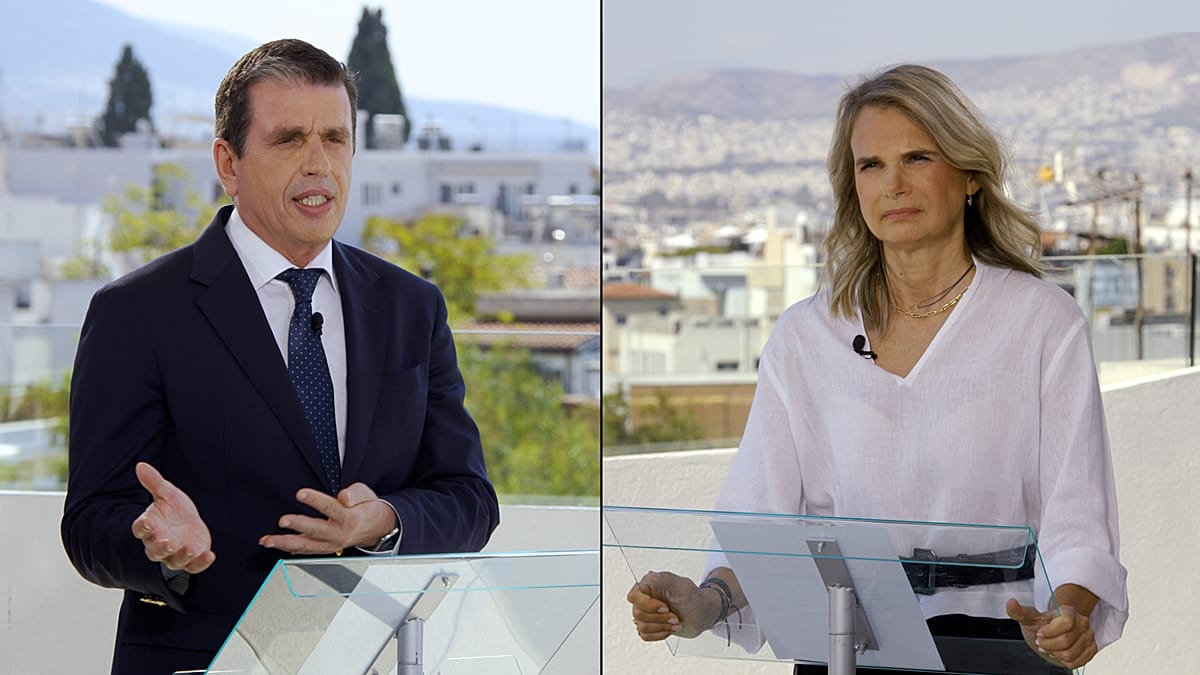
From the studios of Brussels and Strasbourg to a rooftop overlooking the Acropolis, The Ring brought its political debate format to Athens for a showdown that touched on some of the most sensitive issues facing Greece and the wider European Union. The two guests, both members of the Hellenic Parliament, did not hold back as they tackled migration, the cost of housing, and the international arrest warrant against Israeli Prime Minister Benjamin Netanyahu.
Summer border pressures set the tone
The conversation was framed by events far from the Greek capital. In July, thousands of people attempted to cross into the Spanish enclave of Ceuta, a scene that many in Athens found eerily familiar. It recalled the summer of 2015, when hundreds of boats carrying refugees and migrants arrived daily on Lesvos and other Aegean islands, and the 2020 standoff at the Evros border with Turkey, when thousands also tried to force their way into Greek territory.
Those memories have reignited a fierce political debate in Greece, pushing migration back to the top of the national agenda. The two MPs offered sharply different readings of what the Ceuta events mean for Europe and for Greece.
Dimitris Kairidis, a lawmaker for the ruling conservative party New Democracy, stressed that citizens need to feel secure, but warned against copying the extremes seen across the Atlantic. "We must avoid the extremes we see on the other side of the Atlantic," he said, a clear reference to the polarised migration rhetoric in US politics.
Milena Apostolaki, an MP for the centre-left PASOK party, the main opposition, took a different view. She argued that the Ceuta incident was "used as a propaganda tool to undermine Spanish Prime Minister Pedro Sánchez," suggesting that migration is often weaponised for domestic political gain.
Housing and poverty: who can afford to live in Greece?
The debate quickly turned to the cost of living, a topic that resonates with many Greeks, especially younger generations struggling to find affordable housing in Athens and other cities. Apostolaki cited Eurostat data showing that Greece ranks second in the EU for poverty and social exclusion, behind only Bulgaria. She used those figures to question the government's economic record.
Kairidis acknowledged that Greece has lagged behind due to the prolonged economic crisis, but insisted that significant progress has been made since his party returned to power in 2019. He pointed to falling unemployment and rising investment as signs of recovery, though he conceded that more needs to be done to ease the burden on households.
The housing crisis is not unique to Greece. Across the EU, from Lisbon to Berlin, soaring rents and property prices have become a political flashpoint. In Greece, the problem is compounded by the legacy of the debt crisis, which left many families without savings and pushed a generation to emigrate. The tourism boom, while welcome for the economy, has also driven up prices in popular areas, as recent data on Greece's July tourism surge shows.
Common ground on Ukraine and the ICC warrant
Despite their differences, the two MPs found common ground on foreign policy. Both agreed that Europe needs to engage in dialogue with Vladimir Putin to bring the war in Ukraine to an end, a position that reflects a broader debate in Brussels and national capitals about how to balance military support for Kyiv with diplomatic off-ramps.
They also concurred that Greece has an obligation to execute the International Criminal Court's arrest warrant if Benjamin Netanyahu were to set foot on Greek soil. The ICC issued the warrant in connection with alleged war crimes in Gaza, and Greece, as a signatory to the Rome Statute, is legally bound to cooperate. The issue has become a test of European commitment to international justice, with several EU member states expressing varying degrees of willingness to enforce the warrant.
The Athens edition of The Ring underscored how migration and housing are intertwined in the European political psyche. As the EU debates new migration rules and member states grapple with the social fallout of the cost-of-living crisis, the Greek experience offers a cautionary tale. The country that was once at the epicentre of the refugee crisis now faces a different kind of pressure: keeping its own citizens from being priced out of their homes.
For now, the political battle lines are drawn. Kairidis and his party argue that stability and security must come first, while Apostolaki and PASOK insist that social justice and affordability cannot be sacrificed. The next election will tell which vision resonates with Greek voters.